5 Surprisingly Comforting Truths

-1-

The hard truth – Knowing everything is an impossible goal.


Why it’s comforting –

Ever fall prey to analysis paralysis? Where you become so focused on trying to gather all of the information that you find it difficult to make a decision and take a step? This hard truth highlights the fruitless nature of that obsessive drive. Once you realize – and accept- that it is impossible to know everything, it’s easier to set a focus AND a limit on what you need to know. And then once that is reached, you move forward.


-2-

The hard truth – Mistakes are inevitable.


Why it’s comforting –

It’s stressful and exhausting trying to achieve perfection in everything that you do. When you give yourself permission to make mistakes, you free your energy towards better pursuits. Furthermore, when mistakes are seen as natural and inevitable, it becomes easier to avoid an emotional reaction to the mistake and take full advantage of the opportunity to learn to do better.


-3-

The hard truth – You will be disappointed and you will disappoint others.


Why it’s comforting –

Sometimes being disappointed can feel very personal, especially for those of us that have experienced betrayal. On the flip side, disappointing others when you sincerely tried can be a brutal gut punch with a heavy dose of guilt and shame. Yet when you consider those together, it helps to show that the occasional disappointment is normal and not a big deal. Keep your expectations in line with reality, handle disappointment with grace and act in accordance with your beliefs. And then let go of worrying about disappointment.


-4-

The hard truth – No number of people can make you feel loved if you don’t love yourself.


Why it’s comforting –

Guess who you always have by your side?

You!

You don’t need to be famous or have a ton of Instagram followers to feel loved and valued. You don’t even need a significant other. All you need to fully accept, embrace and celebrate yourself. The rest is gravy.


-5-

The hard truth – Certainty – and safety – is an illusion.


Why it’s comforting –

We make so many choices out of the fear or loss or the fear of the unknown. We stay with what we know and what seems like a sure bet even when it’s not the right bet for us. Once you realize that even the “safe” choice doesn’t protect from harm, it becomes easier to do what is right for you instead of what appears to have the least amount of risk.


Today, I’m Grateful

Today, I’m grateful for an amazing start to the new school year. My 8th graders threw me an incredible birthday surprise a few weeks back and each of them wrote me a special note. It took me days to read them because the tears kept flowing.IMG_E1011837700C-1

Today, I’m grateful for an amazing – and totally badass – husband. He competes in the Atlanta Open next weekend and in an NFC fight the following weekend, both as a BJJ black belt. But even more importantly, at home he always fights for his family.

IMG_1467

Today, I’m grateful for two weekends in a row spent with my dear friends. Yesterday we went apple picking. Despite the heat, we had a great time, with the highlight being the hilarious combination of animals in the petting zoo.

IMG_A50157285E53-1

Today, I’m grateful for the incredible community on Twitter that I’m honored to a part of. I love seeing people who have been hurt turning it around into something beautiful to share with the world.

Today, I’m grateful that my mom is about to embark on a trip that has great meaning to her. Despite her physical challenges, she has managed to keep traveling.

Today, I’m grateful for my health. After a scare a few weeks ago about a possible retinal detachment, my vision is slowly improving. I’m hopeful for good news from the doctor tomorrow.

Today, I’m grateful for an upcoming trip to the Keys with my husband. I love traveling with him and I’m looking forward to the forced downtime. I’m especially excited about the prospect of night kayaking.

Today, I’m grateful for family. I will get to see many of them in a couple weeks, including my grandmother who is now 100 years old and one of the wisest people I know. And the visit will be in Wisconsin, so even if fall is still on backorder in Atlanta, I’ll get to enjoy some cooler air.

Today, I’m grateful for my puppies. Kazh is healing after tearing off a nail and Emma (who makes bad decisions) is fine after going through the front window (for the third time). Snuggles with them are the best.

Give Yourself Permission

We are often our own harshest critics. We berate ourselves for the same things we respond with compassion to in others. Instead of doing the best we can, we often “should” ourselves into shame and paralysis.


So for today, practice being as kind to yourself as you are to others.

For today, give yourself permission to…


Struggle even when your struggles seem to pale in comparison to those of others.

Sometimes we measure our traumas against those of others. And when they don’t even begin to compare to the magnitude of the horror that some of faced, we believe that we shouldn’t feel the way we do. That somehow we don’t have the right to struggle because our struggles are minor compared to those around us.

Yet one trauma doesn’t negate another. Experiences are measured not by how they compare to others, but by how they compare to what you have been through. You can have a hard time even if it seems minor. Your feelings are real and valid.


Feel okay even when things are falling apart around you.

I attended a tragic funeral recently. And like at all such gatherings, there were moments of shared laughter as people traded stories and memories. Brief periods of respite from the pain, rising through the sadness like bubbles to the surface.

And those moments are precious. It is okay to smile even when you have tears pouring from your eyes. It’s okay to set aside the grief for a period and enjoy life. There is no rule that states that grieving and living are mutually exclusive. You can do them both at once.


Secretly feel relieved even when you’re devastated.

There are times when our hearts and our brains are in opposition. When we know that a loss is needed, but yet we struggle to let go. This is the death after a protracted illness or the divorce after a long period of dysfunction. We grieve outwardly, while secretly also feeling relieved that it is over.

And that’s okay, to both miss something and also be at peace with it ending.


Feel sad just because.

There are days when you’re just not okay. There’s no reason, at least none that you can put your finger on. You’re just sad. Or withdrawn. Or anxious.

And those feelings, whatever they are, are allowed.

When we try to tell ourselves that we shouldn’t feel that way, we tend to only amplify the sensations. Instead, give those feelings permission to be and let them move through freely.


Not be at your best.

Maybe you’re the star employee at work. Or typically a Grade A parent. But not today. Today, you’re struggling to get it together. And then you make it worse by comparing your performance today to your high expectations of yesterday.

It’s okay to have days where you lower the benchmark. So maybe you didn’t prepare the normal healthy breakfast for your kids this morning and you had to rely on a fast food drive through. They still ate. And for today, that’s a success.

Not every day is going to be the best performance. As long as you still show up, you’re doing it right. 


Ask for help.

When it comes to this life thing, we’re all in it together. There is no reason to try to do it all alone.

Asking for help is both the greatest gift we can give ourselves and the biggest sign of courage.

Give yourself permission to feel how you feel and to accept help when those feelings become too much to carry alone.

What Anxiety Can Look Like

From the inside, anxiety is pretty easy to identify – a tightness in the chest or stirring in the belly, overactive thoughts that tend towards the, “What if?” and an underlying sense of fear or dread.

But from the outside?

Anxiety can take many different forms, some of which may resemble a different root cause entirely.


Anxiety can look like aloofness.

When someone is anxious, they’re not living in the world; they’re living in their head. To others, it can seem like they’re withdrawn, not interested in engaging. Yet the reality is that they’re so busy battling the thoughts in their head that they don’t have the attention to spare towards those around them.


Anxiety can look like pessimism.

It’s not that those that struggle with anxiety only see the negative; it’s that they believe that they have to anticipate all of the possible outcomes so that they can be prepared for any eventuality. When good things happen (or seem about to happen), anxious people have a hard time accepting it because their brains are still telling them that things can change in an instant.


Anxiety can look like perfectionism.

Anxiety likes to have things in order. It’s a lie the anxious brain likes to use, “If you can do everything right, you’ll be okay.” And so the drive towards perfectionism is strong and the fear of falling short (which of course, is inevitable), is equally as powerful.


Anxiety can look like having trouble committing.

“Am I doing the right thing?” anxiety questions before agreeing to something. “What if there’s a better option?” the mind asks. Those that are anxious often spend substantial time researching and weighing options before making a decision. And even once a decision is made, the doubts may persist.


Anxiety can look like high achievement.

Anxiety has an energy to it and often that energy acts like a motor that drives achievement. The anxious mind has trouble relaxing, which combined with a fear of failure can lead to some impressive achievements. Not that the anxious person will ever relax and enjoy their successes.


Anxiety can look like a need for control.

An anxious brain tries to anticipate every potential outcome. And of course, those outcomes are limitless. So to improve the odds, an anxious person will often try to control the situation and steer the outcomes a certain direction.


Anxiety can look like struggling with time.

Those with anxiety often have a dysfunctional relationship with time – they either believe there is not enough or they avoid thinking about it altogether. As a result, they will either be too early late, believe they will never get it done or put it off until the last possible minute.


Anxiety can look like a failure to begin.

“Am I doing the right thing?” “Am I qualified to do this?” “What if I fail?” These thoughts mean that the anxious person can spend an inordinate amount of time on the starting block, scared of taking that first step. This can lead to unfulfilled promises of action.


Anxiety can look like an entertainer.

For some, the anxiety is channeled into performance. They are always “on,” often the center of the party. By playing a role, they are able to find some distance from their unease. And by shifting the attention towards their performance, they are able to hide their anxiety.


Anxiety can look like a calm exterior.

Many people with anxiety hide it very well. While they may be panicking inside, their demeanor doesn’t even register the slightest elevation of pulse.


Whether you experience anxiety yourself or have someone in your life that struggles with it, once you recognize its disguises, you are better prepared to handle it appropriately.

How We Handle Failure

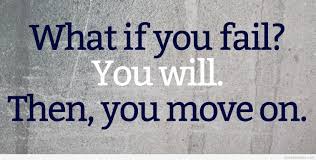
As I was reacquainting myself with my students last week (yes, we start school WAY too early in the south!), I reminded them of my belief that the math they will learn in my class is important. But the lessons in learning how to handle frustration and failure are even more important. Because, let’s face it, many of these kids may never have to solve a quadratic equation as an adult or explain why an exponential function has an asymptote, but they will certainly face failure. Probably many times.

images-53.jpeg

And I’ve to realize how important learning how to handle failure really is. In fact, I would go so far as to say that it is one of the primary forces that shapes who we become. The good news? Even if we have a had a subpar response to defeat in the past, with practice and the right mindset, we can learn to improve our relationship with failure.
images-52.jpeg

Five Negative Responses to Failure

Giving Up

I think all of us have released the words, “I give up!” in frustration when the fifteenth attempt at something still neglects to result in the desired outcome. It’s easy to become fatigued and weary, especially once the thinking brain has expended all of its energy and allows emotions to take the helm.

Internalizing the Message

“I suck,” we mutter to ourselves, confusing the line the action with the person, believing that we ARE a failure instead of a being that failed at something. This response is often ingrained in childhood when perfection (or at least the illusion of it) is expected of you from the adults in your life. You equate failure with rejection.

Avoiding Risk

If you don’t try, you cannot fail. Some respond to failure by refusing to take risk, preferring to practice the perfect and staying safely on known ground. This choice is rationalized as prudent, even wise. Yet the decision is made out of a fear of failure rather than a careful weighing of the potential risks and rewards.

Lashing Out

Some get angry when facing failure, attempting to cover the discomfort and vulnerability inherent in defeat with a veneer of hostility. “It’s not me, it’s you!” the response insists, hoping that by keeping people on the defensive, the failure will be overlooked.

Hiding the Evidence

This response is another that develops when failure is not accepted. When the inevitable happens, it is seen as shameful. And what do we do with that which shames us? We bury it.

images-8.png

Five Positive Responses to Failure

Accepting the Inevitability

Perfection is an illusion. There is no creature on this earth that succeeds in everything it tries. The newborn foal stumbles and falls before it learns how to walk on its shaky and spindly legs. The tree fails to root down deeply enough into the dense soil and almost topples during a storm.

And we are no different. Failure is as much a part of life as breathing. By accepting that, we can remove some of the emotion often associated with it. Rather than being shameful or a sign of weakness, failure is a sign of life.

Viewing Failure as Information

When I was preparing my classroom for the new school year, I had to adjust the legs on several of the student chairs. I glanced at the screws holding the legs together and estimated the proper size of screwdriver needed. On my first attempt, I managed to almost completely strip the screw while failing to loosen it enough to adjust the leg. That failure provided me with information – the screwdriver was the wrong size.

Once we have information, we are able to make adjustments and try a new approach. Without failure, we would never know what modifications are beneficial. Failure is a part of evolution; it steers us towards what works.

Taking Responsibility Within Locus of Control

Those that know how to use failure to their benefit are quick to own their failures, but only the ones within their control. There are two important facets to this response. The first is that once we claim responsibility for something, we give ourselves the power to change it. Secondly, by only accepting responsibility for things within our influence, we refrain from wasting energy trying to change things that we do not have dominion over.

It can be scary to admit that you failed. We don’t want others to see us as weak, as flawed. Yet by taking ownership, you remove the opportunity for others to use your failures against you. And the reality is that much of the time, people respect those that immediately and completely admit their failings as long as they are also making an honest attempt to learn from those defeats.

Reminder to be Open to Learning

Do professional athletes ever outgrow their need for a coach?

Nope.

Yet all too often, we become so comfortable (okay, cocky) within our own areas of expertise that we forget that we should still be learning.

And failure is happy to give us that reminder that there is always room for growth. For improvement. Failure equals humility and humility keeps us open and pliable.

See Failure as Opportunity

And this is what it comes down to.

Every failure is an opportunity.

A chance to try again.

Only now with more experience and knowledge of what doesn’t work.

Every failure is an opportunity.

A change to do better. To respond differently.

Without failure, there is no learning. No growing.

When we see failure as something to avoid, we are robbing ourselves of the opportunity to become the best version of ourselves.

And when we are able to become comfortable with failure, we are able to use it to take the next step. And then the next.

We will stumble. We will fall.

But as long as we get back up, learn from what didn’t work and keep trying?

Well, there’s no stopping us.

images-51.jpeg