Is It Time For You To Quit One Of These Self-Appointed Jobs After Divorce?

Prior to divorce, one of your predominate life roles is that of “husband” or “wife.” And once that position is pulled from you, it leaves a job opening that is often filled with a self-appointed role that ultimately causes more harm than good. Is it time for you to quit one (or more) of these post-divorce jobs?

Detective

In my day job, I was a math teacher, educating teenagers on how to find x. In my evenings, I dedicated myself to finding my ex so that he could face the legal repercussions of his illegal activities. Through a combination of triangulation based on account activity and Google Earth, I was able to deliver an accurate address to the police.

In the beginning, this cyber sleuthing had a purpose. Yet even once he was located and his illegal actions verified, I had trouble letting go of my new-found investigative skills. The searching felt purposeful, the details, important. By focusing on assembling information, I was able to distract myself from what I was feeling.

I decided to put in my letter of resignation for my detective role on the day after the divorce was final. I did one last search, cleared my browser history and packed away all of the accumulated paperwork. His whereabouts and activities were no longer any of my concern.

Psychiatrist

It didn’t make any sense to me. I just couldn’t wrap my brain around how my vowed protector had morphed into my persecutor, seemingly overnight. The only way that it made sense to me was if he embodied some sort of monster archetype, only described in modern psychiatric terms.

I reflected upon his childhood. I considered his traits and innate responses to stress. I carefully matched his characteristics against those that define various personality disorders until I settled on the label of sociopath. The non-violent type, as far as I knew.

For a time, I found peace in my amateur diagnosis. It was a way of finding some sense of control. By naming it, I found some dominion over it. But then memories, good memories, starting bubbling up to the surface. And I couldn’t integrate those with my current image of him. So I let go of the labels, and instead tried to see him as an imperfect man, flawed as we all are, and more a stranger to me than I knew.

Advice Columnist

Many of my coaching clients have unwittingly assumed the role of advice-giver and confidant with their exes. In the marriage, they were the competent ones, the ones who knew how to get stuff done.  And their ex partners? Let’s just say they were content with having someone else take the reins.

And even once the households were divided, the struggling ones turn to their exes for advice and assistance and the more adept ones find themselves in the position of caretaker and organizer. In some ways, it’s a mutually beneficial relationship – one person gets their needs met and the other is able to maintain a sense of control and feels as though they are needed. On the other hand, this one-way exchange keeps both people tied to the past, limiting autonomy and promoting an unhealthy dependence.

In a marriage, it’s natural to turn to your spouse for advice and to voice your opinion freely to your spouse. But after a split, the advice-giving is best done by someone else. It’s okay to step back and let your ex manage – or even mismanage – his or her own life. They are no longer your responsibility.

Medical Examiner

My marriage died a sudden death. And I had a driving need to understand why. I had no ex husband willing to talk, so I had to perform the marital post mortem with only the impression of the body remaining.

I was convinced that the only way I could obtain closure and be able to move on was if I could follow the precursors to the demise step-by-step. I examined and assembled clues like puzzle pieces. I developed theories, some more plausible than others.

It was strange, in my pursuit of the “truth,” I began to realize that the actual facts mattered less than the narrative I crafted around them. I eventually settled on an explanation that helped me forgive and let go. And only then did the drive to dissect the past fade.

Prison Warden

Divorce is scary and disorienting. Nothing is certain, everything is in question. I often hear from people that respond to this frightening period with absolutes- “I am never going to trust again,” “I am never going to let anybody in again,” “I just can’t do this.”

They are acting as sentry, building walls and posting guards around the uncertainties of life. They seek to control all that enters and prevent any unauthorized exits. For the prison warden, the rules are rigid, the mind always watchful and the expectations have been constructed around the idea that everyone is disreputable.

Being a guard against life is not only exhausting, it’s doomed to disappointment because it’s impossible to protect from all misfortune. By all means, be observant and alert. But you don’t have to wear the Kevlar vest just to live your life.

Tabloid Journalist

“Can you believe what he did now?” I asked my coworker after informing her of my ex’s latest shenanigans. The news brought her some entertainment and distraction from work and sharing it made me feel important. Of course, in order to maintain interest, the news always has to be fresh and ideally, each new story tops the last.

This self-appointed role combines the obsessiveness of the detective with a need for attention and validation. The salacious details are mined and then shared, followed by the reward of a shot of feel-good dopamine.

The tabloid journalist requires drama to survive. Even if they are not directly manufacturing it, they are elevating it through attention and energy. It feels boring at first, turning away from the revelatory details. But it soon becomes freeing as you realize you are not dependent upon “likes” for your friendships and you have time and energy to dedicate to more advantageous pursuits.

Defense Attorney

For almost a year, I carried a printout of my ex’s mug shot and associated newspaper article. Whenever I would have to deal with somebody about a delinquent account or talk to another attorney, I would present them with the paper. It was my clumsy attempt at saying, “I’m innocent. He’s the one who did this! Please don’t judge me.”

Part of my drive to proclaim my innocence came from my ex’s attempts at gaslighting. He had engaged in some extensive character assassination behind my back while we were married, spinning horrific (and quite creative) falsehoods about me. And so I became obsessed about trying to clear my name and restore my reputation.

Eventually, I realized that those who knew me didn’t need my evidence of innocence, they had faith in me regardless. Those that had been fed a steady diet of lies by my ex were unswayable and so were not worth my efforts. And the relative strangers that I was so determined to convince? They didn’t really care whose “fault” things were, they were just doing a job.


Take an honest inventory of the roles you’ve assumed after your divorce – are they serving you or is time to quit and move on to a new line of work?

How to Remove the Emotion When Dealing With a Difficult Ex

Some people end up friends with their exes.

Some people are able to successfully navigate their way into a companionate coparenting or business relationship with their spouse.

And others have an ex from you-know-where that continues to cause pain and wreak havoc long after the divorce.

Sometimes you can go no-contact and excise the malignancy.

But what can you do if you can’t remove your ex from your life but you still want to remove the emotions from the interactions? You may be stuck with them, but you don’t have to be stuck with how they make you feel.  Here are 11 ways that you can find emotional distance from a difficult ex.


(function (v,i) {
var scp = v.createElement(“script”),
config = {
ChannelID: ’59c4d02d28a06117d405b228′,
AdUnitType: ‘2’,
PublisherID: ‘254863889856617’,
PlacementID: ‘pltcqFJsrTEyaQkNyOJ’,
DivID: ”,
IAB_Category: ‘IAB14-2’,
Keywords: ‘divorce’,
Language: ‘en-us’,
BG_Color: ”,
Text_Color: ”,
Font: ”,
FontSize: ”,
};
scp.src=’https://s.vi-serve.com/tagLoader.js’;
scp.type = “text/javascript”;
scp.onload = function() {
i[btoa(‘video intelligence start’)].init(config);
};
(v.getElementsByTagName(‘head’)[0] || v.documentElement.appendChild(v.createElement(‘head’))).appendChild(scp);
})(document, window);


How to Take the Emotion Out of Dealing With a Difficult Ex


Even though my ex husband left my life, he left his impact behind in the form of tens of thousands of dollars of debt that fell on me to repay. Every month when I had to make those payments, I felt like all of the emotional progress I had made was washed away. I would grow angry, fearful and despondent all over again as I was forced to face the ugly reality. It wasn’t physical contact with him, but it was a monthly appointment with his presence that I was required to keep.

It’s one of the more common dilemmas faced by my coaching clients: “I’m doing great and then I have to see my ex and I feel like I’m back to square one.” Some are like me and have been left cleaning up the mess their exes left behind. They have to find a way to balance their responsibilities with their emotional wellbeing. For others, they have children and regular contact is required for the sake of establishing some sort of co-parenting relationship. So for them, the question becomes one of maintaining the children’s relationship with the other parent without sacrificing yourself in the process.


Rename and Reframe

When you see your ex, your brain floods with memories of who they were to you. Perhaps you remember the halcyon early days or the pain you felt when you discovered that they had been unfaithful. You’re viewing them through the lens of a spouse, a partner, and remembering the ways that they failed you in that role.

Those memories carry a powerful emotional punch. A punch that leaves you winded and spinning. So take a step back. That person on your doorstep is no longer the one who held you and then hurt you; they are simply your children’s other parent.  You can even label them this way in your phone’s contact list.


Pay Attention to Your Physical Sensations

Does your breath become more rapid and shallow when you hear your ex’s car pull into the driveway? Maybe you can feel the prickle of rage run down your back when you see their name show up on your phone. For me, any reminder of the financial mess caused a physical sensation of nausea and panic.

Simply by being attuned to these sensations helps to keep them from running amok. Be aware of how your body responds even if you feel like you can’t alter it at this point. Label the sensations with non-judgment – “Oh, my hands are sweaty and trembling.”


Ask Yourself, “Why Does This Still Bother Me?”

Name your feelings and trace their roots. You are no longer married to this person, so why are their words and behaviors still able to trigger you? You may be dealing with some unresolved pain from the divorce. Or maybe this activated some long-buried childhood wound. And sometimes the response is merely one of habit, reacting in the way to which you have become accustomed.

Regardless of the reasons, one of the best ways to deactivate a trigger is to dig into it to remove its power source. Spend some time with a therapist, your journal or a trusted companion and explore why you’re still responding so strongly.


Bookend the Contact With Positive Activity

Contact with the ex has the potential to ruin several days if you allow it. There’s the building anxiety leading up to the contact, the actual confrontation and then the recovery period.

In order to limit the effects to the actual contact, bookend the encounter with positive and engrossing activity to help distract you before and shift you out after. Limit the amount of time and energy available for anxiety and rumination.


Practice Mindfulness

Begin some sort of mindfulness training to help you find your inner calm regardless of what is happening in your world. Meditation often talks about learning to view the storm through the window instead of being in the storm. You cannot control the rain, but you can learn to find some distance from its impact.

Mindfulness is also powerful because it trains you to accept what you cannot control and teaches you how to have mastery over your breath and to some extent, your thoughts.


Rehearse Your Responses

If your ex has a tendency to push your buttons in search of a response, take some time to rehearse what you are going to say ahead of time. Practice this with somebody else or in front of a mirror. Repeat it until it becomes rote, devoid of emotion.

You cannot keep them from poking at you, but you can refuse to engage. Having a pat, non-emotional response is a great first step.


Don’t Be Their “Person”

Some exes still look to their former spouses to have their emotional needs met. I even know of people who turn to their ex partner when they are having difficulties with the person they left the marriage for! It can be difficult after divorce to transition into the new, more distant, roles after years of being a team.

If your former spouse is turning to you for emotional support and advice, inform them that you cannot fulfill that role anymore. It is no longer your responsibility to be their shoulder to cry on or their sympathetic ear.


Temporary Outsourcing

There are times when any contact is simply too painful to contemplate. Be creative – are you able to outsource any of this to automation or to a third party? Be aware that this approach is a bandaid, a temporary breather so that you have the time and space needed to create the necessary emotional distance.


Don’t Take Their Behavior Personally 

Whether your ex is a malignant narcissist seeking their own gains without consideration or a lost and wounded soul who can’t seem to get themselves together, their actions say way more about them then they indicate about you. So don’t take their words or behaviors personally.

If they are generally a bad person, remind yourself that this is simply their approach to everyone. If they are struggling, find a place of detached empathy for them and seek to understand the motivations behind their words or actions.


Gratitude 

This was my greatest tool in the years I was a prisoner to the debt my ex left behind. After every check written, every bill paid, every debt collector spoken to, I would add an item to a list of something that I was grateful for that I would not have had without the divorce.

It’s easy to focus solely on the bad in the situation, to allow the negativity to flood out your senses. By taking the time to force yourself to list the positive effects, you’re expanding your perspective and training your brain to look for the sun behind the clouds.


Find Your Power

In high school, I picked up the sport of fencing. At the beginning, I excelled in the drills but fell apart in the bouts when my opponents actually had the audacity to attack me.

“You know what they’re going to do,” my coach hollered at me one day from the sideline, “So why do keep reacting the same way that allows them to score a point?”

And he was right. I knew the moves my opponent was going to attempt. I had no control over their attacks. But I could lunge out of the path of their blade or parry differently so that they lost their opportunity.

It changed my view of the bouts. I was no longer focused on what my opponent was going to do to me. Instead, I learned and practiced how to responds differently so that their attacks landed less frequently and with less force.

One of the hardest parts of divorce is the overwhelming feeling of powerlessness that comes with it. And when you’re allowing your ex to dictate your moods and responses, you’re giving your power away.

Take back your power. Take back your life.


The Importance of Choosing Your Tribe

Even in the best of times, the need to belong is a powerful force. And in the worst of times? There is nothing more important than finding your tribe.

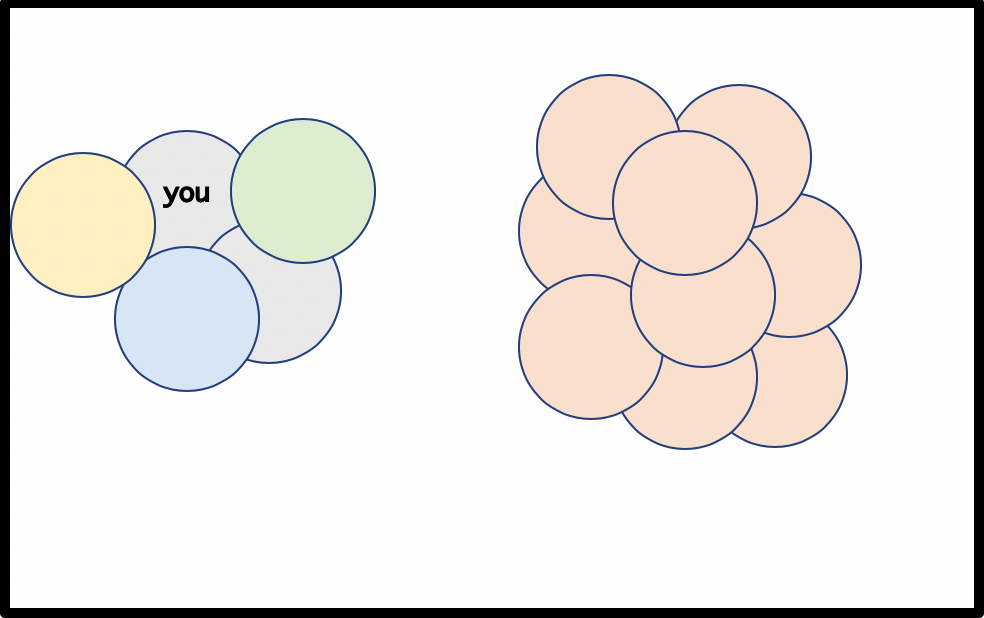
When something tragic happens, it often leaves us feeling like this –

We feel isolated. Alone. It’s as though pain has its own language and nobody else speaks that tongue.

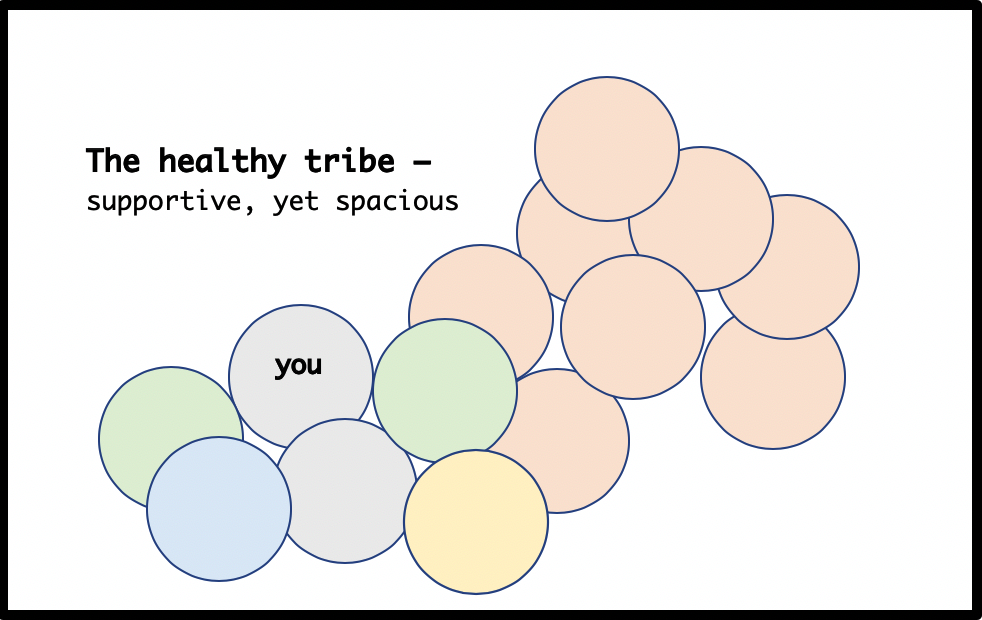
And then one day, either by chance or from actively searching, you find this –

And it feels amazing. You’re not alone after all. Somebody else knows the words that pain whispers through the long nights.

Over time, you meet more. “I’ve found my people. My tribe,” you think to yourself, enjoying the much-needed connection and solidarity. Some are further along in their journey. Others, like you, are still taking their first shaky steps.

You feel supported. Accepted. Instead of your pain making you an outcast, it is now your admission ticket to the new club. “You’re one of us,” it says.

tribe

In a healthy tribe, the members offer up both encouragement and tough truths. They come together out of shared pain, but more importantly, they grow together out of a desire to move through the hard times. The connections strengthen the individuals while at the same time, allowing each person the space and freedom to explore their own path, accepting the idea that life is not one-size-fits-all.

tribe

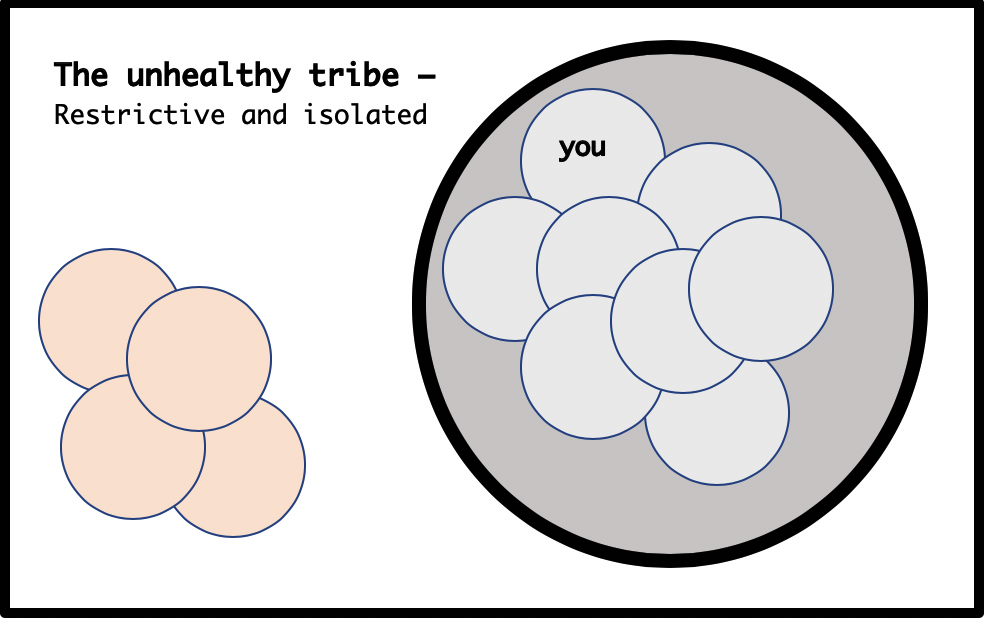
Yet sometimes, a poorly-chosen tribe can hold us back. Misery loves company, so when we’re in pain, we have a tendency to attract more pain. So it’s easy for a tribe to become focused on what brought the members together and amplify each other’s cries within the closed-off space. Furthermore, an unhealthy tribe feels threatened by progress so the group works to create an “us vs. them” culture to keeps its members contained.

tribe

There are few decisions more important in life than choosing your tribe. Since we become the people we spend the most time with, your tribe becomes your identity.

Before you choose your tribe, ask yourself these questions:

  • Are they focused on destruction or creation? In other words, are their energies directed towards tearing other people down or building each other up?
  • What is their goal – progress or commiseration? The latter has its place, but it’s generally not a space you want to occupy for the long run.
  • How do they view dissent or individual growth? Are you encouraged to speak your truth and explore your path or are you expected to toe the line?
  • When you spend time with your tribe, do you feel encouraged or defeated? Do they provide you with hope and promise or fill you with dread?

One of the best feelings in the world is the joy and connection that comes from finding your tribe. Choose wisely, and your tribe will be your greatest champion.

Is the Time Spent In a “Failed” Married Wasted?

failed

When my math students first start to tackle more difficult algebra problems, they retain their elementary focus on determining the single correct answer. While this difficult work is still relatively new to them, they have a tendency to completely erase or even tear up an entire page of work that led to this incorrect value of “x.”

One of my goals during this time is to help the students focus on the process. Once they recreate the steps that led to the wrong answer that made them quit in frustration, I’m able to show them that, more often than not, they completed every step correctly with one simple mistake that led to the wrong answer. I point out the correct reasoning that I see in their work and also highlight the errors that led them astray.

They learn that it’s not only about the end goal; it’s also about the process. And by analyzing their work that led them to the wrong answer, they learn how to recreate what they did well and how to avoid the mistakes.

I see marriage as much the same.

It’s easy to see a “failed” end as a sign that all the years invested were wasted. It’s easy to get frustrated and to want to erase all of the memories or tear it up in anger. It’s easy to focus on the mistakes and neglect to see all of things that went right.

Is the Time Spent in a “Failed” Marriage Wasted?

“I’ve wasted half my life,” I wailed to my friend from my spot curled up against the doorframe on her checkered kitchen floor.

She turned from loading the dishwasher, “Don’t ever say that. Nothing is ever a waste.”

At that time, I certainly didn’t agree with her. After all, I had just realized that some or all of the past sixteen years had been a lie. I learned that the man I pledged my life to had been manipulating and conning me. I was in the process of losing everything I worked so hard for – from the house to the savings to even the dogs.

I felt defeated.

It was not unlike spending money and time anticipating a lavish vacation only to come down with the stomach flu upon arrival. Only this vacation spanned the better part of two decades and wiped out more than just my appetite.

I wondered how I would ever come to terms with squandering sixteen years. After all, I could rebuild my finances, find a new home and even a new husband, but time was one thing I could never get back.

I was angry at myself for what I viewed as a bad investment.

I gave most of my teenage years and all of my twenties to this man.

Years that now felt wasted. Opportunities passed by and paths never taken.

I felt like I had been led blindly down a dead-end road. A worthless journey to nowhere. And it was an expensive trip.

I grew angry, blaming him for stealing my years. My youth. My potential.

I was angry at him. But even more, I was angry at myself for investing my time and energy into a relationship that didn’t survive. I felt stupid as I thought back to the decisions that I had made with the assumption that he would remain my husband. Decisions that I had been at peace with became regrettable as soon as soon as the marriage ended.

Thinking back to the Choose Your Own Adventure books of my youth, I wished that I could somehow go back and do things differently. Remake those decisions for meand not for the sake of compromise or for the marriage.

But as far as I know, time travel is an impossibility. And I realized that by ruminating on what I could have, should have done differently in the past, I was wasting my days in the present.

I had to begin by forgiving myself for making the choices I did with the information that I had at the time. It may have been a bad investment, but at least it was made in good faith.

I reframed the “bad investment” as a nonrefundable deposit.

The time was spent and could not be unspent. Instead of viewing it as an unwise investment in a failing endeavor, I decided to define it as a deposit on a better life.

Since the price was steep, it was up to me to make sure that the deposit wasn’t wasted. And so I got busy building the best life I could possibly create.

I started by addressing all of those assumptions I had reached about myself over the years, all of those things I grew convinced that I could not do. Additionally, I considered all of the feats I had always wanted to do, but never seemed to make time for. And one by one, I crossed them off the list. With each new adventure, I focused less on the time “wasted” and more on the challenges met.

Next, I tackled the gaslighting, the false words my ex-husband spoke about me. And as part of finding my truth again, I worked to refute each negative claim in kind. Not through words, but through actions. In doing so, I started to break free from the emotional abuse and come back to myself.

I found love again and, even though the journey back to trust was a rough one, I am beyond grateful that my serpentine path led me to this place.

And finally, I sought ways to use the experience to help others. To transform the negative into a positive. And with each person I reached, the time invested became a worthwhile contribution.

Each of these endeavors reduced the resentment for the price I paid and replaced it with gratitude that I had the opportunity to live a better life.

I remembered and appreciated the good times.

When my resentment for the time invested in my first marriage was at its worst, I was focusing on the horrific end to the relationship and the financial and emotional fallout. It was no wonder then that the time felt wasted – I was basically seeing the exchange as sixteen years of my life traded in for $80,000 of my ex’s debt, an inevitable foreclosure, having to rehome three dogs and months of medication to function. It’s not a trade I would recommend to anyone.

But that analysis wasn’t really accurate. Because the marriage was more than just its ending. As I started to allow myself to remember the good times we shared, I no longer felt so cheated out of those years.

In fact, whenever the feeling of bitterness over the trajectory of my life would rise to the surface, I would tamp it back down with good memories of the past and gratitude for the opportunity to live through it.

I vowed to learn from the time spent in the relationship.

When I started dating again, I defined a “successful” date as one in which I learned something – about the man, about myself or about life in general. By that metric, every single date (even if I was stood up!) was a success.

And that’s how I decided to frame the years in my marriage as well. In those sixteen years I shared with my ex (reframed from my initial response that I “gave” him those years), I learned everything from how to be an adult to how to veneer MDF. And I took all of those lessons with me.

Those years spent in a “failed” marriage are simply a part of my story.

Because nothing is ever wasted if we enjoyed it in the moment.

Nothing is ever wasted if we learn and grow from the experience.

And nothing is wasted because it helps shape who we are today.

To see those years as wasted was really a reflection of how I saw myself after the piercing pain of rejection.

But those years weren’t worthless and neither was I.

Those moments may not have been deposited into the life I expected, but they turned out to be an investment into an even better future.

Choosing to see those years as anything-but-wasted was a gift of forgiveness to myself. I made the best choices I could have at the time. And now I know better and I choose better.

And I choose to make sure to live a life that I will never feel is wasted.

Wondering why I choose to put “failed” in quotes? It’s because I don’t see divorce as a failure. Learn why.

Pep Talk

I’m feeling anxious today.

But before I get to that, I have to share with you a few pictures from my spring break this year. It was the inaugural trip with a dear friend of mine (even though I lived with her for the better part of year after my divorce, we have never had the opportunity to travel together).

Since she has had a HARD couple of years and has an elementary-aged daughter that keeps her busy, I gave her the choice of locations. After giving up on the Everglades for being too far, we settled on the Okefenokee Swamp. Which, as it turns out, is absolutely stunning, especially before the heat has settled in.

It was an amazing trip. The best part was simply the time with my friend to decompress and catch up with no external pressures.

The swamp was amazing, but I think my favorite times were evening nibbles out on the dock outside of our cabin (Seriously, this cabin was amazing. Hit me up if you need a place to stay near Valdosta, Georgia and I’ll put you in touch).

On one of those meandering conversations, my friend mentioned that my ex-husband’s picture appeared on her “suggested friends” list on Facebook. It wasn’t his profile, rather he was pictured with a woman that Facebook decided my friend might know.

Let me explain why this is unsettling. At the time of the divorce, I had no social media and neither, as far as I know, did my ex-husband (or, if he did, it was under some other identity). I have never befriended anybody from his life on social media and in almost ten years, I have never had that world intrude on mine.

However, since there apparently must be some connection between my ex’s current female companion (which was NOT the other wife, according to my friend) and my close friend, there are now fewer than seven degrees of separation between us.

Ugh.

I don’t like the feeling of that. And, perhaps most unsettling, it’s made me tempted to look him up for the first time in over nine years. I won’t give into the urge, but I really, really, really don’t like that I’m feeling it. (And as an aside, I feel for the other woman; I hope she’s okay.)

But that’s still not the root of the anxiety.

In a few hours, I’m heading into town to go to a beer festival.

Sounds fun, right?

Well, it should be. But I’m also anxious that I’m going to run into him.

The last time I spoke with him was almost ten years ago. The last time I saw him was just under six. At a festival. In town. Here’s my post about the experience and here’s my reaction once the shock had faded.

My reaction surprised me. Scratch that. The sheer intensity of my reaction scared me.

And so with him more on mind than I’d like and heading into a similar situation, I’m afraid that I may see him again. Actually, I’m afraid of my reaction if I see him again.

I like to think I’ve moved on. That he doesn’t impact me anymore. And for the most part, that’s true. But if I see him, I may just find out otherwise – that there is still trauma in my body waiting to be released.

So I’m anxious.

And giving myself a pep talk –

“It’s okay if you see him. It does not change anything. Even if he is in town, he is not in your life. You have no connections with him anymore; he cannot hurt you. Those reactions you’re having are not due to him in the present, they are simply aftershocks from the earthquake so long ago. You are stronger now then you were then. Wiser. And you know that this will fade. Keep breathing. You got this.”