The Problem With Doing What You Know

When I first started teaching math, I followed the general wisdom of the time that the majority of independent practice should take place outside of the limited classroom time.  As I was advised, I took grades on homework completion, quickly glancing at thirty-plus student papers filled with equations before going over the answers.

At that time, if you had asked me which students would be successful in algebra at the end of the term, I would have replied confidently, “Well, the ones who do all their homework, of course.”

I would have been wrong.

Because what I was unaware of at the time is how many of the students were completing their homework, yet because of some critical misconceptions about the topic, did every problem wrong. Even worse, when the class went over the assignment, they discounted their errors as one-time mistakes or simply careless omissions instead of the deeper misunderstandings that they were.

And by asking the students to complete their assignments in the relative vacuum of home, I was providing the opportunity for them to continue to practice the material incorrectly, thus solidifying the errors. Without outside feedback, they lost perspective on their choices and their progress.

Because if we do something enough, we begin to believe it’s right thing.

When the only voice we listen to is our own, we fail to account for our misjudgments and we lose track of improvement. 

When we do only what we know, our established neural pathways and assumptions become deep-worn grooves, lessons practiced and mastered, even if the conclusions aren’t accurate.

It’s easy to operate like those responsible students, dutifully completing every task that crosses our path. It’s easy to believe we’re doing the right thing because we’re doing some-thing. And it’s easy to discount any missteps as purely accidental or careless when they’re really because of some deeper understanding.

Before my first full year of teaching was out, I changed the structure of my class. I gave more time in class for independent practice and I always devised a strategy for students to verify their answers before the bell. I emphasized the importance of mistakes and that refusing to admit one is the worst mistake of all. I focused more on the quality of work completed than the quantity, making deals with the more reticent students that low homework grades could be modified upon successfully mastering a concept on a quiz.

That year taught me the danger of doing only what you know. I initially modeled my classroom on what I had experienced as a student, and the results were suboptimal. My students were practicing the procedures they knew, reinforcing incorrect pathways.

Progress was made only when other perspectives were considered, assumptions were challenged, mistakes were admitted and risks were taken.

Because sometimes the best step to take is the one into the unknown.

7 Reasons to Cross a Finish Line During Your Divorce

Divorce is often a long process. Apart from assembling the required documentation, writing checks to your attorney and making the requisite trips to IKEA (where you fight with college kids over the practical and value-minded inventory), you end up spending a lot of that time simply waiting.

Waiting for your divorce to be final.

Waiting for the legal approval to make changes to your name, your accounts and maybe your living situation.

Waiting for the uncertainty and the pain to end.

And maybe even waiting to live.


Let’s face it – waiting sucks. Feeling helpless sucks. Feeling insecure and lost as you tentatively start your new sucks.

And you know what can help all of that suck a little less?

A finish line.

No, really.

Learn more about how a finish line can help you here.

When You’re No Longer At Home In Your Own Skin

It was a snake that first taught me that growth is uncomfortable.

It was a Kenyan sand boa, a small and docile breed, that found its way into my life over twenty years ago. The gentle creature seemed to enjoy being handled and even was tolerant of the inquisitive sniffs and snorts of my over-enthusiastic pug.

All that changed one day when he acquired a defensive posture when I reached into his enclosure to refill his water. Startled, I pulled my hand back and examined him through the safety of the glass. I immediately noticed that his eyes were clouded and his normally striking patterns seemed muted.

I soon realized that the young snake had outgrown his own skin and was making preparations  to shed his restrictive covering. Curious and with a front-row seat of the process, I watched him over the next couple weeks.

And I learned that growth is uncomfortable.


The snake’s discomfort was clear. Instead of moving around his enclosure, he alternated between hiding under some debris and attempting to force the old skin off with the help of a rough branch. He refused to eat and he became irritable when stimulated. The translucent eye caps meant that he retained some sense of light and shadow, but he struggled to orient with his compromised vision.

Watching him, I alternated between awe at nature’s solution to a growing body in an inflexible skin and dread that this creature had to endure this experience throughout its life. Growth was inevitable, and with it, discomfort.

Early one morning, I was elated to see the old skin lying across the branch, which apparently had eventually been of assistance. The newly-unencumbered snake luxuriated on his heat rock; he seemed drawn to the warmth more than usual as his new and fragile skin was forming. Later that day, he gladly accepted the offered food, ready to embrace life again.


The snake left my life as abruptly as it had entered and I didn’t think of it for many years. Until one day, some weeks after my ex left, when I suddenly felt constricted within my own life. I had grown accustomed to labels and roles that no longer applied. I existed within limitations that had become self-imposed.

At first, I tried to make it work, to try to force myself back to who I was.

But it didn’t work.

I was uncomfortable, fighting against the inevitable and resisting in an attempt to regain some sense of power and control over my life. I found myself continually drawn back towards my old ways of doing things, wanting to turn away from the fear and the pain.

I attempted to avoid the discomfort, to give it a wide birth and fill my sightline with distractions.

But it didn’t work.

I wanted to lash out. I wanted to hide. I wanted to be anywhere but where I was. Anyone but who I was.

I tried to tell myself to snap out of it, to move on already.

But it didn’t work.

And that’s when the image of the snake filled me with understanding. The growth was unescapable and so was the discomfort. Relief was to found not in an attempt to hold onto my ill-fitting skin in desperation, but in finding the courage to let it go.

And the willingness to embrace what came next.


5 Reasons Why the Anticipation Is Often Worse Than the Reality

anticipation

The yoga classes I take are usually of the hot variety. The room is heated to around 96° with humidity that threatens to fog the glass by the end of class. I’ve been practicing hot yoga long enough that the temperature doesn’t usually phase me after the initial shock of entering the studio.

This morning was a little different. It was warm enough, as Atlanta tends to be in the summer, that my AC was running at a steady clip as I drove to the studio. Even before 10:00 am, the heat radiating off the blacktop caused beads of sweat to form along my hairline as I walked across the parking lot.

When I walked in, the entire studio was already balmy from the combination of the earlier class and the scorching temperatures outside. I started to slip my shoe off to tuck it under the bench when I paused.

My mind started traversing through the expected sensations of the class. I was already hot and I began to dread the idea of willingly allowing myself to become even hotter. As I anticipated the discomfort caused by the intense heat, I contemplated slipping my shoe back on and heading to the sanity of the air conditioned gym.

My anticipation told me to focus on the discomfort rather than the outcome.


Anticipation is a mixture of prudent foresight and alarmist anxiety. It tempts us by promising that preparation is key. And then it traps us in a potentially endless cycle of “what ifs” and worry.

1 – Anticipation Is Often Pessimistic

Anticipation has a devious habit of focusing only on the worst possible outcomes. The delayed arrival home is attributed to a bad accident. The upcoming public speaking engagement will surely be met with ridicule. The readout on the scale must be a sure sign that the latest attempt at healthy eating isn’t working.

The problem with anticipation is that one known fact is then followed by a series of thoughts like the rungs on the ladder, a linear progression of if…thens… leading to false conclusions. The reality is more like a web of millions of possible paths and outcomes following any given fact.


2 – Anticipation Focuses on the Hardship Rather Than the Overcoming Of It

As the small plane slowly climbed to 14,000 feet, I glanced back at the small carabiner that was technically the only thing keeping me from being sucked out of the open doorway. With each foot of increased altitude, my anticipation of jumping out of the plane climbed as well. I was mentally rehearsing the walk to the door and standing in the open and roaring maw without the perceived security of holding onto the frame. My anticipation was so focused on getting out of the plane, that I was completely caught off guard by the sensations after I left its metal body.

And that’s how anticipation is. It builds and builds like a roller coaster clicking up the first, large hill. It only sees the initial gut-wrenching drop, the first step, the beginning onslaught. Anticipation rarely addresses how we might overcome the hardship or how we might feel once our feet are back on the ground.


3 – Anticipation Causes You to Live Life’s Hardest Moments Multiple Times Over

By the time my ex husband left the marriage, I had already lost him dozens of times over in my imagination. It had been my greatest fear. And even though those nightmares only occurred in my own mind, they felt real. I experienced that gut-hollowing feeling several times due to my anticipation and apprehension of living without him.

Once that worst case scenario really did occur, I only had to experience it once more. Even as I struggled to breathe through the pain, I found comfort in the knowledge that once I moved through each stage, I would never again have to revisit it. Even in my dreams.


4 – Anticipation Robs You of the Benefit of Action

Anticipation is like playing chess only without the ability to ever move your pieces even as your opponent zeroes in on your queen. The purely mental exercise of anticipation can lead to a feeling of powerlessness and futility.

When the anticipated becomes reality, it is often accompanied by a driving need to do something. Action provides a sense of progress. Of control. Of purpose. As long as we’re moving, we’re happier. 


5 – Anticipation Causes a Break in the Mind-Body Connection

When something challenging actually occurs, the body immediately steps up to assist. Adrenaline production is increased, causing the focus to narrow to only the most important and increasing the heart rate to encourage action. Cortisol joins the efforts and helps to increase the glucose supply to the muscles, prioritizing immediate energy over longer-term storage.

After enduring horrific traumas or extended periods of extreme difficulty, many people will state they have no idea how they made it through. And part of that amnesia and associated sense of disconnection from that period is due to the body’s chemistry working as both a motivator and a funnel, directing the mind towards choices that favor survival. Perhaps most importantly, the action required bleeds the stress hormones from the body, eventually allowing the return of a normal physical state.

When we’re anticipating, our minds are engaged in the full horror of the event. Our bodies, unaware that the terror is purely imaginary, dutifully step up the production of stress hormones. Only this time, without the accompanying action to deplete the hormone stores, their elevated levels soon become the norm, leading to life lived at threat level red.


I completed my yoga class today. The actual discomfort from the elevated heat was far, far less than what I had anticipated. And taking the class on such a hot day had an unexpected benefit – the August air felt cool as it kissed my shimmering skin on the way back to the car.

A beautiful reminder of the quote by Mark Twain, “I have experienced many troubles in my life, most of which never happened.”


Three Powerful Lessons About Finding Love From An Unlikely Source

love lessons

Because sometimes the way to learn to do something better is to start with what we already know…

shopping-2411667__480

You know: Never go to the grocery store when hungry.

When you succumb to the grocery store on an empty stomach, you’re possessed by a powerful drive to grab anything in your sight. You have a tendency to zero in on high-calorie items, especially those stocked for maximum visual impact. Your reasoning and planning abilities are sluggish, which may lead to a full cart but an empty pantry as you later realize you forgot the staples.

In contrast, when you navigate the store on a full stomach, you find it easier to stick to your list of needed items and resist those temptations that look good only to leave you feeling bad.

Love lesson: Never date when starving for affection.

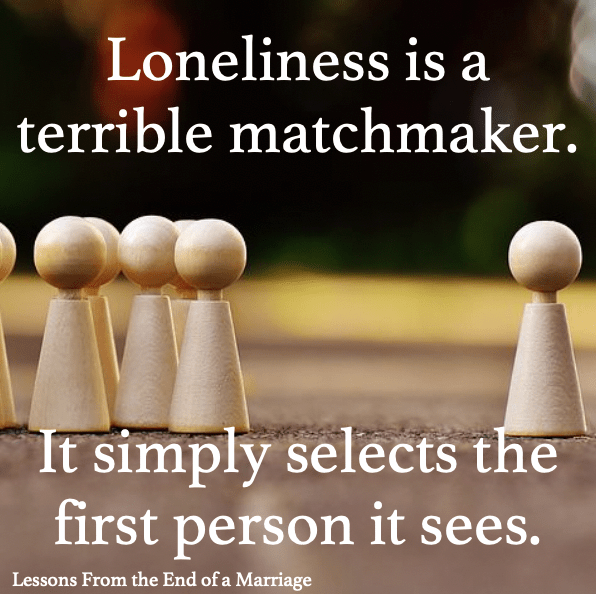
When you’re starving for attention and affection, you may enter the dating scene driven by that ravenous and undiscriminating hunger. You’re likely to grab anything that catches your eye with little thought to its long-term impact.

Instead, strive to fill the voids in your life with friends, family, hobbies, passions and purpose before you seek out romantic love. You will make better choices for the long term and be better able to stick to your list of “must haves.” And you’ll also find it easier to pass on those people that make you feel good in the moment only to cause regret in the morning.

You know: Your cart only has so much space.

A grocery cart has finite space and so decisions must be made about what will be chosen to occupy that real estate. Maybe you notice a sale on soda and you’re tempted to fill the basket until the cans pile over the brim. You may justify this decision, claiming that you’re taking advantage of a good deal and that you never know when such a sale may come around again.

But at what expense? Yes, you’ll have soda for months. But you can’t live on pop alone.

Love lesson: Sometimes you have to let go of what makes you feel good in the moment in order to make space for what fulfills you long term.

Once we have allowed someone space in our lives, we tend to justify their place there even when they may not have been the wisest choice. It can be easy to focus on the parts that fit while actively ignoring the reasons why it’s not a good idea.

It’s a version of FOMO (fear of missing out). Because as long as that person is there, you know you have someone. If you let them go, you risk being alone. But there’s only so much space. And sometimes you have to let go of one thing in order to make room for what you need.

You know: Junk food may be quick and easy, but it is detrimental to your health.

So called “food deserts” earned their moniker not from a lack of food, but from a lack of quality food. Processed foods are tempting because they require little investment of time or money. They promise sustenance and indeed provide some feeling of satiety. These “foods” have been carefully engineered to promote maximum consumption and to encourage dependency.

However, in the longer run, these foods can cause starvation even as they widen the waistline since key nutrients have been replaced with fillers and empty calories. Healthy foods take effort, intention and planning as you turn the raw ingredients into something that will both nurture and fortify you.

Love lesson: Healthier relationships take time and energy to prepare.

Quick fixes are tempting in love as well. Those relationships that ignite quickly and fill you with both a surge of temporary well-being and a driving need for more. They can become a drug, leading you to always search for that next spark of interest. Only to leave you empty and lonely once the initial attraction fades.

Healthier relationships are built from the ground up. There is effort. Intention. Sustained energy and shared responsibility. And the pride and ownership that comes from doing something yourself.