Married Sex Doesn’t Have to Be Lame

The search string, “married sex is lame” led someone to my neck of the blogosphere yesterday. I’m not sure why that combination of words led to me because even though I’ve written a little about sex and more about lame duck marriages, I’ve never written that married sex is lame.

Because I don’t think it is.

Or at least, I don’t believe it has to be.

I guess it starts with a dissection of what is meant by “lame.” Since the Googler isn’t here to explain him-or herself (don’t assume it was a man typing that; I’ve actually heard from more women dissatisfied with their sex lives than men!), we’ll have to make some assumptions.

First, a diagnosis of lame could come from a deficit of either (or both) quantity or quality. A dissatisfaction with the frequency of sex (by one or both partners) could be further broken down by external causes – children, time, illness – and internal factors – resentment, shame, aversion. This may be the entirety of the problem, or it may coexist with a qualitative unhappiness with sex, where physical intimacy is described as boring, predictable or uninspiring.

And sex is important to a marriage.It separates the romantic relationship from friendship. It nurtures a physical and chemical (thanks to our good friend, oxytocin) bond between the partners. The best sex transcends the physical act and becomes an expression of vulnerability and a gift of shared pleasure.

When sexual satisfaction wanes (especially when it decreases unevenly between the partners), it’s something to take seriously. It’s either a sign that something is amiss or it’s a factor that can contribute to the erosion of a marriage over time.

Sex in a marriage is important.

(And please, please, please consider sexual compatibility before entering into a commitment with somebody. If sex is very important to you, be honest about that and find somebody who matches your needs. If you tend towards the asexual, don’t try to be someone you’re not. And also refrain from marriage until after the initial sexual energy of a new relationship has settled. The honeymoon phase is just that – a phase. Not a time to make life-altering decisions).

What Do You Owe Your Spouse?

And you don’t have to settle for the stereotype that married sex is lame sex, becoming more crippled with each advancing year. Of course, you also have to accept your sphere of influence – it doesn’t extend much beyond you. In sex, as with any other endeavor, you can only control your actions and reactions. But even that can be pretty powerful:

Expectations

Because if you believe married sex is lame, guess what kind of sex your marriage will have? If you accept that sex inevitably declines over time, guess what will occur in your bed? If you expect your sex life to continue to be the way it was in the beginning, when you had your oxytocin and dopamine boosters filled to the brim, you will perceive the inevitable ebbs as a sign of impending doom.

Expect sex within a marriage to be good (and even great) and accept that, as with anything, perfection is only illusion.

Prioritization

Think back to the early years of your sexual explorations – Could you imagine having to schedule sex at that point? It practically scheduled itself into every waking hour, at least in thought.

That emphasis on sex will change. Which is good. After all, would you entrust your health to a surgeon with the pervasive sexual fantasies of a 17-year-old boy? I didn’t think so.

Marital sex takes intention. It takes creativity and persistence (and often a calendar and a door lock) to fit it in to the nooks in our busy lives. That’s not a sign of impeding doom. It’s a sign you have a life.

Expend Effort

Anything worthwhile in life requires effort. You won’t have a great sex life if you don’t nurture a great sex life.

And be careful of habit. When external pressures require a decrease in sex for a time, it’s easy to simply allow inertia to carry you along that path. Once the external circumstances allow, make an effort to climb back up into bed. Or the counter. I’m not judging:)

Periodicity

Sex in a relationship will wax and wane. There will be periods of more sex and times of less. There will be phases of fireworks and spans of quiet coupling. Ride the waves. Trust that ebbs will be followed by flows. And allow the troughs to help you appreciate the crests.

And don’t blame those dry periods on the marriage. They would happen if you were single and on the scene too – you just wouldn’t have a convenient scapegoat.

Novelty

There’s a reason that people are generally not sexually attracted to family members (with or without a blood connection). When someone is too familiar, they are no longer sexually attractive. We gravitate towards and over-familiarization of our spouses. Partly from time and proximity and partly from a desire for a feeling of security. But security and passion are mutually exclusive. See your partner as he or she is – an independent person that can still surprise you.

Release of Negativity

If you allow it, a marriage can create quite a collection of perceived hurts and wrongdoings. If you carry those stones of displeasure throughout the relationship, you will begin to resent their weight. And bitterness is certainly no aphrodisiac. Instead of sleeping with the partner who has disappointed you or bruised your feelings, try having sex with the person you fell in love with. They’re still there.

Understand the Role

One of the truisms about gender differences in marital sex is that women often have sex because they feel close to their partner, whereas men have sex to become close. We all too often reduce sex to its mechanical components. And yes, the physical act and release is important. But it’s not everything. Sex is a shared experience, bringing closeness.  It is an opportunity for vulnerability and acceptance. It is a time to give and share pleasure.

Express Desire

One of the most common reasons you hear for an affair is, “It felt so good to be desired again.” That’s sad. We all have a need to be wanted and accepted. That’s perhaps the biggest gift you can give your spouse -the continued and open expression of desire along with the temperance of judgment.

“I see you. I accept you. And I want you.”

Self-Acceptance

It’s not just your partner you have to accept – it’s also yourself. It always makes me sad when I hear people (usually women on this one) bemoan their “fat” bellies and expanding hips and assuming that their husband finds them repulsive.

Another truism comes to mind here – “Confidence is the sexiest thing a woman can wear.” When we love ourselves, we invite others to see us in kind. Don’t give society the power to define what is sexy; you create your own sexy. And then own it without apology.

Curiosity and Openness

We become bored when we are boring. Harsh, I know. But true. It’s easy to build boxes and then live within the walls. Through away the recipe. Mix up the dance steps. Play. Explore together. Be curious rather than conclusive.

And I leave you with…

Top ten reasons married sex is the best sex:

  1. Practice makes better. And you’ve had plenty of opportunity to rehearse.
  2. You can help someone you care about feel wonderful. And they can return the gift.
  3. You don’t have to decline an invitation for sex just because you are wearing the underwear with holes in them or you forgot to shave your legs.
  4. Sex is better when you’re relaxed and comfortable being open and vulnerable, both of which come easier when you’re with somebody you know and trust.
  5. You’ve already been accepted by your partner so you can put away the worries of does he/she like me.
  6. You have a shared sexual history. So not only can you engage in fantasy, you can also engage in memory.
  7. There is less pressure to appear perfect, either in appearance or performance, since you’ve seen your partner both at their best and at their worst.
  8. Vacation sex.
  9. You have opportunities to explore and refine, selecting what works and discarding what doesn’t.
  10. Because everything is better with love. Even the naughty stuff.

And I hope the Googler in seek of help can discover that for themselves.



How to Crush a Crush

Crushes are awesome. They are the first day of sunshine after a rainy week. They are a sweet bite of cake that tastes even better than imagined. They are the anticipation of the release of the sequel to your favorite movie.

They remind us that we’re alive. They make us feel attractive and ignite sexual energy. They highlight the best in people and encourage us to see the best in ourselves.

But crushes can also be dreadful.

Especially when they occur when one or both of those involved is already involved with someone else.

And when that happens, the best approach is crush the crush.

Accept It

Denying your feelings won’t work. If you try to bury them, they will only come back to bite you. Accept your crush. Even if you feel like you shouldn’t feel that way. Because you do. And that’s where you have to begin.

Name It

Once you name your emotions, you gain power over them. Sometimes a crush is overwhelming and is christened as “love.” Yet it can’t be love if you don’t even really know the person – the real person, not your fantasy created from a few data points. It’s lust. It’s excitement. It’s novelty.

Create Distance

If you’re in a relationship, it’s your responsibility to head off any potential affairs before they may reach a point of no return. If your crush is in a relationship, it’s your job to respect that partnership. Limit your exposure, especially isolated exposure, to your crush.

Don’t Catastrophize

It’s a crush. Point A. Don’t assume that it’s automatically going to proceed to Point Z. Most crushes burn hot and burn out fast. What may seem like a sign today that you’ve made the wrong choices in life may fade into obscurity before the next mortgage payment is due. Desire is not destiny. 

Take Off the Glasses

The rose ones, that is. When you’re crushing, it’s easy to perceive the object of your ardor as perfection incarnate (in fact, I would wager that most crushes are 98% fantasy and only 2% reality). But they are merely human. Allow yourself to see the imperfections. It helps to temper the roaring flames of fantasy.

Release the Guilt

Crushes are normal. Natural. Don’t beat yourself up for finding somebody attractive. It’s okay to feel that way. Just…

Don’t Act Upon It

If this an illicit crush because one or both people are partnered, then it is best left untested. A crush is a feeling. Feelings pass. If you act upon it, it’s a behavior. And behaviors have consequences.

Don’t Fixate

Yes, you’re thinking about them. It’s going to happen. But don’t encourage it. No stalking on social media. No intentional fantasizing. You’re not going to be able to bar the doors to any thoughts but you also don’t need to roll out the welcome mat.

Channel the Energy

One of the best parts of a crush is the influx of sexual energy and excitement. If you’re in a relationship, tap into that energy and reroute it back into your bedroom. Besides, great sex with your spouse will go a long way to crushing that crush:)


Biting My Tongue Until It Bleeds

“If you can’t say anything nice, don’t say anything at all.”

We’ve all heard that wisdom. Advice handed down by a parent or teacher, perhaps in response to unkind words we uttered or as a reminder that we don’t have to share every thought that crosses our minds.

And much of the time, that advise is indeed wise. It’s usually better to scroll past an inflammatory post on social media than to attempt to engage. There is no reason to share your annoyances about your coworker with them (as an aside, I am so happy that the singular “they” is now accepted!!!! no more him/her nonsense!!!). And even in a relationship, biting one’s tongue is a critical skill to develop.

Yet, as is so often the case in life, this advice is written in black and white, while we live in a world of gray.

Sometimes there are things that need to be said. Things that may not be nice.

Another truism guides us here –

“Before you speak, ask yourself: Is it true? Is it necessary? Is it kind?”

And that’s where I often mess up.

Not by saying things.

But by holding them back. Letting them build. Until they erupt, small bits of truth simmered until burnt in emotions and assumptions.

Which isn’t fair to the person on the receiving end (unfortunately, usually Brock) and it leads to a room full of ugly emotions.

It’s an error in identifying what words are necessary. An error that leads to a muddling of truth and an unintentional dash of unkindness as the initial feelings are allowed to go to rot.

Recently, I’ve made an effort to identify the reasons why I have a tendency to bite my tongue until it bleeds:

Introversion

As an introvert, I tend to process silently (or in writing), only speaking once I’ve had time to think about something. It means I’m not prone to impulsive comments or saying something that is only half-thought out, but it does mean that I can give the impression that I’m complacent when I’m really trying to think about what to say.

Analytical Nature

I naturally tend to analyze (every)things. That combined with an independent streak means that I try to solve the puzzle of my emotions on my own. My brain naturally gathers and examines data points, only sharing the conclusions once they are reached. Unfortunately, the conclusions are often not valid.

I Want to Be Liked

I don’t want to be a bother. A nag. I want to ride the waves rather than make them. As a result, I will often swallow my distress instead of voicing it. Choosing to make myself ill in an attempt to preserve others. Yeah, there’s a little ugly martyrdom there.

Self Doubt

This is a side effect of the divorce. I struggle to differentiate between feelings that are originating from something that is bothering me in my present and those that are simply echoes from the past. And as healing becomes more complete and triggers fewer are further between, I find that I try to dismiss things too quickly. Only to have them bubble up later.

Flood-Prone

Even though my triggers are better, the fear of abandonment can still cause me to flood with emotion, shutting down all hope of rational thought for a time. And when I’m flooded, I tend to retreat. Shut down.

—–

I used to avoid expressing my feelings out of a fear of confrontation. A worry that displeasure would immediately translate to rejection.

I’ve come a long way on that fear, no longer nervous about speaking up.

And I thought that was enough. That courage to speak meant that I would speak when needed.

And I’m having to accept that there is more to it than that. And that even though I’m no longer afraid, I’m still not where I want to be.

I need to learn to get better at identifying what emotions are merely the death throws of a dying trigger (and are best ignored) and which ones are the cries of an injured heart (and need expressing).

I need to get better at not allowing my analytical brain to create spreadsheets of data without at least alerting the other that there is processing going on.

I need to get better at speaking up instead of building up.

At sharing my truth before biting my tongue for so long that we both end up bloody and raw.

I’m good with restraint.

Time to become better with release.


Do’s And Don’ts When Your Partner Withdraws

It can be quite painful when you sense that your partner is pulling away or retreating within. It’s easy to climb the panic ladder, following a trail of assumptions that determine that the withdrawal is a sign of a fatal condition.

And yes, withdrawal is a sign. A sign that something is unbalanced in your partner’s world and he or she is attempting to reinstate equilibrium. And that’s often an inside job.

So what’s your role when your partner withdraws? What actions are better avoided and which ones will render aid to the situation at hand?

———-

Don’t take it personally.

When somebody pulls away, it’s natural to jump to the conclusion that they’re pulling away from you. Yet that’s often not the case. In fact, here are 7 reasons that people withdraw in relationships. And many of those have nothing to do with the relationship at all.

And yes, maybe this particular withdrawal does originate from the relationship or perhaps it is a sign of a negative pattern of communication. But nothing good can come from reaching that conclusion prematurely.

Don’t smother.

My childhood dog was a free spirit, a wild child that always viewed an open door or loose dirt beneath a fence line as an opportunity for adventure. The first few times she escaped, I would run after her in desperation.

Which only made her run harder.

Eventually, I learned to sit still and she would often come to me.

When we are afraid of losing something (or someone), we often respond by grasping. When we feel suffocated by something (or someone), we often respond by running.

Don’t withdraw.

It can be painful to feel a distance between you and partner. Lonely. Isolating. And some respond to this pain by retreating inward themselves. And yes, it can feel safer behind that door. But two locked doors are more difficult to breach than one.

Don’t obsess.

Don’t provide sanctuary for a mindworm that feeds upon your fears. Your cyclical thoughts only serve to make you miserable; they offer nothing in the form of resolution or peace.

Don’t enable.

If your partner is making poor choices or refusing to seek assistance when it is obviously necessary, refrain from enabling those behaviors. Think tough love. Not sacrificial love.

———-

Do set boundaries.

Struggle is no excuse to act sh*tty. You do not  have to tolerate any and all behaviors. Decide where your boundaries lie. Communicate them. And then stand by them. Here is some further information on boundary-setting.

Do take care of yourself.

You’re in a tough spot. A position of helplessness and alienation. So be kind to yourself. Step up the self-care. Rally the supporters. Seek connection and reassurance from safe sources. Never allow one person to determine your worth.

Do seek an explanation.

You deserve to know what is going on. It may be that your partner does not have the words or ability to understand his or her own actions yet. You may need to be patient while being persistent that it is their responsibility to dig into the root causes of the behavior. And just how patient you will be is up to you (see boundaries).

Do be introspective.

While your partner is dealing with his or her own stuff, take an opportunity to examine your own thoughts and beliefs. I often see spouses giving up when their partner refuses to participate in couple’s counseling. When often, this is a great time to seek help by yourself, for yourself. It is a great time to examine patterns and assumptions that you may carry that impact your relationship.

Do offer support.

You and your partner are a team. And team members step up when one is taken down.

———-

Remember that you cannot control another’s actions, only your response. You cannot force your partner to come out of hibernation. But you can decide how you will survive the winter.

11 Ways Home Improvement Tests Your Marriage (And Why It’s Worth It In the End)

Now I know why I didn’t become a plumber.

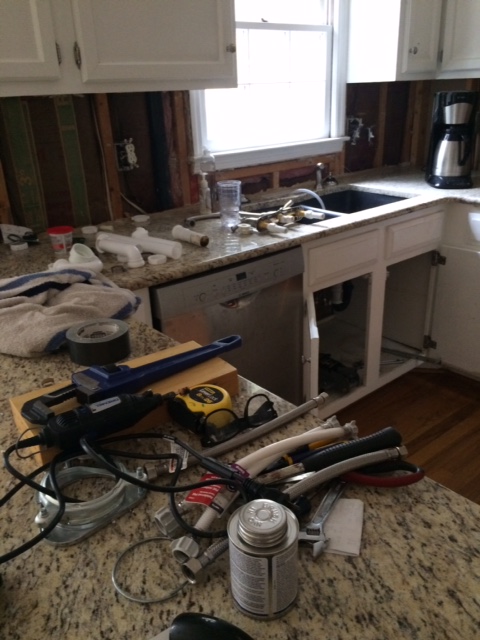
Of course if I was a plumber, I would a) be getting paid to deal with this BS and b) it wouldn’t be my kitchen going on four days without water.

Beautiful new counters underneath a pile of not-the-right-size plumbing parts.

I’m convinced that plumbing is the most contemptible of all of the home improvement projects. It’s not complicated – connect this to that in such a way that fluid flows freely and leaks are eliminated. The problem comes when apparent malevolent spirits installed the original pipework (glued PVC connector on the drain pipe? Really?) and plumbing manufactures seem to find glee in both creating an infinite number of connector styles and failing to design (or, in the case of the big boxes, stock) products that meet customer’s needs.

I’ve only given in once and hired a plumber. And that was after 5 hours in the freezing dark with my then-husband trying to attach a new water line to the house after the blue poly finally gave up the ghost in the dead of winter. It’s such a difficult expense to justify when the elusive part is always promised at the next trip to the hardware store.

Which always seems to result in one more item then needing to be returned.

As well as one more test for your marriage.

Any decently-sized home improvement project has the ability to challenge your marriage in the following ways. Even if you break down and hire a plumber.

1 – Money, Money, Money Down the Drain (Assuming You Have One Installed!)

I think we’ve managed to spend $100 a day at Home Depot over the past week. And that’s just on the little bits and pieces that make the big-ticket stuff work. Add to that the increased cost of prepared foods or eating out and of course, the cost of the cabinet refacing and counter top and it gets scary. Hey, maybe I can turn my kitchen into a haunted house and charge entry – it may not scare the kids, but I bet the parents will be petrified 🙂

Spending money while stretching a budget can be stressful. And that can become even more difficult when you have one partner with champagne tastes while the other is carefully watching the wine cooler budget.

But even, as in our case, when you agree on the decisions, watching the money wash away is stressful. It’s important to communicate fully about your fears and work together to decide how far the budget can be stretched. It’s a lot easier to tolerate the expense when you’re working as a team.

2 – Managing Frustration Without Biting Off Your Spouse’s Head

Home improvement projects are always a roller coaster. They begin with hope and the tantalizing freebies of sample swatches and Pintrest pictures. Then comes the first reality check when you begin to associate a budget and a timeline with your desires.

And then there are the inevitable and numerous setbacks. I can’t even begin to tell you how many times Brock has had to say, “I have bad news” over the last week.

And the project is still in its early stages.

It’s impossible to not be affected by the bad news, but it is so important to work to manage that frustration without gearing up for a fight with your partner. The fact that the bolt they’re trying to attach doesn’t fit is not a personal failing. Don’t treat it as one.

And the best way to deal with frustration? Humor.

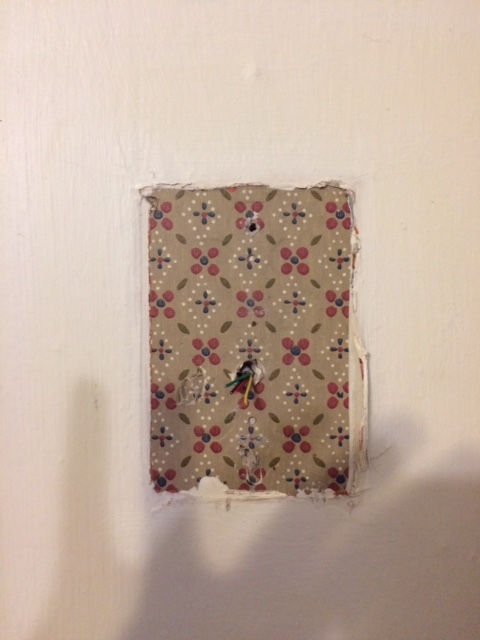
A hint of kitchen past once hidden behind a phone jack. We joked about removing all the paint and restoring the wallpaper to its old glory:)

3 – Flexibility Demands Even Greater Than Those Required by Yoga

It’s funny how you much you can learn about someone by watching how they handle disorder. Once I emptied the bottom cabinets, I declared the kitchen pretty much closed until the implements were returned.

Brock, on the other hand, simply dug through the kitchen items in the other rooms, found what he needed and set to making spaghetti.

Proof positive that he is the more flexible one when it comes to home environment.

I’m still learning:)

4 – Coping With Change and a Dearth Of Coffee

I’m used to moving through my early morning routine driven by pure muscle memory and habit. I can make the coffee and my breakfast with no thought and little attention.

But now all of that has changed. Making coffee now requires a trip to the bathroom and a small cup to use as an intermediary to fill the pot. In order to dispose of the old grounds, I have to first find the small compost bucket, which seems to enjoy playing hide and seek with the other items we are constantly looking for. And for now, the used mugs are sitting unwashed while we work on getting the water running again.

Ugh.

Change is hard. And change in your home with your spouse is harder still. Be patient with each other as you’re working through new patterns and new habits. It will smooth out. Eventually.

5 – Lack of Personal Space or Please Get Your Elbow Out of My Ear

Our home is not small but the available footprint has decidedly shrunk now that the kitchen cupboards have vomited their contents into the dining and living rooms. And the kitchen itself? It’s like playing hopscotch on a moving ship.

And it’s not only the intrusion of stuff where it doesn’t belong that lends to a sense of claustrophobia. It’s also the close – very close – proximity you have to be in with your spouse while engaged in exasperating or tedious labor that seems to strive to reach Twister proportions.

I’m pretty sure my elbow did end up in my husband’s ear last night as we were both crammed under the kitchen sink. Tiger sat nearby, looking upset that he wasn’t invited to what he saw as a cuddle party.

IMG_3968

Anytime space is at a premium, tempers can more easily flare. Douse them with good music, good laughter and a favorite home improvement beverage.

6 – Learning Your Partner’s “Home Improvement” Language

Love language, smudge language. We all know what is really important in a marriage is learning your partner’s home improvement language.

“Can you hand me that wrench thingie over there?”

I glance over there and see a total of five wrench thingies, none of which seem appropriate for the task at hand.

“The one that looks kind of like the old channel locks but newer.”

Turning my gaze, I spotted the needed implement at a different over there.

Part of learning you partner’s home improvement language is learning their vocabulary.

But that’s only the beginning.

In order to be fluent, you also have to know their strengths and weaknesses. Their skills and when it is best to pretend that the power tools aren’t working.

It’s pretty cool that on this project, Brock and I were able to divvy up tasks by strengths with little conversation. We both know that he is going to be the one to deal with the contractors and make sure that stuff gets done even when there are hiccups and I’ll be the one to paint the ceilings and find the new storage items. You know, the ones that go over there.

7 – Admittance of Wrongdoing and Acceptance That Watching HGTV Does Not Make You An Expert

“I need help with this one. I just can’t seem to get these screws in,” I said, passing the pieces of the new bar stool over to Brock. He managed to line them up and tighten them down, only to look up from his work and realize that I had attached the seat on upside down.

Oops.

When undertaking a project of any magnitude and tackling projects with a skill set that doesn’t get exercised enough to go pro, mistakes will happen. I have quite a bit of knowledge about home repair (more thanks to my ex than television, but I do have to admit to some HGTV viewing), but I have been the assistant more than the surgeon on these operations. So sometimes often my results leave something to be desired.

And it turns out the screws went in much easier once the seat was turned around the right way. Who knew?

8 – Biting of the Tongue And the Avoidance of “I Told You So”

Brock never made me feel stupid or inept because of my bar stool debacle. And I happily returned the favor a couple days later. When working on the home, you and your spouse are a team. And tearing one member down only serves to lower the performance of the entire team.

It can be tempting to call out mistakes, especially when they compound frustration by adding to the time or money needed for a project, but it is a temptation best avoided.

Because once the scolding begins, it rarely stops.

9 – Compromise And Learning to Love (or at least tolerate) Your Partner’s Taste

I wanted to simply swap out existing trashcans and relocate the kitchen one to a corner by the fridge. Brock balked, expressing a distaste for my chosen location.

And once I realized that his desire to not have the can there was greater than my desire to use the spot, I spent a couple hours locating a new can that can fit in a location that we can both live with.

Home improvement is one of those times when you have to let go of always getting your way. Stand up for what is important and compromise or even give in on the rest.

At the end of the day, your spouse’s happiness is way more important than where you choose to throw away your trash.

10 – Getting It On (When All You Want to Do Is Go to Bed)

These are the kind of sexy texts we’re sending to each other right now. Don’t be afraid to scroll down; it’s entirely SFW:)

Is this the one we need?

Unless you’ve always harbored a fantasy about carpenters or electricians, there’s really nothing about home repair that will get your engines revving. In fact, it can easily have the opposite effect when you’re both tired, grumpy, sweaty and probably covered in some sort of very unsexy goo.

The truth is that sometimes you have to wash the plumber’s putty out of your hair (or scrub the adhesive off your hands!) and take a bedroom break. The kitchen sink will wait (and Home Depot is open late).

11 – Dealing With the Unexpected Without a Breakdown

When the trip to Home Depot on Saturday was a dud and we discovered the needed part couldn’t be delivered until Tuesday (why can Amazon ship me shoes on the same day but shank extenders for my faucet take four days????), I almost lost it. This means we’re not only looking at several more days of a waterless kitchen, but it also means that we may have another date night under the kitchen sink on a work day. I prefer my cupboard snuggles on the weekend.

And then we looked at each other, shared looks of despair, frustration and finally resolve.

We’ll get through this. Together.

And Why It’s Worth It –

There is nothing like the celebration of reaching a shared vision through joint effort and teamwork.

Assuming you’re still on speaking terms, of course.