In and Out of Love

My brain, numbed and molded into a box from days of administering standardized tests is slow to make connections and weave non-standardized sentences this morning. I have found myself strangely drawn towards curves over the last two weeks – doodling nonsensical and nonlinear designs, sitting in the comforting arch of the non-corner of my deck and appreciating the bends in the trees and the undulations in the clouds.

It always takes some time for me to re-adjust. To remember that life is not multiple choice and that children are not defined by which bubble they darken. To feel comfortable again speaking off of a script and speaking my mind. Today, I am purging myself of the testing remains and spending time without monitoring minutes or erasures.

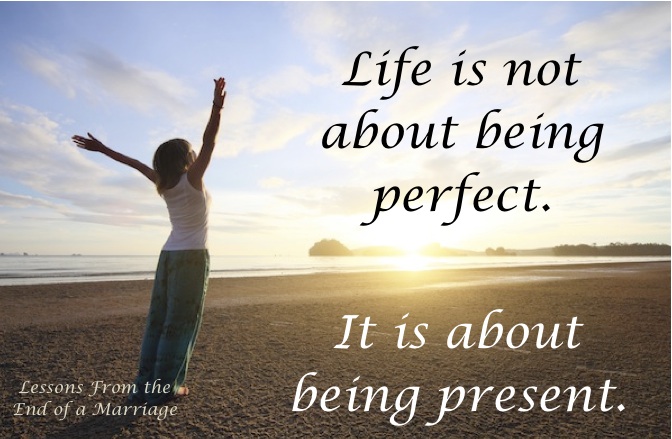
Meanwhile, here’s another collection of some interesting articles that I have encountered over the last few weeks. Enjoy. And remember, life is not a test. There are no wrong answers, only different paths.
presentlife

The Science of Betrayal

This research invested the effect of oxytocin on feelings of betrayal. The results are interesting and not what I would have expected. My ex expertly used affection, and thus oxytocin, to keep me calm.

Life Sucks

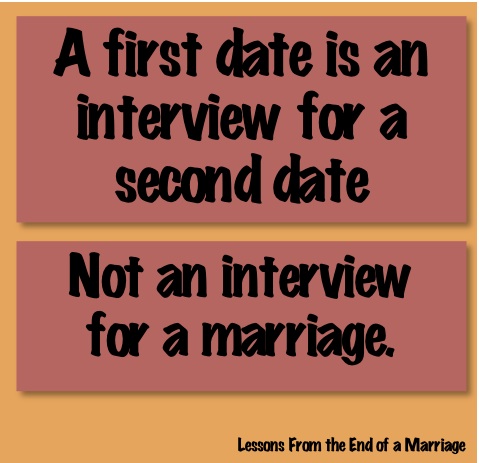
After the Divorce: 5 Ways to Know if You’re Ready to Date

Good stuff here. I have to admit, I started dating before I had resolved all of these (I was still pretty angry), but they all had to be resolved before I could really be in a relationship.
interview

She Shared Her Brutally Honest Experience of His Affair and It Worked

I share this not because I think it will “work” to save a relationship on the rocks (you have to have a straying partner willing and able to listen first), but because I think it is a well-written description of what it feels like to be betrayed. Countless writers have attempted to describe the pain in words. I don’t think any words can quite embody it. But these get close.
pullplug

The 10 Biggest Reasons People Fall Out of Love

It’s interesting the perspective that can be gained when distilling something so complicated into a simple list. I know I fell out of love at first sight once I realized that he wasn’t the person I thought he was.

Happily Ever After

5 Tips to Improve Your Self-Talk

We work hard to improve our physical environment – creating a comfortable home and welcoming space. Yet sometimes we neglect to spruce up the environment we spend the most time in – our own minds. The words we say to others have influence and the words we say to ourselves have power. Choose them carefully.

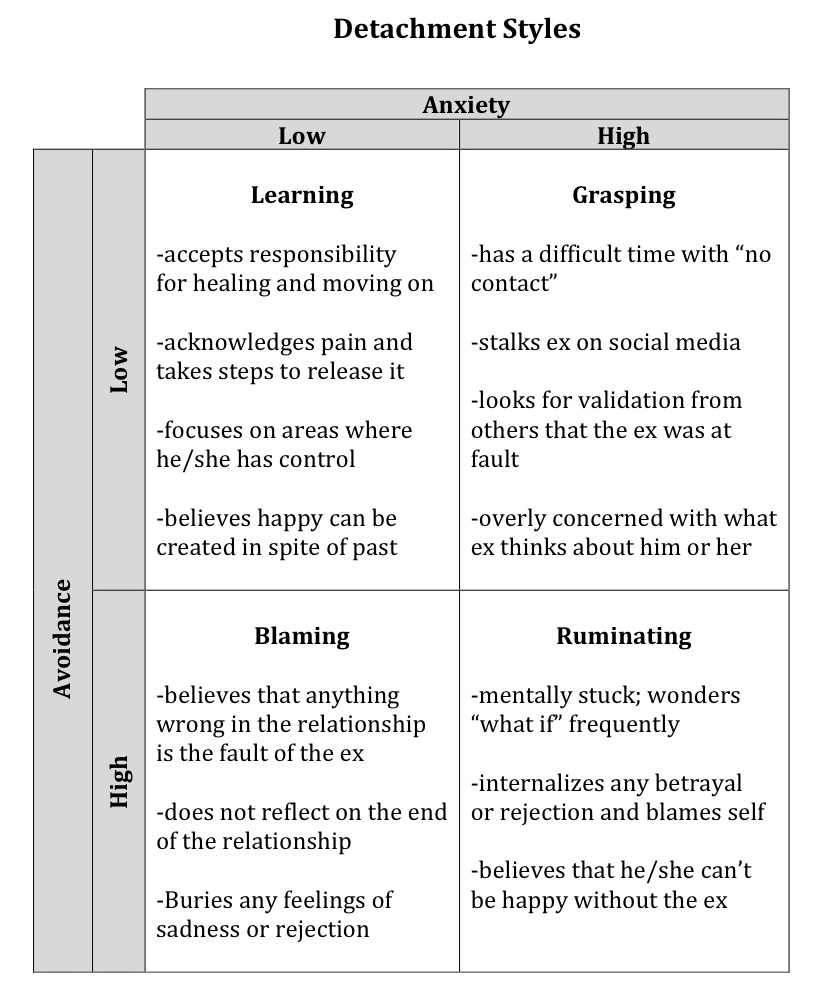
Detachment Styles

Much has been written about attachment styles, starting with ways that infants bond with their caregivers and then extrapolated to how people respond in their romantic relationships.

Here is a summary I made of the four primary attachment styles (information from Psychology Today):

attachment stylesIf you are not familiar with attachment theory, it’s worth a look. It’s amazing how much of how we respond in relationships can be described within this matrix.

Of course, the way we respond at the end of a relationship also depends upon our personal makeup and early experiences. I created a chart of detachment styles based upon the same criteria.

detachment stylesAs with with attachment styles, you will likely recognize yourself in more than one category or realize that you have moved from one box to another over time. These are not fixed traits; you can change your position with intention and effort.

Breaking up happens. How do you want to detach?

The Little Things

I had to smile when I reached the realization.

Brock and I were couch-locked, tucked under blankets in front of a roaring fire built to chase away the cold. The movie we selected began with some screen text to set the scene. Without hesitation, Brock started to read the words to me. Not because I’m illiterate, but because I’m pretty much blind. He always reads distant (I’m useless with street signs) or movie text to me without my having to ask.

A half hour later, my lips were starting to lose their protective coating of beeswax. “Where’s the emergency chapstick?” I asked. He picked up the extra tube from the end table and passed it over to me. Within weeks of starting to date, he had emergency chapstick stashed in his car and around his house. I can get pretty panicky when I can’t locate lip balm.

After the movie ended, I retired to bed (I’m pitiful) while Brock stayed downstairs to watch another flick. Some time later, I felt my Kindle being lifted off my head and my glasses being slid off my face. I stirred and grunted as he kissed my forehead before walking over to his side of the bed. One of the signs of my singleness for a few years was the semi-permanent indentations on my nose from falling asleep with my glasses on every night. Now that only happens when he’s out of town.

Each of those gestures says he sees me. He knows me. He loves me.

We tend to look for love in the grand scale. The words. The romance. The events.

When it often finds its home in the little things.


Holding

We push people away because we are afraid of letting them in and being hurt when they leave.

We grasp on to people that are not good for us because we are afraid of being alone and someone is better than no one.


Pushing and pulling are fear, not love.


Love is holding.


Loosely enough so that each person has the freedom to grow and change.

And firmly enough so that each person knows they are supported.


It is trusting the other person enough that they want to stay even if they have the ability to leave.

And trusting yourself that you will be okay if they do.


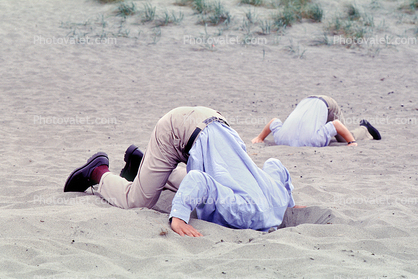
Love Is Only Blind When Your Head Is In the Sand

Do you ever look back at a former relationship and wonder what you saw in your one-time flame?

Or do you ever question a friend or family member’s choice in partners?

It’s easy when you’re outside of a relationship to view the bigger picture, the distance providing perspective while damping emotions.

But when you’re in it?

It’s all too easy to bury your head in the sand.


We stick our heads in the sand in relationships for a variety of reasons:

Avoidance

A wife sees a suggestive text on her husband’s phone from an unknown female. Her heart begins to race and panic floods her system. The hint of an affair is overwhelming to her; she cannot face the thought that her marriage is in trouble and that she may lose her husband. She turns away from the text and tries to pretend that she never saw it. That it didn’t happen.

When we see something that frightens us, we have two choices: approach or hide. In a relationship, the latter can cause problems as the truth is not faced because of the anxiety of losing the partnership. Of course, the fear persists even when the truth is not faced head-on. This state is usually temporary when either the truth becomes too big to avoid or the anxiety becomes too high to tolerate and the evidence is finally challenged. Burying your head out of fear may make you blind but it leaves you even more vulnerable to attack.

Mindlessness

A husband is busy at work, long hours and stressful clients have kept him away from home both physically and emotionally. He prides himself on providing for his family and doesn’t really have the time or energy to consider the status of the marriage as a whole. His wife, meanwhile, appreciates his efforts but feels isolated and lonely as her partner has become a husband in name only.

Heads can end up in the sand even without intentional digging. Stay still long enough and the tides will conspire to bury you. This is a blindness born of inattentiveness and busyness rather than willful evasion. Regardless of the motivation, the outcome is still a relationship in danger due to a lack of clarity and communication.

Willful Ignorance

A wife is pretty sure that her husband has a mistress. She intentionally chooses to turn a blind eye to his affair because he is a good father and stable husband. So she decides not to confront him and, even more, chooses to avoid situations that may reveal evidence of the infidelity. She knows something is there but chooses not to look.

This blindness is born more of pragmatism than fear. The reality is known to an extent and even quietly accepted. It’s a desire to pretend that life isn’t messy and emotions can be subjugated to reason. It’s a carefully edited and narrated form of the relationship. Although often dismissed, there is a sadness in this buried head that comes from lack of vulnerability and associated intimacy.

Bargaining

Prior to the marriage, a husband knows that his wife has problems with anger. He is uncomfortable with her temper and it raises red flags for him. However, he wagers her temperament against her other qualities and decides that the good outweigh the bad. When others bring up her outbursts out of concern, the husband responds by dismissing the concerns and tallying the pros that she brings to the table.

This is a common approach when a partner has issues with violence and/or substance abuse. There may be several very good qualities that are only occasionally accompanied by the bad. It’s a dangerous game; however, as the blinded partner slides into enabling the poor behaviors and choices.


A healthy relationship is one where both partners have their heads tall, looking out for problems on the horizon and addressing them as they approach. Burying your head may make you feel safe for a time but it’s no way to live.

Have the courage to lift your head.

Trust that you can handle whatever you see.

True love isn’t blind.