Thoughts From a World Turned Upside Down


It’s a strange time right now, isn’t it? The entire globe is facing an imminent threat, the first since technology has us so connected and plugged in all the time. It’s a pressure cooker for human behavior, amplifying our usual responses and coping mechanisms.
As of this moment, we don’t know what is overreaction and what is blind complacency. All we can do is try to sort out the valid information from the noise and make the best decisions we can from what we know.
It’s evident that we need to strive to understand this virus, its treatment and its prevention. Yet also critical is that we make an effort to understand the reactions within ourselves and within those around us. Because no matter what the next few months bring, we need to work together and not allow this to further divide us.
Right now, you have two opposing camps – those that are voicing their fears and those that are ridiculing the people that are expressing fear. Yet the truth? Both groups – and those in between that are staying silent – are experiencing some anxiety.
Fear can often express itself in some unexpected ways – covering from anger to humor to distraction. It’s easy to miss the signs in others or even in ourselves. Learn more about how fear manifests: 15 Ways Fear Hides in Plain Sight.
It’s easy to laugh at the people who have been stockpiling toilet paper. Yet I understand the urge. When we feel out of control, we have a drive to do something – anything – to try to mitigate the outcome. So, yes, filling your home with endless rolls of tissue is a nonsensical response to a respiratory virus, yet it is a tangible action that people feel like they can undertake. It’s not unlike the midwives of old ordering the men to bring hot towels. Purpose and action help to temper panic. Learn more: On the Need For Action
It can be frustrating when people refuse to admit what seems obvious to others. Yet to them, that denial is what is keeping them safe. It’s confirmation bias in action; we actively discard information that doesn’t match our beliefs while seeking out points of view that conform that we are correct. And confirmation bias is extremely resistant to change. Learn more: Jumping to Conclusions.
At this point, the actual number of deaths in low from a global standpoint. Most of us are still untouched by the actual illness. Yet we are all grieving. Trips have been canceled or postponed indefinitely. Sporting events shuttered. Planned gatherings dissolved. School events removed from the calendar.
Yes, in the scheme of things, these things are minor. Yet, every loss brings grief as expectations are dashed and a new reality is accepted. And just like with everything, people respond to grief in myriad ways.
From racist remarks and actions towards the Chinese to memes implying that those who become ill are filthy and don’t have basic hygiene mastered, there is quite a bit of “us” vs “them” going around. Where whatever commonality that the “them” group shares is absent in the “us” group, thus providing a sense of invincibility. We want to believe that we have control and sometimes this is used as an excuse to hurt others.
Our stressed brains are not our best brains. The ability to reason and consider multiple perspectives is reduced and we have a tendency to revert to all-or-none thinking. This makes dialog more challenging, as it feels more like a battle for the “win” than an exchange of ideas.
By all accounts, we’re in for a challenging few months, regardless of the trajectory of the virus. Lives have been upended (at least in the short run), financial futures are uncertain, and emotions are running high. Now more than ever, be kind to one another. Seek to understand the motivation behind the words or actions that seem out-of-place. Consider that people can have different approaches to the same problem and different responses to the same situations.
Remember that we’re all in this together.
My first marriage was in December 1999, the apex of the collective anxiety around Y2K. At the time, my fiance and I operated from a place of optimism, rationality and faith. Despite the warnings and fears that we were constantly being bombarded with, we decided to move forward with the assumption that everything would work out.
And it did. Well, at least the transition into the new century worked out. (The marriage was something else entirely, but I don’t think I can blame Y2K for that one.) All of that anxiety and fear building up to the new year grew as flat as the leftover champagne while the sun rose on January 1.
Staying calm and present during times of uncertainty is hard. By nature, we are uncomfortable with the unknown. Yet life is not a book, where we can peek at the final chapter before we dig into the narrative. Our lives offer up no synopsis prior to living so that we can prepare ourselves for what is to come.
It’s easy to get swept up in the anxiety of the unknown, to put life on hold while waiting for the conclusion to be revealed and for life to return to normal.
Yet even the idea of an “end” is a falsehood. Consider the current arrangement of the continents. We know they used to exist in one solid mass (Pangea), that has since broken apart and drifted into the familiar patterns we were quizzed on in school. Yet the drifting is not over, the formations are not set. Just because most of the changes are too slow to be perceptible within a human lifespan, does not mean that change is not occurring.
We want to know how it ends so that we can be reassured that we’re making the right decisions. We want to know how it ends so that we can be prepared. We want to know how it ends so that we can adjust our expectations accordingly.
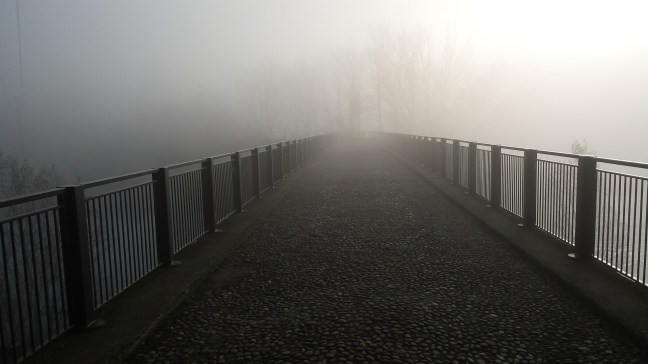
We want to see the end of the bridge, tethered securely to a welcoming shore, before we take the first step.
Yet standing still does not keep the unknown at bay. It simply restricts our lives as the future unfolds. We can’t see the end. We can’t change the end. But we can make the decision not to live in fear of the end.
I have a five-year spiral journal. My entry earlier this week included, “I wonder what we think about the coronavirus one year from today?” And I don’t know what entry might be recorded on that same page next year. The previous entry might remind me of a forgotten fear, the virus and the associated panic a distant memory. Or, life may have changed dramatically to the point of becoming unrecognizable. Most likely, the entry will fall somewhere in between. But in the meantime, I have 364 more entires to record. And I’m going to take them one day at a time.
Because we may never know how it ends, but we can be present while we get there.

Are you staying with the status quo because it is right… or because it is comfortable? Change is hard and so we often try to talk ourselves out of it, even when we know it’s the right thing to do.

I’m the in clarity-seeking and courage-building phase of a major life change. And like any change, it’s scary. Especially in that wind-up to the actual leap.
I’m very aware that I need to manage this anxiety around the transition, otherwise it will keep be stuck in the same place that is sending me clear signals that’s time for change. But it’s time to replace words with actions. To stop making empty promises to myself and start making decisions.
And it all starts by confronting my fears.
My fears are lying to me, telling me the following –
It’s not that bad.
I can’t do anything differently.
The transition will be hard.
What if I make the wrong decision?
I’ll go broke.
I’m failing by quitting.
You won’t be successful.
It’s almost as though my fears earn a commission based off how well they can keep me frozen in place.
Now, I KNOW these are lies. But sometimes I struggle to believe it.
So today, I sat down with a journal selected solely for this transition and challenged each fear in turn-
1 – What is the fear telling me?
2 – What is the worst-case scenario in relation to this fear?
3 – If the worst-case happened, what agency would I still have?
4 – What evidence do I have to refute the claims that this fear is making?
5 – When have I faced a similar fear in the past and what was the result?
Wow. This was powerful stuff. First, simply writing out each fear and exposing it to the light of day helped to reduce some of its power. Exploring what decisions I could make if the worst happened gave me some sense of control and comfort that I would be okay. Counteracting each fear with evidence had the effect of distinguishing between a bark and a bite. And finally, reflecting on how I’ve successfully faced my fears (and worst-case becoming real) in my past helped to build my confidence.
I got this.
And for those of you facing a similar challenge, you got this too!
 Lessons From the End of a Marriage