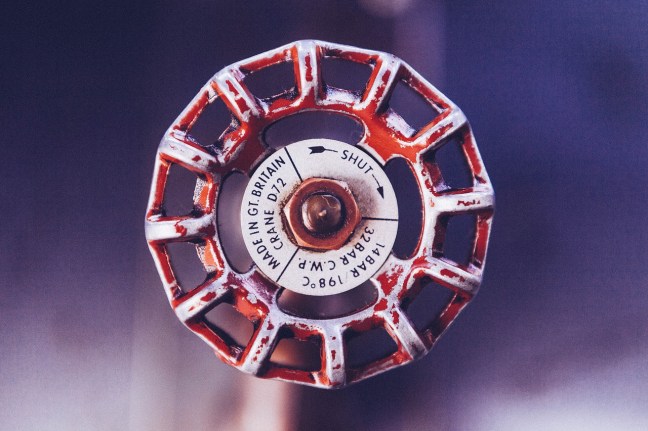
Escape Valves

I couldn’t help it. Giggles burst from my lips like foam spilling out of an over-filled latte.

I had been taking my Yin yoga class seriously up until the point where the instructor, usually calm and serious, mentioned the human nature of moving away from the stretch. I inwardly groaned at the first escape from the discomfort she mentioned – leaning the body over to the right to release some of the tension on the psoas – as I shifted my own weight back to the left to fully face the stretch. But then I had to laugh as she continued to mention two other common ways that practitioners lessen the intensity.

And I was doing both of them.

She described this human tendency to avoid discomfort as seeking an escape valve. A way to reduce the pressure and lower the harshness of an experience.

And it really is universal, isn’t it. We try to avoid pain or even unease on the yoga mat. In relationships.

And even in our own minds.

It makes sense. At a basic level, we are programmed to avoid pain in order to protect the body and stay away from dangerous objects and situations. Pain is an important sensation. It tells us to remove our hand from the hot stove or to stay off a broken ankle so as not to cause further damage. Relational pain sometimes informs us that we are in an unhealthy or even dangerous environment and provides the encouragement to leave. Internal pain flares when we neglect our own innate sense of right and wrong and serves as a wake-up call.

Those pains are intense. And the message they send is a critical one – stop what you’re doing now or you will only make it worse.

But often we confuse pain with discomfort. It makes sense to seek to avoid pain.

Yet it frequently it makes sense to embrace discomfort.

On my yoga mat this morning, my breath hitched as I leaned into the stress, shutting off the escape valves. If asked, I would have replied in that moment that I was in pain.

But I really wasn’t. In fact, as I breathed into the psoas and relaxed the surrounding muscles, the position lost its intensity and I was even interested in exploring the pose further. By facing the discomfort, I was able to reduce the discomfort.

Without the instructor’s prompting, I would never have faced the initial discomfort. Unconsciously avoiding even the merest suggestion of pain. And as a result, I would have unwittingly nurtured that area of tightness, allowing it to grow unrestrained.

It doesn’t feel good to feel uncomfortable. But that’s often exactly where we need to be.

———————-

I see the use of escape valves all the time in people facing the end of a relationship –

They decide that they should be over it by now and push it out of their conscious mind. Yet no matter how much you push it down, it always resurfaces until the lessons are released.

They try not to think about their ex or the end because doing so creates pain. Yet trying to avoid the thoughts only makes the thoughts grow more powerful. If they are addressed as they arise, they fail to grow.

They look to distractions to escape the inevitable pain of the end of a relationship. Yet the distractions only work for a time and the pain is patient.

They downplay the impact of the end on their well-being, pretending that it really doesn’t bother them. Only their acting out in other ways belies their assertion.

——————–

The pain at the end of a relationship is more the discomfort from the yoga mat than the agony of a hand on a hot stove. If you face it and work with it, it will begin to release.

Opening an escape valve feels good in the moment. And sometimes, when the pressure is too great to bear, it may be needed. But if you find that you constantly need escape valves, maybe it makes more sense to repair the basic system.

(Note: There is a very important distinction between ruminating and processing. Ruminating would be like taking the yoga pose just to the edge of the pain and then tensing up, holding the breath and staying in pain. Not fun and also not going to get you anywhere. Processing is more like moving through the pain: understanding, exploring, softening, opening and finally releasing.)

Lessons From the Wake

I’m good at making excuses for my fears.

Damned good.

In fact, the excuses are real. I just choose to ignore the solutions.

But I’m tired of living that way.

So I refuse to anymore.


This past week, I had an opportunity to water ski for the first time.

Let me clarify. It was not the first opportunity in my life to water ski- I’ve had many of those over the last 20 years. It was; however, the first opportunity I chose to accept.


And, like all fears, it seemed so silly after it was faced and the excuses so easy to overcome.


And, like all fears, facing it and mastering it brought an incredible feeling of strength and potential.

My lessons that day are embedded within water skiing, but they apply to facing most any fears.

Surround Yourself With the Right People

The situation on the boat this day was perfect. I had a teacher/driver/guide/coach that I trusted and who was patient and positive. There were other skiers on the boat who had only a few more hours practice than me – watching them showed me it was possible. When you’re with the right people, you feel supported enough to take a risk.

Accept Your Weaknesses

My primary excuse for avoiding water skiing over the years was my fear of losing my (very expensive and very necessary) contact lenses. On this day, I brought a pair of swim goggles. Rather than allow a weakness to hold you back, find a way to work around it.

Learn From Your Failures

On my first attempt, I got up but then immediately fell back into the water. After a quick debriefing, I learned what I did wrong and corrected it on the next try. Failure is a teacher, not an end.

Capitalize on Your Strengths

My form was not ideal on my first, 3-minute run. But I could use my strength (literally, in this case) to make up for my lack of finesse. Your own strengths can help to balance your weaknesses. Let them.

Don’t Compare Yourself to Others

There were some VERY good skiers on the boat. I didn’t compare myself to the woman who grew up on skis. That would be silly, pointless and disheartening. I compared myself to the Lisa who always said, “No, thanks” to the offer to ski. Rather than use others as your benchmark, look to your own progress.

Prepare But Don’t Overthink

I had a boat lesson on the proper form (tight ball with skis up) and most important tip (keep your arms straight) but, once I was in the water, I silenced the brain and let the body tell me what to do. Overthinking tends to make something simple into a complicated mess.

Set Realistic Goals

For some reason, I always had a fear of water skiing. That meant that I had a bigger hurdle to overcome than many on their first attempt. Allow for your fears and create realistic expectations for you.

Celebrate Success

After my three minute ski, I crawled back onto the boat and was greeted with cheers and high fives. Allow yourself to enjoy the feeling that comes from tackling something new. It’s pretty awesome.

And finally,

Allow Yourself to Have Fun

And try not to get too much water up your nose!


Comps

In residential real estate, the value of a property is often found through market comps, the comparison of the property in question to other, nearby residences that are similar. Of course, no property is identical to any other, so adjustments are made to the sales prices of the comps to arrive at a value for a given property. It’s as much art as science, learning the values of the various adjustments, adding here and subtracting there in order to create a level playing field.

I like this strategy – using comparisons yet also recognizing individual character and worth. In fact, it’s not a bad game plan in other areas as well, as I discovered this past week.

We just returned from our second (hopefully) annual ski trip. Last year, it was just Brock and I. This was perfect, as I was very nervous about tackling the sport. For some reason, going downhill is panic-inducing for me. Like, limbic system lockdown panic. This only happens when I am the one in control of steering and slowing – rollerblades, bikes, running and even driving. Roller coasters and sitting in a passenger seat on a fast descent are no problem – in fact, I love them.

A huge improvement over last year's newborn giraffe posture! :)
A huge improvement over last year’s newborn giraffe posture! 🙂

It would be easiest for me to avoid those situations that require me to trust my ability to control my speed and direction. Easiest, but also limiting. And, if there is one takeaway lesson from my divorce, it is not let fear ever limit me again.

Last year’s trip was the first time I ever really tackled this fear of the downhill head-on. And it was quite a meeting. Seriously, check it out, if only to laugh at the pictures of me looking like a newborn giraffe attempting to take its first steps:)

This time was a little different. I knew a little more what to expect, which tempered some fear but also provided scaffolding for expectations, which I had avoided year one. Furthermore, we were not alone this time; we were joined by three friends, two who as accomplished skiers and one who was brand new to the sport.

On the first day, I went with Brock straight to the easiest green run that I had skied last year. I was nervous as the lift neared the top, wondering if the feeling of my skis on the hill would be familiar or if my body would remember how to move. It wasn’t bad. I bailed soon after my skis hit the snow, which I also did every time last year. Once I stood up and took a few deep breaths, I was ready to tackle the slope. I never fell, but I sat down (my reaction when panic set in either due to excessive speed or fear that I couldn’t steer around someone) several times. I went down that same slope several more times that afternoon, each run a bit better than the previous.

Yup, that is a hill.

But I still hadn’t mastered my nemesis. That run has a short, steeper portion about halfway down. It’s a bit tricky, not only due to the increased decline, but also due to the curve, steep, treed drop-off and the heaps of other beginners who didn’t make it down in one attempt. Each time, I would stop at the top of the hill and wait for a clear (or at least clearer) path. Each time, I would make it about halfway down the slope before panicking and bailing. As the attempts went on, I grew more and more frustrated with myself.

It didn’t help that this time, I was also comparing myself to another – the brand new skier in our group. By about run number three, he was able to make it down that entire green slope without falling. I saw him, another novice, as comparable to myself. So when I fell short, I felt defeated.

I carried that feeling into day two. That, plus a serious sleep shortage and a not-too-happy belly, led to a limited day. But it still had its bright spots.

In the morning, I again did “my” run, this time with one of our friends who is an excellent skier. He was trying to encourage me to give up on the snow plow method of braking (which is what I was taught the previous year) and instead use turns to control my speed. By the end of the run, I was starting to pick up his suggestions and become comfortable in their application.

Brock then joined me on my next run. I had two firsts – I made it off the lift without bailing and I made it down my nemesis without ever touching the ground (which my bruised butt appreciated!). Once I realized I made it down intact, I was distracted and fell soon after. I was surprised to feel tears on my cheeks as I stood up. Tears not from pain, but from the satisfaction of facing and conquering a fear. Not unlike the tears that fell during the marathon.

At that moment, it didn’t matter that there are many that could ski that hill backwards and blindfolded. It didn’t matter that our novice friend mastered faster than me. All that mattered was that I faced my fear, stayed with it and learned to trust my ability to make it through. I had been using comps to judge myself, but I had failed to make adjustments. Unlike our friend, I had some repair work to do before I was ready enough to gain confidence on the slopes. Once I allowed time for those restorations, I was right on track.

By midday, I had graduated to a more difficult and longer beginner’s run. I again made it off the lift (this time one with a VERY steep ramp at the offload) without bailing. And, although I fell several times, I handled each hill better than the last and allowed my speed to pick up more and more. At one point, alone on a lift, I thought of the trust fall activity where one person with eyes covered, falls backwards, counting on a partner to break the fall. Until that day, I hadn’t been letting myself fall. On that day, I learned that I could let go and trust myself to get back up.

By the third morning, I approached the slopes with confidence rather than trepidation. I made it through six beginner runs without falling or bailing (yes, including my nemesis!). My legs were giving out but I could feel that it was no longer as taxing on my mind. I was no longer facing a fear, the hills had become known. Maybe not allies yet, but no longer adversaries.

During the entire trip, Brock had been pushing me to try an intermediate blue slope. I kept pushing back, convinced I was not ready. I think I surprised him when I met him at the bottom of the slope and asked him to run a blue with me. I knew I was ready yet I also knew it would be a challenge. It didn’t let me down. Well, actually, I guess it did, as my flawless beginner runs gave way to multiple tumbles (including a spectacular face plant).

But you know what? I never panicked on that run. I never got frustrated. I didn’t compare myself to the other newbie who had been skiing blues for two days by that point. All I thought about was the progress that I had made.

Because regardless of the comparisons we make to others, we are all unique properties with our own areas of strength and weakness. Rather than trying to compare yourself to the others, work on your own renovations, making yourself the best you can.

As for me, I may never be the best skier around, but I am the best skier I can be. At least until next year, when I plan on mastering those intermediate slopes:)

That ain't no bunny slope!
That ain’t no bunny slope!