The Love You Find When You Struggle to Love Yourself

We’ve all heard it so much that it has become trite – “You have to love yourself before someone else can love you.” There’s truth in that statement because when we look for love outside of ourselves before we’ve found it within, we’re likely to end up in one of the following relationships:


Accepting Mistreatment

This is perhaps the most tragic result of a lack of self-worth. When you don’t see yourself as worthy, you’ll put up with a lot of abuse and neglect because you believe that is what you are worth.

This pattern is self-perpetuating. The abuser needs you to believe that you are less-than so that they can continue their threats and mistreatment. Their negative words join those that already reside inside your head, creating a cacophony of self-hate.

Perhaps this pattern is anchored in childhood or maybe it became learned during adulthood. Regardless of its origin, the first step in breaking out of an abusive relationship is believing that you deserve better. Because you absolutely do. The way they are treating you says more about their demons than you’re worth. Never forget that.

Tolerating a Controlling Partner

Some partners fall short of abusive, but they seek to unduly influence others because of their own fears of being rejected or abandoned. When your sense of self is low, it’s easier to accept this power imbalance because you doubt your own contributions.

When you don’t believe that your words matter, it’s hard to speak up. If you constantly downplay your ideas, you’re leaving a void for someone else to fill. When you allow someone else to make decisions for you, you’re communicating that they have more value than you.

Practice small. Set some easier boundaries. Practice having the difficult conversations. Build your confidence. Your words matter. Your ideas matter. YOU matter.

Acting As a People Pleaser

Not all relationships that come from a place of lacking self-love are abusive or controlling. Sometimes, the damaging patterns are much more subtle and may even be mistaken for a positive trait.

When you struggle to love yourself, you are holding onto a fear that others will not love or accept you. Often, this fear manifests in desperate – and often unhealthy – attempts to make others like you or to make yourself indispensable to them. These actions can serve to keep people in your life, but you’ll always wonder if they love you, or merely what you can do for them.

The same actions have an entirely different feeling when you’re doing them from a place of service or generosity instead of fear. Practice separating who you are from what you do. Put safeguards in place to ensure that you’re not giving more of yourself than you can afford. And make sure that when you’re trying to please others, that you place yourself on that list too.

Afraid to Leave Yet Not Happy Staying

Are you staying with the wrong person because you’re afraid of never finding someone else that will love you? When you harbor a belief that you’re lucky to have found someone that thinks you’re worth their time, you become paralyzed within that relationship, afraid to leap because you’re convinced that there is nothing else for you.

When you’re struggling to love yourself, the thought of being by yourself is terrifying. After all, who wants to spend every day alone with somebody they don’t like? As a result, you may elect to stay with someone…anyone to avoid being alone.

Make learning to accept yourself your number one priority. Learn to be okay – or even happy – in short stints by yourself. Slowly increase the duration until you start to believe that you are enough all on your own. You don’t need anyone else to complete you because you’re already whole.

It Starts Here…

We all want to feel loved and accepted. When we don’t feel that way towards ourselves, we often attempt to seek it from an external source, believing that we will be okay once somebody loves us. The problem with this belief is that it has it backwards – Love from another doesn’t make you accept your own worth. Your own worth attracts love from another.

The first step to finding a healthy relationship with another is creating a healthy relationship with yourself.

It all begins with you.

Six Ways We Hurt the Ones We Love

My ex husband used to tell me, “I’ll never hurt you.” I knew it was bullshit. After all, the ones we love are also positioned to hurt us the most, even when it’s unintentional. Yet even though I knew his statement was wrong, I chose to believe him. Because I wanted it to be true.

In contrast, my now-husband will occasionally say, “I will hurt you. And you will hurt me.” I don’t necessarily like to hear it (after all, it’s not what I want to be true), but he’s right.

At some point, in every relationship, we hurt – and are hurt by – the ones we love.

Yet all those hurts are not the same. This is definitely one of those cases where the intention behind the act matters as much as – or even more than – the magnitude of the emotional injury.

1 – We Hurt the Ones We Love Inadvertently

We get careless. Speaking without thinking and making hurtful comments we don’t really mean. Often, we know we’ve stepped over the line as soon as our voice leaves our mouth. And apologies – and regret – soon follow.

This type of hurt is especially prevalent when people are busy, preoccupied or tired. We can try to mitigate it by taking a few moments to decompress from work before entering the home or being careful about topics broached when stress is high. Regardless, as long as we’re human, this sort of accidentally trespass will happen. Apologize, acknowledge the hurt feelings and move on.

2 – We Hurt the Ones We Love Unconsciously

Sometimes we forget that we don’t know everything about the people we love. And sometimes we say or do something hurtful without knowing that it is a tender area.

These are distressing missteps for both parties; one feels badly for the accidental wounding and the other is tending to the wound. At the same time, these can also be healing transgressions, as they provide an opportunity for increased vulnerability and openness.

3 – We Hurt the Ones We Love Cautiously

There are times when getting our own needs met mean hurting someone else in the process. This is deliberate harm, meaning that it is conscious and premeditated, yet it is also compassionate harm because the impact on the other is considered and buffered as much as possible.

Sometimes, hurting others in the short term is both necessary and kind for them in the long run. This is true for everything from administering a childhood vaccination to asking for a divorce in a lifeless marriage. Step carefully and with kindness, but make the needed cuts.

4 – We Hurt the Ones We Love Selfishly

When you hurt someone without regard for their feelings, it is different than the previous method. It’s selfish to act without regard for others when your wants crash against theirs.

This is often the type of hurt that arises from cheating. One partner is feeling unappreciated or ignored and so they seek to meet their desires without considering the pain that it will cause their spouse. Often, they will perform creative cognitive contortions to evade facing the reality of what they’re doing to their partner. In the worst cases, the selfish person then attempts to cover their initial harm with lying, manipulating and/or gaslighting. Jerks.


5 – We Hurt the Ones We Love Instinctively

We know what we have learned. And for those that have been raised in homes where any attention is good attention and abuse becomes muddled with love, they may hurt others from a place of unconscious reflex.

This is a tragic hurt as the contagion of unacknowledged trauma carries forth like a virus, infecting the next in line. And the only way to stop its spread is to face its origin and learn how to neutralize its power.

The hurt that radiates outwards from addicts, often leveling those around them, fall into this category. Yes, their actions are selfish, but they are operating at an instinctual level in an attempt to meet their needs.

6 – We Hurt the Ones We Love Intentionally

It’s difficult to accept that this is even possible. How can you love someone and yet seek to hurt them at the same time? Yet it is not so unusual for us to simultaneously possess such diametrically opposed – yet intense – emotions.

For some, it may come from an innate cruelty or disorder, abuse in its most ruthless form. For others, it is a much less harmful, using love testing in an attempt to alleviate their own anxiety.

Hurting the ones we love is inevitable. Yet it is within our power to limit the harm and to take responsibility when it does happen. And when we’re on the receiving end, it’s helpful to consider what may be behind the words or actions that caused pain.


Freedom of Information

It’s been a rough week.

I keep telling myself that things will settle down.

Yet those things never seem to get the message.

I’m usually the strong one. But right now, I’m feeling pretty weak. And all pretense of strong disappeared Friday night. Earlier that day, we had a lockdown drill at school. Our school doesn’t believe in doing the hyper-realistic drills that bring in fake shooters and try to replicate the chaos of the real situation.

But that doesn’t mean that drills are easy. Far from it. Usually, I’m able to build some distance between the discussions I have to have with the students and my own emotional reactions to the reality we live in. I guess my current state of overwhelm meant that those walls were pretty flimsy.

Because later that night, at home with my husband, I suddenly broken down when the show we were watching had a scene with excessive gunfire. Normally, fictional violence doesn’t phase me. But I guess I’m not normal right now, because I ended up crying and shaking under the covers.

As is often the case with emotional eruptions, it was about much more than just the one thing that eventually triggered it. My husband and I spent Friday night talking through some options. And I’ve spent some time this weekend researching possibilities, communicating my needs and finding some hard numbers.

I still don’t have an answer to my current overwhelm, but I feel so much better now that I have data and an outline of options. I no longer feel as trapped and just having some possible plans explored gives me some breathing room.

It can be scary sometimes to face the hard facts. But there is freedom in information. Just knowing that you have options makes the current one feel less like a trap and more like a choice.

10 Ways to Make Online Dating Suck a Little Less

Online dating can be awesome – you have a huge pool of potential dates to select from, you are able to screen for basic compatibility ahead of time and you can “meet” people while you’re on the sofa in your sweats. But online dating has its downsides. The sheer number of people available can be overwhelming and a succession of mediocre (or even terrible) encounters can leave you feeling defeated.

The following ideas can help you get the most out of your time with online dating –


1 – Ensure Your Basic Emotional and Social Needs Are Already Met

If you are turning to online dating to have your emotional needs met, you’re setting yourself up for failure. You can expect to have many superficial encounters and even if you meet someone that you click with, it will take time to build emotional intimacy with them.

Asking your online matches to meet your basic needs for connection and validation isn’t fair to them. They are not looking for someone to take care of (or, if they are, it’s a red flag that they’re not ready for a relationship); they are seeking someone to spend time with and get to know. It’s a lose-lose situation when people are too “hungry” for connection when they begin dating – the grasping will push others away and the need for emotional contact will go unfulfilled.


2 – Limit Your Choices

I remember when I first made my Match account about nine years ago. A newbie to online dating, I cast a wide net, basically setting my parameters as males between the ages of 25 and 45 in the metro Atlanta area. I was rewarded with a never-ending stream of profiles that numbered close to 40,000. I knew I needed to date a lot of men to learn more about what I was looking for, but that seemed a little excessive.

I was hesitant about narrowing my parameters too much, as my goal was to meet a variety of people. Luckily, Match had a manageable number of “daily picks” that they sent out and so I limited myself to pursuing those profiles.

We all can become overwhelmed when there are too many choices. In fact, a study with a jam display in a supermarket found that when there were too many varieties to choose from (I think the limit was eight), customers were less likely to make a purchase. But as soon as the choices were narrowed, selections increased. When we have a seemingly infinite number to choose from, we believe that we can always find one better. Of course, that means the looking becomes endless.

Find a way to curate the profiles you see. If you’re on a large dating site, explore how you can narrow the potential matches you see. Alternately, consider signing up for a smaller, more specialized site that already filters matches for you. Because when it comes to online dating, the number of people available is both a blessing and a curse.


3 – Meet Early and Have an Easy Out

One of the best pieces of advice I received was to limit the amount of time spent messaging somebody before a meeting. It’s amazing how someone can seem like a perfect match via text, but become an immediate “No!” once you see them in person. Statistically, you’re going to meet a lot of duds (although I’ll explain soon how this can still be a “good” date). If you have already built somewhat of a relationship through messaging, it can difficult to cut them loose. Whereas if they are still a relative stranger, it’s much easier to say, “I’m just not feeling a connection. I hope you have a wonderful afternoon.”

Keep the initial encounter simple and ensure that you can leave early if you want. Coffee is a standard choice here for a reason – it’s cheap, it’s everywhere, it can be over in as little as twenty minutes and if there is a connection, you can always get a refill.


4 – View Each Encounter as a Lesson

This was my favorite way to avoid “bad” dates. Before each encounter, I would remind myself that my only goal was to learn something – about the other person, about myself or about some area of expertise that they had. And as long as I came away with some new information, I considered the date a win (even if I never wanted to see the man again!).

I found that this approach helped to remove some of the pressure off each date, because I wasn’t so worried about them being the “right” one. It aided in conversation, as my motivation truly was one of curiosity. And best of all, that knowledge stays with you even though the person may not.


5 – Get Out of Your Head

Anybody else like to stress about things? Overthink their choices? Worry that people won’t like you?

Yeah, me too.

And if that’s the attitude that you have before each date, dating is going to be stressful.

You may already know what works best for you to get into a flow state and get out of your head. Awesome. Do that before each encounter.

If you’re at a loss, here’s what worked for me –

I found one “date” dress that I wore constantly. It looked nice and (very importantly), it was super-comfortable. This removed any agonizing over what to wear for first dates. I scheduled dates for either right after work (so that I wouldn’t have the opportunity to let stress build) or for after a gym session (where the activity would bleed any anxiety). Before I got out of the car, I would take five deep breaths and remind myself that all I needed to do was learn one thing.

And then I jumped in, putting all my focus on my date so that there was no room left to reside in my own thoughts.


6 – Do Things You Enjoy

Dating takes time. So you may as well double up and do things you enjoy while you’re on a date. The benefits are two-fold: you are more likely to be relaxed and happy and your date will get an opportunity to get to know you better.

I went to museum exhibits, hiked nearby trails and went snow tubing on some of my dates. Sometimes I enjoyed the companionship, and sometimes the experience was the enjoyment. Eventually, I learned to keep a list of locations or upcoming events at the ready so that I could suggest them easily.

Alternately, be open to new experiences, that are novel either to both of you or only to you. There’s an energy that comes from novelty that can enrich any date.


7 – Depersonalize Any Rejections

I know rejection stings.

But when you’re rejected from an online connection or after a first date, that rejection has nothing to do with you. After all, the other person doesn’t even know you yet.

They have an expectation of what they want in their head. And based upon what they have seen, you don’t meet that expectation. That’s not a value judgement on you. It has nothing at all to do with you not being good enough.

You are simply not what they are looking for. As straightforward as somebody wanting a blue car instead of a red truck.

Keep being you. You’re exactly what somebody is looking for.


8 – Give People a Chance

I first met my now-husband nine years ago at a coffee shop after messaging on Match. If somebody had told me when I walked out of our meeting that I had just been with my future husband, I would have been incredulous. I mean, the date went fine, but there were no fireworks and no clear signs that we were a great team.

Those came months later.

Remember that the entire purpose of a first date is to decide if you want a second. The second is to figure out if you both want a third. Don’t worry too much about the unforeseeable future in the beginning and be open to somebody being the right fit even if there’s no sparks flying during the initial meeting.

Also, don’t be so wedded to a “type” that you ignore great people that could just bring out a whole other side of you. By all means, look for potential partners that share your basic values, energy level and life trajectory, but don’t be too limiting about the details.


9 – Take a Break When You Need To

Online dating can feel like a job. And it’s one you can quit at any time. Whenever you find yourself dating because you feel obligated or you find that you’re becoming bitter about the type of encounters you’re having, take a breather.

Dating is more a marathon than a sprint. Take the scenic route. Enjoy breaks when you need them. Focus on the other relationships in your life. The internet will still be there when you’re ready to return.


10 – Remind Yourself it’s a Numbers Game

You’re not going to find what you’re looking for on the first date. Or the second. But that doesn’t mean you won’t find it.

I think sometimes we see dating like a well-organized clothing store. You walk in, locate the gendered section you want, walk to the display that appeals to you and rifle through the rack until you locate your size.

But that’s not how it works.

Dating is more like a flea market where there is a lot of junk that you have to wade through to find the treasures. As a result, you have to commit some time and energy to the search. You may enter with an expectation of what you’re looking for, but then something completely different may catch your eye.

Be curious. Be patient. And have fun.

Life’s too short to do otherwise!

Divorce: Formulating Your Exit Strategy

Deciding to divorce is only the first step. Next, especially if you expect your partner to put up a fight, it’s critical to develop your exit strategy.

Ensure Your Basic Needs Are Met

Before you leave, you need to make sure that you can survive on your own.

If you are earning an income that goes into a shared account, consider funneling some of that ahead of time into a new account in your name only. Depending on your state laws, this money is still considered marital property, but this strategy makes it more difficult for your spouse to cut off your access to funds. This may also be a time to consider ways that you can increase your income so that you will have more financial flexibility.

If you don’t have your own income, it’s critical to figure out how you will live, both in the short term and in the long run. Be careful about assuming that your partner will voluntarily pay your living expenses; divorce has a way of bringing out the worst in people. Sometimes, judges will require a working spouse to pay for the other’s basic expenses during the divorce proceedings, but that is not a given.

You may have to accept a living situation that is less-than-ideal for a time. If you’re in an abusive relationship, contact shelters in your area. Even if they are not a fit, they will have access to other resources within your city. Alternately, consider staying with friends or family until you can get back on your feet. Or, perhaps in your case, living under the same roof while the legal process is sorted is a viable option.  Regardless of your intentions, it would be beneficial to have at least one back-up plan. You don’t need someone’s change of mind to leave you with nowhere to go.

Once you file for divorce, it’s as though marital assets are placed on hold. There are benefits to this, such as a working spouse is required to maintain health insurance for the nonworking partner. However, there are also downsides because there are limits on what assets can be sold and how the proceeds are divided. Be careful to learn the laws in your jurisdiction before you assume that you can make certain financial decisions.

Make Copies of Important Documents

When it comes to paperwork, divorce is even worse than buying a house. So the more information you have access to, the better. Start by making copies of any important documents in the home – tax returns, insurance paperwork, mortgage documents, etc. Place these in a safe location so that you can access them later.

Furthermore, don’t assume that you’ll still have easy access to any online accounts. Again, divorce often brings out the worst in people and passwords may be changed without your consent. Log in to any important joint accounts and take screen shots of the vital information. Make sure that you have account numbers and other information you may need to regain access.

Select and Consult an Attorney

The best way to locate an attorney that fits your needs is by word of mouth. Of course, this does mean that you have to reveal your intentions to at least one other person. If that is not possible, try searching online forums that break down lawyers by geographic area and look for personal reviews.

Be realistic in what you want from your attorney. They do not have the power to bring about closure or emotional healing. No matter the settlement and custody arrangements, you are likely to emerge with a sense that the agreement is unfair. And also understand that a judge can override anything your attorney promises. So don’t be swayed by big talk.

Finally, make sure you select an attorney that fits your needs. If you may use mediation, are they experienced in that endeavor? Are you able to afford their fee structure? Do they have experience in your particular situation? Are they someone that you feel comfortable with?

It’s also worth spending a little time educating yourself about the divorce process in your district. It’s an emotional and confusing undertaking and having some knowledge about what to expect goes a long way to making it just a little bit easier.

Reinforce Your Support Systems

Divorce is not a time to be stoic and attempt to do it alone. Consider opening up to a select group of friends or family if it feels comfortable to you. If you need to wait until the divorce is public knowledge, decide ahead of time who you think you can lean on during the rough periods.

Consider bringing in some professionals, in the form of a counselor, coach or even someone who will provide you with ancillary support (for example, I scheduled regular massages during my divorce to help with the ravages of stress on the body).

While you’re shoring up your reinforcements, also pay attention to those that bring negative energy into your life. This just might be the time to cut them loose, or at least keep them at arm’s length for a time.

Decide How to Deliver the News

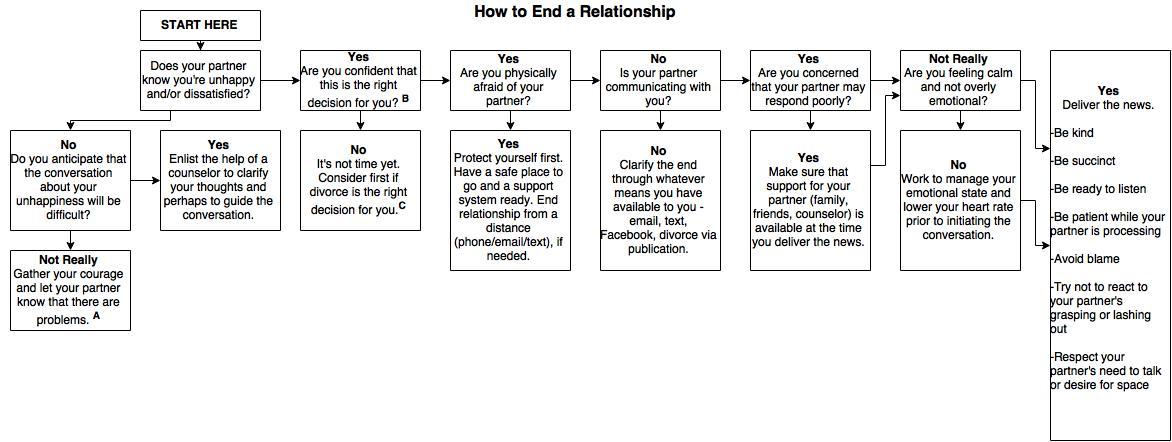
This just might be the hardest part, especially if the choice is unilateral and you believe that the decision will not be well-received.

This flowchart can help guide you in ending your marriage. .Obviously, not all possibilities are included, but it can serve as a framework for your own particular situation.

how-to-end-a-relationship.jpg

A – Use Your Words (How to Have the Difficult Conversations)

BShould You Divorce? 12 Questions to Consider

CHow to Save a Marriage in Ten Steps

Notice what is absent from this chart – ghosting, abandonment, manipulation and withdrawal. Remember you once loved this person. No matter the circumstances, there is no reason to be cruel.

Create Boundaries and Structure in Your Schedule

Divorce leaves a cavernous void in your life. Without prior planning, it can be tempting to fill it in unhealthy ways. Additionally, we tend to experience better mental health when we have some boundaries around us. The end of a marriage erases some of those lines and so it’s important to replace them with some sort of structure to keep from feeling completely unmoored.

Take advantage of this time to fill your schedule with healthy endeavors. Here are some ideas for you to consider. 

Know that no matter how much you plan, you will not be able to foresee all that divorce will entail. Regardless, some intention ahead of time can help alleviate some anxiety and can offset some of the challenges that you may face. And as you move through the next several months, keep reminding yourself that this will get easier. One day at a time.