Guest Post: Five Ways to Make Your Divorce Less Stressful

It’s taken as a given that our lives are getting more and more stressful by the day. In all honesty, it’s not hard to see why: we’re busier than we’ve ever been, the cost of living keeps rising and we’re frequently bombarded with conflicting information.

With modern life being so stressful and divorce being one of the most taxing things that we can experience, the need to destress and take care of yourself during this difficult period cannot be overstated. Failing to do so is likely to have significant and adverse long-term effect on both our physical and mental wellbeing.

Here are five things you should do to make your divorce less stressful:


  1. Stick to email

As you’re probably going to need to communicate with your spouse at some point, it’s best you do it via a medium you can easily step away from if you feel yourself starting to get angry. That’s why we recommend communicating via email until your divorce is finalised and you’re both feeling a bit calmer.

‘But text messages are easier’ you may argue and, you’d be right – but that’s the problem. As your phone is omnipresent, it’s all too easy to give in to temptation/frustration/anger and send an inflammatory message. Now, we know that you can probably send an email from your phone but the lengthier nature of these messages, coupled with the fact you’ll need to do that little bit more to send them, means you’re much more likely to come to your senses before hitting ‘send’.


  1. Allow yourself to feel how you feel

In my experience, it’s divorcees that actively fight the inevitable negative feelings that do themselves the most psychological damage. Battling against emotions that are completely natural is going to do little more than make the process of divorce harder and, ultimately, leave you feeling guilty for feeling the way you do. This, in turn, will create a very unpleasant and damaging cyclical process.

If you feel sad, angry or anything else, you have every right to – just let it be.


  1. Take advice with a pinch of salt

Sometimes, the advice you’ll receive from friends and family will be excellent, but sometimes it’ll be counter-productive, overly emotional and, well, just bad.

Sadly, all of the people who are close to you will be well-intentioned, but they’ll also often provide advice and insist you should follow a course of action without having really considered the potential consequences. Just think about that for a second and I’m sure you’ll be able to think of a time you did something similar; like when you were speaking to that friend who was considering resigning to setup a restaurant, for example. We often tend to tell our friends what we think they want to hear rather than what we actually believe to the best course of action and forgetting this can lead you to make bad decisions which could make your divorce very stressful indeed.


  1. Be aware of your needs

This can be a tough one as, often, we’re wholly unaware of what our needs are at any given time. That said, when we feel upset, stressed, anxious or any of the other negative emotions that come bundled up with a divorce, it’s worth taking a moment to see if we can determine what we need at that time.

It could be some company, your favourite meal or anything – if you’re unsure of what you need, don’t worry, just be kind to yourself and give yourself the time you need to work it out.


  1. Exercise

This is certainly the most conventional piece of advice on this list, but it’s also undoubtedly the most effective. When we feel stressed our boy releases the stress hormone cortisol and it remains in our bodies promoting negative feelings until we burn it off through physical exertion.

So, by regularly partaking in exercise, you’ll not only help your self-esteem, but will go a long way towards averting the negative emotions brought on by a divorce, too!


Author Bio:

Jay Williams has worked with divorcing individuals for more than a decade with Quickie Divorce, one of the UK’s largest providers of online divorce solutions. He lives in Cardiff with his wife and two-year-old daughter Eirys.


Diving for Pearls

There are times when Truth is important –

When my students use verified geometric theorems to prove triangles congruent.

When my husband tells me where he’s going on a Tuesday night.

When my doctor asks about my family history of cancer.


And then there are times when Truth really doesn’t matter.


A person reached out to me yesterday with the concern about their place in their former partner’s view – did they love me or did they use me?

As I sat on the bench in the gym locker room typing out a response, I was transported to a time when that same question consumed me. As the details of my husband’s other life began to surface, I couldn’t help but contrast what I was feeling at that time (loved) with what he was doing at the time (anything but loving). There was no doubt that he was acting without concern for me towards the end, but did that mean that he never cared for the entire sixteen years?

I was obsessed with answering this question. I would consider evidence in the form of memories or discovered facts and dutifully enter a mental tally mark in either the “He loved me” or the “He loved me not” column. And yet, I never seemed able to settle on a true answer. For every indication that he loved me at some time, I could find a counterclaim that I was merely a pawn in his game.

I was looking for definite proof. For Truth.

But what I really wanted was for the pain to stop.

And Truth, assuming it could even be ascertained, really didn’t matter.


I made a conscious decision to retire my search for Truth. I accepted that he had used me  in the final few years of the marriage and I chose to believe that the love I felt prior to that was real. Maybe I’m right and he did have the capacity for love until he collapsed under the pressure of shame and addiction. Or, I may be completely off base and he may have been a manipulative sociopath from the beginning.

It doesn’t matter.

The marriage is over. I don’t need this information to make any decisions in the present moment. My views don’t impact my ex one way or the other. I’m not presenting this conclusion as definitive and I’m not deceiving anyone. There are no judges evaluating the evidence for my claim and no real-world repercussions either way.

It only matters within me.

So I choose to believe the truth that brings me peace and allows me to hold onto some of the good memories instead of throwing sixteen years of my life away.


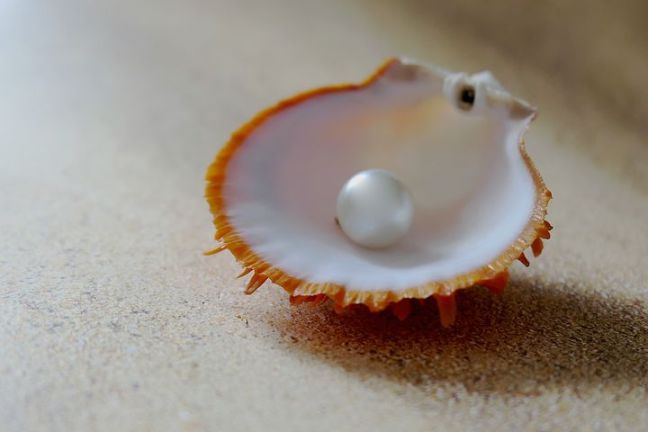
Oysters developed a resourceful strategy for handling unwanted and irritating invaders. In order to reduce the pain from a wayward grain of sand or grit, they surround the unwanted particle with smooth coating of calcium carbonate.

That’s how I see my resolution to conclude that I was once loved by him – a pearl enveloping and softening the pain.

And it may not be Truth in any real sense, but it’s real enough to me.


Was Divorce What You Expected?

When You Don’t Want to Go Home

One of the most painful sentences that I have ever been on the receiving end of was, “I didn’t want to come home.”

Those words were a cannonball to the gut, a sharp exhale followed by a tremulous and hesitant inhale.

Because home should be a place where you want to go. A sanctuary where you can recover from the bruises that the world inflicts upon you. Ideally, home is the welcoming hug. The safe space where your armament can be removed along with your shoes.

And so to be told that I was contributing to a home environment that brought dread instead of relaxed anticipation? Ouch.

And yet, I can understand this feeling of not wanting to come home. As I expect most of us can.

Relationships, even the best ones, are challenging. And there are times when having to take somebody else’s emotions and needs just feels overwhelming. Perhaps you’ve fallen into a cycle of negativity and you need some space to untangle the interactions. Or maybe you’re not feeling accepted as you are, which is ever more painful when it happens at home than in the broader world. And sometimes, we outgrow our home, the rigid shell binding when we crave expansion.

Pay attention to that feeling of not wanting to return home. What is it telling you?

In my old life, I always looked forward to coming home. Until that home transformed into an empty shell, a life’s vessel without its lifeblood. The floors echoed, sending out reminders of the years they had been traversed together. The walls seemed to taunt me, speaking of better times. I only managed one night there after he left, an endless darkness spent pacing the living room with a persistent hope that I would soon hear the garage door rumble open. The reminders proved too much for me to bear.

The next day, I escaped to a friend’s home. Which immediately became my home. One I wanted to return to at the end of each day. When it came time for me to establish my own space, I chose the apartment and its furnishings carefully in an attempt to cultivate a space that welcomed me back. Little from my old life occupied the space. It was a blank slate, ready to accept the imprint of a new life.

My home now welcomes me each day. It offers both reminders of the best times and the shared laughter and it also holds the impressions of loss and tears. It’s a place where I feel both accepted and challenged. And on those days when everything is just a little too much, it offers comfort and consolation.

Home holds so much power over us. It is where many of the best and the worst memories are formed. The most important relationships of our lives play out upon its floors. It receives our greatest hopes and dreams and sometimes surrounds us as we say our goodbyes.

It said that you can’t go home again. Yet as long as you accept that home changes with the years and you can rebuild at will, you can always find your way back.


Are You Wondering if You Tried Hard Enough to Save Your Marriage?

Have you reached the conclusion that your marriage is over yet you are still questioning your decision? Are you haunted by the thought that maybe you didn’t try hard enough to save your marriage and that you were too hasty in pronouncing it dead? Are you experiencing guilt surrounding your decision to divorce, especially as you see the ripple effect that it has on others?

I can’t reassure that you did everything you could and I also cannot tell you that there was more that you could have done. Only you know the particular culture of your marriage, the efforts you put forth and the responsiveness (or lack thereof) of your ex. But maybe I can help you find some clarity in your decision.

Just the fact that you’re stressing about your choice means that you are giving this decision the attention it merits. Your questions are a natural response to a life-altering conclusion, a sign that you take your commitments seriously and that you have empathy for the impact that your choices have on others. Furthermore, by wondering if there was more that you could have done, you’re demonstrating personal responsibility, an honorable trait.

Yet even though that questioning is a sign of consideration and character, listening to the constant barrage of “What ifs…” can drive you crazy, especially in the immediate aftermath of the split when everything seems worse than before. This constant doubt can hold you back, keeping your energy focused backwards instead of moving on from where you are.

The decision to divorce is rarely clear-cut. It’s no wonder you’re feeling confused when the waters are murky. This is especially true when you are unable to make a mutual decision about divorce, when the decision rests entirely on your shoulders. Maybe you’ve spent years trying to get your partner to engage and they continually refuse to put forth any effort in the marriage. Perhaps you’ve endured endless cutting words and psychological sabotage. Or possibly your partner is okay with a mediocre life and marriage but you desire more.

Regardless of your situation, your sphere of influence can only travel so far. You can makes changes within yourself. You can talk to your spouse about what you want your marriage to look like. You can ask for changes, suggest ideas and implement new strategies. But you also cannot do all of it alone. If you’re not satisfied with your marriage and your partner is refusing to work with you, you’re ultimately left with three choices: 1) accept the marriage and your spouse as they are, 2) stay in the marriage and continue to be unhappy and frustrated, or 3) leave.

I like to compare these choices to what happens when your bicycle breaks down:

I see the vows as like the wheels on a bicycle. Ideally, both are fully functioning and working in concert. If one tire is a little flat, the other can help support the weight for a time until the tire is re-inflated. If one wheel is bent, the ride may not be over as long as the metal is hammered back into shape. Yet if one wheel is removed, the bicycle is useless no matter how hard the remaining wheel works. And it’s time to either find a new wheel or learn how to ride a unicycle.


Here’s a painful truth – even if the decision to divorce was the right move in your case, it doesn’t mean that you’re necessarily going to feel good about it. The right thing is rarely the easy thing. And sometimes the decisions we have to make are going to result in some collateral damage. (Here are your responsibilities when making a decision that will negatively impact others.) You have to balance your needs with the desires of others.

For parents, it is impossible to separate the decision to divorce from the impact it will have on the children. You may be wondering if you should have stayed and dealt with your unhappiness quietly in order to preserve a two-parent home for your kids. Yet this is often presented as too simplistic of a choice: go and it’s bad for the kids or stay and it’s good for the kids. Both options have both potentially detrimental impacts and allow for new possibilities. Divorce is difficult for children, but so is staying in a home with fighting or constant negative energy. Make your choice and then do what you need to support your kids.

It’s common to question the decision to divorce in the year following the initial separation. This is a challenging time for everyone, a dismantling and demolition. From this vantage, it can often seem that the decision was made recklessly because the marriage doesn’t seem so bad compared to its aftermath. Be patient and compassionate with yourself during this period. This temporary struggle is not a sign about the integrity of your decision to divorce.


Some of the most difficult divorce decisions come when you still love your partner but you are unable to stay married to them for some reason. That’s a hard pill to swallow, that just because you love someone, it doesn’t necessarily mean that you’re good together. It’s true, sometimes the greatest sign of love is letting someone go. Even when the release hurts likes hell.

As you move forward with greater wisdom and self-reflection, you may indeed realize that there were things that you screwed up in your marriage. You can allow this to solidify into guilt and regret or you can accept that you did the best you could at the time and promise to not let those lessons go to waste in the future.


Related reading:

What Do You Owe Your Spouse? 

What Makes a Marriage Successful? (And Why Divorce Doesn’t Mean Failure)