Who Do You Turn To For Help With Your “Character Building Experiences?”

I recently read a synopsis of a study that demonstrated that people receive a more empathic response from someone who has not been through a particular difficult experience than from someone who had survived something similar.

photo

At first glance, it seems counterintuitive. After all, who knows how rough it is better than someone who has lived it?

But that’s not the whole story.

Because the people that have experienced the trauma have been changed by it.

And that alters not only their perception, but also their response.

Protective Amnesia vs. Unrestrained Fears

I remember trying on the idea of living without my husband a few years before he left. The exercise wasn’t prompted by anything in the relationship; I was simply reacting to the news of a coworker’s impending split by trying to put myself in her shoes.

And I couldn’t wait to take them off again. My imagination went wild and my pulse followed suit. It was her living nightmare and it was my envisaged one. I responded with nothing but, “I am so sorry” and “That has to be so scary,” using my own unrestrained fears as a bridge to her situation.

It’s different now. I’ve lived those fears. But, to be completely honest, I don’t really remember the pain in the rawest sense. I know I felt it; I can read my journals and emails and see the devastation in the pictures of me from that time. But it’s almost like it happened to someone else.

My brain has slid a protective cloth over the worst of it, softening the pain like the sun’s harsh rays through a gauzy curtain. The protective amnesia allows me to function without the sharp memory of the pain. And it also means I can easily underestimate how bad it really was and how horrible it is for someone else in a similar position.

Known Present vs. Imagined Future

When we haven’t experienced something, we have no benchmarks. No reality checks. It’s all imagination and prediction. When somebody’s character is being tested, it’s easy to use their current situation as a template for their future, assuming that the way it is is the way it will be. Face to the tree and blind to the forest.

But once we’ve been there, we see the larger picture from our vantage point above the woodland. We appreciate the struggle and yet we know that it is able to be mastered.

But when someone still has the imprint of the bark on their flesh, the last thing they want to hear is about the view from the top. And yet sometimes the message they need to hear is that there is a top somewhere above the trees.

Progression vs. Isolation of Thought

It you want a hug and commiseration, you may be better off turning to somebody who has never been through your trial. They will view your situation as it is. Isolated. You will be nurtured and they will cry along with you.

If you want reassurance that it can get better along with a kick in the pants, talk to someone who has been there. They know the progression of effort that it takes to climb out. And in many cases, they appreciate the gifts hidden within their struggle It may not feel as nice to hear their perspective, but sometimes a dose of tough love is needed.

They were once in a position where they didn’t know if they would survive.

And yet they did.

And they know you can too.

Love With a Ten-Foot Pole

When catching up with my mom’s neighbor (and member of the virtual Lisa cheering squad over the last 6 years) last month, he jokingly asked me how I managed to fall in love again.

“I assumed you would have those boys held back with a ten-foot pole. After what you’ve been through, I sure wouldn’t blame you!”

“It doesn’t work that way,” I responded. “Love from ten feet away is no love at all. Gotta go for it or decide you it’s not for you.”

Love is all or none.

If you try to hold it at a distance, you end up pushing it away.

If you attempt to control it, you will inevitably strangle it.

If you build walls and hang back out of a fear of being hurt, you are avoiding the very intimacy that is the foundation of a relationship.

If you punish your new partner for the sins of the old, you are wrapping the new in the cloak of the past.

If you assume that this partner will also hurt you, you are more likely to be hurt again. After all, the dog that you expect to bite often does.

Love is always a risk. Whether you’ve been hurt before or not.

It’s just that those of us who have felt the anguish of an end know exactly what it is we are risking.

And you may decide that it’s not for you. That you’re happier alone and don’t want the risk or the compromises again.

That’s okay. Life is not one size fits all. Tailor your life to your specifications.

But if you do decide you want to let love in, you have to be ready to embrace it. Risks and all.

That ten-foot pole may make you feel safer, but all it’s really doing is keeping love at arm’s length.

Love is all or none.

The Storm Before the Storm

Today was supposed to be the easy day. The calm before the storm of two weeks of standardized testing that begins tomorrow.

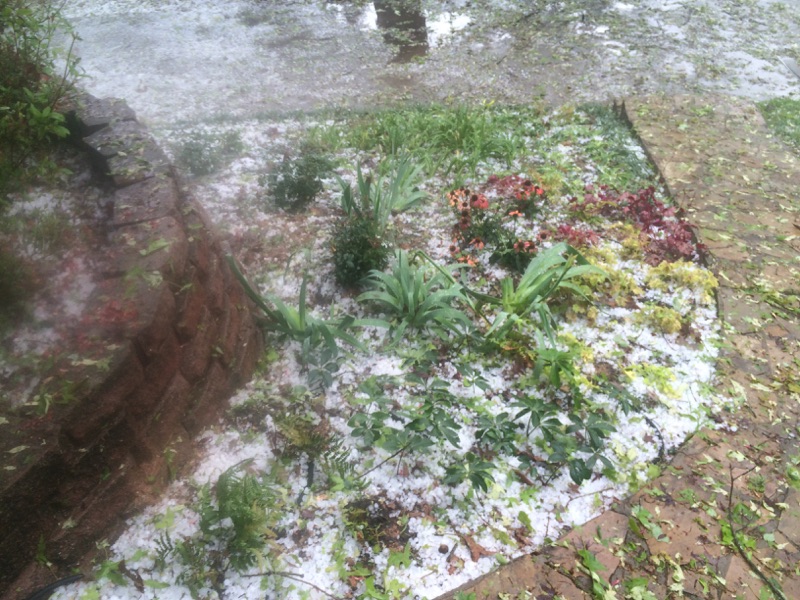
Instead, today was the storm. Literally.

Just moments after I commented on the dark clouds gathering outside to my 5th period class, the principal’s voice came over the intercom, announcing the tornado warning.

Instead of an easy afternoon, we spent over an hour trying to keep hundreds of 8th graders, lining the hallways like an endless line of two-legged dominoes,  silent and off their phones.

In between “Shushes,” I checked my phone for the most recent updates from my husband, where he was chased down to the basement due to the tornadic activity. Which happened to cross right over our area.

That's a lot of hail!
That’s a lot of hail!

It’s always crazy being the teacher in these situations. We have our own worries, but have to play it cool for the sake of the students. Or hot, in this case, as the hallways have no air conditioning.

I decided to change my warm-up for my last period class. Who says math isn't applicable to real life??
I decided to change my warm-up for my last period class. Who says math isn’t applicable to real life??

Thankfully, the husband, the dog and the house made it through the storm just fine.

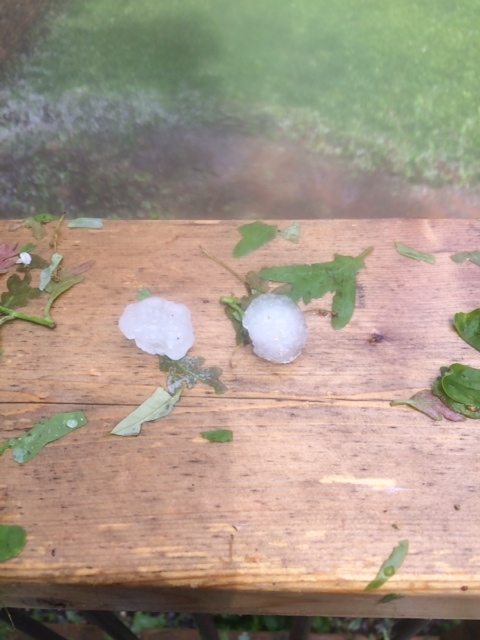
Big hail, too!
Big hail, too!

My plants?

Not so much.

It looks like my hostas have been ravaged by the world’s hungriest caterpillar!

They look like the kale after I put it in my Vitamix.

Ugh. Maybe I can convince myself it’s a reason to buy a few more this season?:)

I’m finally home and fed and squeezing my swollen calves with compression stockings.

Here’s hoping that this was the storm before the calm.

The Pace of Processing

I have this large bag above the washing machine where I store the coins rescued from pockets and removed from overflowing wallets. Every year, the bag reaches its bursting point, the hard imprints of the coinage threatening to rip apart the delicate walls.

The money is essentially worthless in this form. Pounds of pennies required in order to exchange for something of value. So every year, I haul the bag to the grocery store, where I feed the coins through a machine that turns my useless currency into crisp, worthwhile bills (minus a service fee, of course).

Every year, I fail to remember the plodding pace of the machine and I inevitably overload it with too great a volume. But the machine will not be hurried; it processes trash into treasure at its own pace. It reads each piece of input, sorting it into an appropriate pile after making note of its value. Some items it deems unable to be classified, and it spits them out for further review.

The machine works best when the coins are fed into it at a steady trickle. When the entire bag is upended, the sheer mass of the coins slows down the feed into the chute, the pathways gummed up and the limits overloaded. Regardless, the process always feels protracted to me, always taking longer than I assume it should. I grow frustrated at the delay between placing the coins on the shelf and the total being updated on the screen, which continues to change long after the last coin has disappeared into its maw.

We are not unlike that unhurried coin machine when it comes to processing our pasts and our pains.

We do best when information is fed to us in a steady stream. It gives time to fully break apart each new tidbit before facing the next.

When too much is piled on, it overwhelms the process and yet each element is attended to in its own time.

There is no rushing the exercise. It simply takes time to sort through the detritus, spitting out the garbage and finding the value in the rest.

There is often a lag between the input and the conclusion. It doesn’t mean progress isn’t happening.

It means it has its own timeline.

Be patient.

The Ex Purge: How to Break Up in the Digital Age

From the moment I came home to my husband’s cleaned-out office and a typed letter on the kitchen island, I became a certified professional level cyber stalker. I used Google Earth to get a bird’s eye view of the home he was staying in with his other wife. I learned her school and employment history. I discovered where she grew up and I even found her sister’s name. I compulsively read her blog, where I found pictures of her and mentions of my, I mean our, husband. I even had to endure a description of them showering with monkeys on a trip to Uganda shortly before the court date for the divorce. As I read about their seemingly happy travels, I couldn’t help but wish they encountered monkeys throwing poo.

Fifty years ago, if a spouse disappeared, they disappeared. There were no options for information short of hiring a private investigator. But today, we can all be P.I.s with nothing more than a phone. It’s a bit scary when so much information is available so easily.

I was obsessed. Driven. Once I started looking, I couldn’t stop. Each new image or tidbit of information made me feel ill.

But the sad part? The part that kept me going? It also gave me a thrill. Not in a good way, but in an addiction-feeding way. It was like an itch I couldn’t scratch. Chasing the dragon of information into a rabbit’s hole of social media. With each click, I felt worse and yet somehow I expected the next click to make me feel better.

But it never did.

Instead, all it did was drive my addiction for information.

I felt like I needed to know what he was doing and where he was. Part of it was learning to let go of him; for 16 years, I always knew (or at least thought I knew) where he was. It took time to adjust to no longer needing to know about his life. Part of it was driven by the divorce process; evidence of his whereabouts and activities were fed to the lawyers to bolster the case and refute his outrageous claims. And part of it was that I hoping to find some sign that he was not happy. That he regretted his decision. I wanted some sign that he missed me.

And I never did.

I knew that this obsession wasn’t healthy. I could feel the itch growing stronger with each scratch, worrying the wounds open and allowing them to fester. In the weeks leading up to court date, the behavior grew along with my anxiety about the possibility of seeing him again and of the outcome of the court’s decisions. I was consumed and it was eating me alive.

So I decided to fight back. I set a date – March 12, the day after the court appearance – as the last time I would ever look for information on him again. On that morning, still riding high from the relief of the conclusion of the legal process, I checked the wife’s blog one more time. She didn’t mention her husband’s divorce. I wasn’t surprised. I closed the window, cleared the search memory on my computer and packed away all of the papers around my desk that held the results of my searches. It felt a little scary, cutting that last tie. But I felt in control again.

I was done; I would never look again.

And I stuck to it, resisting the urge even when I learned information from a television producer that made it sound as though he had new charges pending. I didn’t dig when Jeff Probst informed me about the felony warrant. And I didn’t even think about talking to Google when I saw him two years ago at a local festival.

It was a complete and total ban. A self-imposed safe-search filter that has no work-around.

Want to institute a similar ban yourself? Here are some suggestions:

Be Firm

This is no time for moderation. Facebook posts are not like food; you can survive without them. This is all or none. Commit to none.

Put It In Writing

Write down your conviction. It helps to make it more real and makes it a little more difficult for your brain to try to justify “just one click.” In the beginning, make sure a written version of your ban is visible. You can even change your wallpaper on your devices to a reminder to stay safely away from that rabbit hole.

Dig Into the Why

Explore, preferably in writing, why you feel the need to view these pictures and read this information. What do you gain from it? How does it make you feel?

Enlist Others

It’s difficult not to turn to your preferred search engine when you hear a tantalizing piece of gossip from somebody about your ex. So, ask them to help you stay clean. Explain what you’re doing (and maybe add a dash of why you’re doing it) and request that they not pass along any information to you.

Watch the Precursors

Be mindful of the times and/or situations that make you more prone to initiating a search. Is it when you’re lonely? Bored? Facing an anniversary? Prepare a change of venue or activity ahead of time that can be implemented during those dangerous times. For example, I knew that I was more inclined to look when I was feeling anxious. So, I would go for a run (sans phone) whenever my nerves were singing.

Understand the Limitations

Social media is a Photoshopped version of real life. You’re seeing what people want you to see; not the reality of the totality of their lives. When you are concluding that your ex is over the moon because of a particularly sappy photo, you’re doing the same thing as a teenage girl comparing herself to an edited supermodel. It’s not real. Don’t spend your days contrasting your real life with a fantasy.

Verbalize Your Urges

When you feel the urge to look, say it out loud. Yes, you’ll feel silly. That’s partly the point. When you verbalize your drive, you are pulling it into your conscious mind where you have more control over what you do with it.

Remove the Triggers

Clear your history. Unfriend as needed. Remove associated reminders from your surroundings. Do everything you can to avoid seeing anything that opens that door.

Plan Alternatives

Sometimes the drive to look becomes so powerful that it demands action. So have an alternative lined up. What will you do when the pull becomes too great to resist?

Use Technology

There are countless apps and programs that deny you access to your social media accounts for a set period of time. These can be useful when you’re feeling particularly vulnerable.

Create a Virtual Hug

Surround yourself with images from your life that make you feel happy and hopeful.

Prepare for Slip-Ups

You may fall off the wagon. That’s okay. Plan ahead to make sure you don’t stay off. If you start looking, set a timer. When it goes off, you’re done. After a cyber-stalking binge, go on a technology diet, restricting your access until you feel at peace again. Have a “sponsor” at the ready, a friend who knows of your plan and is supportive. Reach out when you need to borrow somebody else’s will power.

Like with anything, removing your ex from your digital life becomes easier with time. And as the urges fade, it’s replaced with peace. You no longer what he or she is up to. And you no longer care.

Because you’re too busy creating your life.

Related: What Happens to the Ones Who Leave?

farewell-20196_1280