The Mistake You May Be Making With Your Divorce Pain

“Why am I still hurting so badly?” the email implores of me, the writer speaking of her ten-year-old divorce.

As I read her message that details her divorce and her continued and prolonged sadness, I found myself thinking about how the modern western world handles death.

Before the rise of the modern medical and funeral industries, death was truly a family affair. Most people died at home, where there bodies were then washed and dressed by their loved ones. This intimate experience provided an opportunity for the survivors to come to terms with the loss and to grieve together. Denial or avoidance of the reality was simply not an option; there was too much to do.

Death has now become sanitized. Distanced. We have the ability to turn away when it becomes too much. We can keep the discomfort at arm’s length while we fill our minds with no shortage of distractions. By avoiding the grief, we prolong the grief.

And we’ve gotten quite adept at avoiding pain.

Not only when it comes to death, but also when it comes to divorce.

At first, it seems ideal to try to give the pain a wide berth. After all, we’re often advised, “If it hurts, don’t do it.” But sometimes that detour around the discomfort is an endless path and the only way out is through the thick of the heartbreak. Here, let me guide you.

How to Deal With the Pain From Divorce


When you continually avoid the pain, every time you feel the agony, it’s as raw as the first time.


Whenever I have an open day off work, I like to go to a Korean sauna across town. The wet area of the facility has a variety of pools ranging from hot to cold. Verycold. When I first lower my body into the frigid water, I gasp and then stop breathing as my body is shocked into silence. The cold slices through my skin and my panicking brain begs for me to leave.

Sometimes I listen to the alarm in my mind and I quickly exit the pool, where I immediately warm up again. Of course then, if I decide to reenter the pool, I have to start from scratch, beginning with the initial pain of the icy waters.

Other times, I am able to stay in the water. I focus on my breathing – slow deep inhale, pause, slow full exhale – until the screaming in my brain finally quiets. And as I hold my body still, a strange thing begins to happen. The shock and discomfort of the cold begins to recede and is instead replaced by a sense of calm surrender.

Emotional pain is no different. If you strive to avoid the discomfort, you inadvertently expose yourself to the initial trauma time and time again. However, with prolonged exposure, you begin to acclimate to the grief. You begin to trust that even though it is terrible, it is not fatal. You learn how to focus on loosening the bindings around your heart so that you can allow your breath in and in doing so, begin to calm the mind.

If you’re struggling to stay with emotional pain, start by training yourself to tolerate physical discomfort. Try hot yoga, distance running or even an ice cold bath. Let the body begin to teach the mind.

Recognize the power that you’re giving the pain when you constantly strive to avoid it.  We seek to turn away from pain because we fear it, yet maybe what we should really fear is the denial of a natural and ultimately, illuminating, emotion.

When you repeatedly tell your story, you move from character to narrator.


When trauma first happens, people are often compelled to tell their story, with all its gory details, to anyone who will listen (or at least pretend to listen). This early telling is emotional. A re-experiencing where the body punctuates each word with its visceral memories of the pain.

And in time, this drive to recite the story fades. And often at this point, people pack up their memories and lock them away in some dark recess of the mind. Yet in doing so, they’re missing a powerful healing opportunity.

Researchhas revealed that the power of EMDR, a type of therapy that uses eye movements to help neutralize trauma, is not in the specialized actions, but in the continual recounting of the difficult experience in a safe and supportive environment. With repeated exposure, the person gains a little more distance from the pain and even begins to feel some power over it as they begin to shape the narrative structure around their memories.

Another way to practice retelling your story until you gain some space is through the use of journaling. Write your experience. Take a slightly different viewpoint and write it again. Try expressing it in third person. As you expose yourself to the pain repeatedly, it loses its power over you.

Healing from intense pain is like suturing a deep wound.


I remember being so raw. Emotionally guuted and bleeding tears. Yet life continued and I was needed. So I managed to tuck the pain inside for most of the days so that I could function in the world. And to many, I probably appeared fine. But the wound was only closed on the surface. The real healing was happening beneath.

The care for an emotional wound is not unlike a physical one. Let it breath. You may need to keep it covered while you’re at work or when you have to put on a brave face for the kids. But when it’s safe, take off the bandage and let the fresh air in.

Keep the wound clean to avoid festering. Sometimes you have to remove debris that is impeding healing. And it will sting. But that pain is necessary to keep you healthy.

Don’t poke at it. Differentiate between pain that is helpful (exploring your response to a trigger) and unneeded agony (checking your ex’s Facebook every day).

And like a physical wound, once the injury has already occurred, the offending object that caused the damage is no longer of consequence. Only the healing matters.

Don’t wait until you are healed to begin living. There are smiles to be found amongst the tears.


Part of dealing with the pain is being with the pain. But that’s not the whole story. Because even though you hurt right now, you are not only the hurt. Pain does not restrict you to a waiting room while life passes you by. It’s okay to keep living even while you still ache. After all, smiles and tears can often be found together.


The Importance of Choosing Your Tribe

Even in the best of times, the need to belong is a powerful force. And in the worst of times? There is nothing more important than finding your tribe.

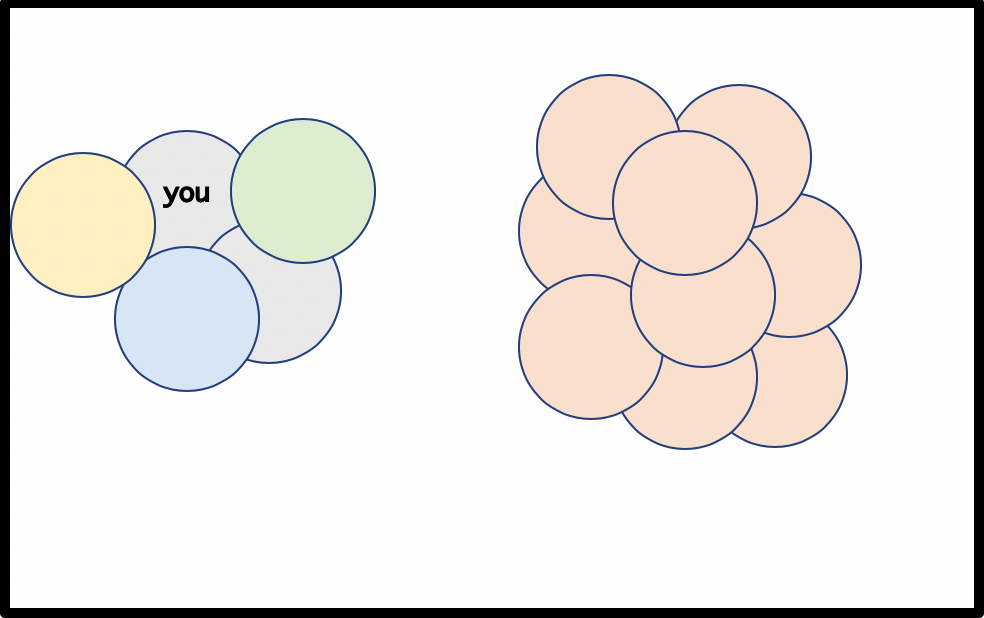
When something tragic happens, it often leaves us feeling like this –

We feel isolated. Alone. It’s as though pain has its own language and nobody else speaks that tongue.

And then one day, either by chance or from actively searching, you find this –

And it feels amazing. You’re not alone after all. Somebody else knows the words that pain whispers through the long nights.

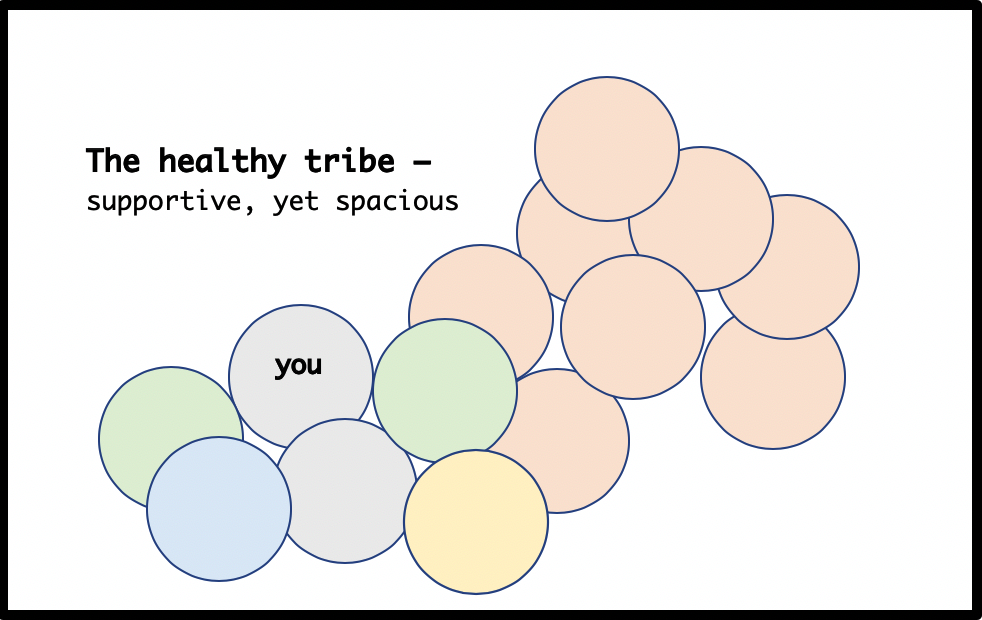
Over time, you meet more. “I’ve found my people. My tribe,” you think to yourself, enjoying the much-needed connection and solidarity. Some are further along in their journey. Others, like you, are still taking their first shaky steps.

You feel supported. Accepted. Instead of your pain making you an outcast, it is now your admission ticket to the new club. “You’re one of us,” it says.

tribe

In a healthy tribe, the members offer up both encouragement and tough truths. They come together out of shared pain, but more importantly, they grow together out of a desire to move through the hard times. The connections strengthen the individuals while at the same time, allowing each person the space and freedom to explore their own path, accepting the idea that life is not one-size-fits-all.

tribe

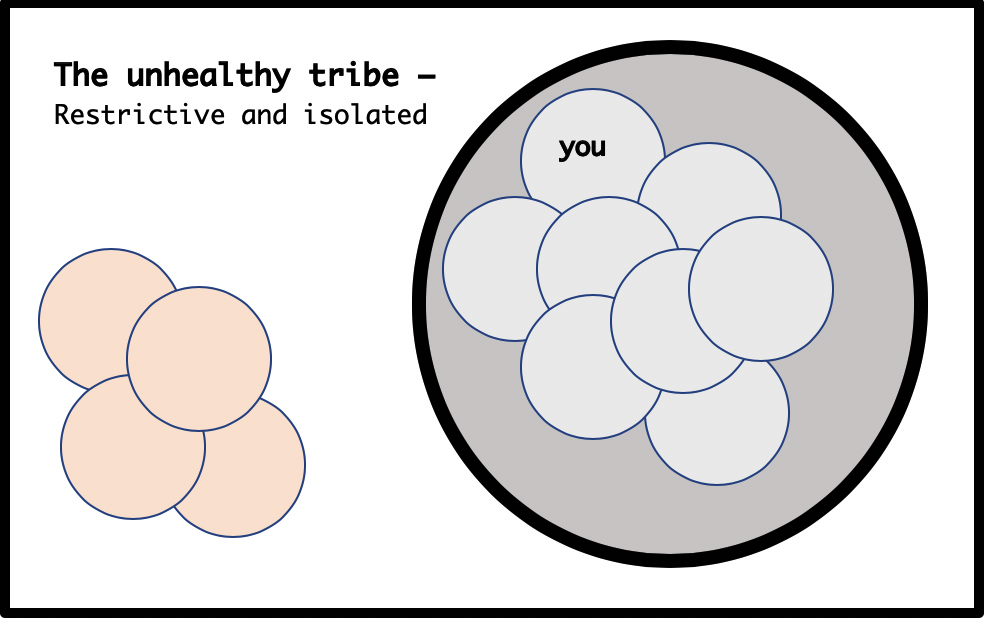
Yet sometimes, a poorly-chosen tribe can hold us back. Misery loves company, so when we’re in pain, we have a tendency to attract more pain. So it’s easy for a tribe to become focused on what brought the members together and amplify each other’s cries within the closed-off space. Furthermore, an unhealthy tribe feels threatened by progress so the group works to create an “us vs. them” culture to keeps its members contained.

tribe

There are few decisions more important in life than choosing your tribe. Since we become the people we spend the most time with, your tribe becomes your identity.

Before you choose your tribe, ask yourself these questions:

  • Are they focused on destruction or creation? In other words, are their energies directed towards tearing other people down or building each other up?
  • What is their goal – progress or commiseration? The latter has its place, but it’s generally not a space you want to occupy for the long run.
  • How do they view dissent or individual growth? Are you encouraged to speak your truth and explore your path or are you expected to toe the line?
  • When you spend time with your tribe, do you feel encouraged or defeated? Do they provide you with hope and promise or fill you with dread?

One of the best feelings in the world is the joy and connection that comes from finding your tribe. Choose wisely, and your tribe will be your greatest champion.

9 Reasons to Jump Back Into Dating After Divorce (And 9 Reasons to Take it Slow)

“Are you dating after divorce yet? I might know someone…” asks your coworker as you share the elevator on Monday morning.

“You’re dating already! Are you sure you’re ready?” questions your friend after hearing your breathless tale of the other night.

“You know,” announces your mom on your weekly phone call, “It’s not too late for you to find someone new. You’ve got to get back out there.”

“You don’t want to rush into anything,” cautions your therapist when you mention that you signed up for a dating site.

The messages we get about when to start dating again after divorce are confusing and often conflicting. And that friction doesn’t only come from outside voices, it also comes from within as we question ourselves and our motivations.

The decision about when to start dating again is a personal one. You can listen to your coworkers, your friends, your family and your professional support system, but ultimately the choice is yours to make.

9 Reasons to Jump Back Into Dating After Divorce (And 9 Reasons to Take it Slow)

I took an enormous swan dive off the high board into the dating pool after my tsunami divorce.

Within six months of my ex disappearing with only a text message, I signed up for Match and went on an average of 8 dates a week. It sounds crazy now. And it was crazy then.

Looking back from the vantage point of being happily remarried many years later, here are some of the pros and cons of jumping back into the dating pool after divorce:

Pro: Distraction

There’s no way to sugarcoat it. Divorce sucks. And it is certainly much more enjoyable to meet somebody for a night on the town than to spend yet another night in your empty home.  The excitement of meeting new people goes a long way towards distracting your brain from your current – and possibly sucky – situation.

Con: Delayed Healing

However, too much distraction only acts to delay the healing process after divorce. Those feelings are there for a reason and they won’t disappear until you face them and process them. You have to grieve the loss of one love before you’re ready for a new love.

Feelings are like a vampire. If you try to bury them, they only come back to bite you.

Pro: A Reminder That You Can Love and Be Loved

With any divorce, but especially those that include betrayal or abandonment, the self-esteem takes a huge beating. And dating is like a salve applied to those wounds. It feels good (and a relief!) to be desired again, to be courted again.

Con: Looking For Love in All the Wrong Places

It feels good to be wanted by others, but it’s no substitute for finding love for yourself. One of the biggest lessons in divorce is how to truly get back in touch with you. Don’t let anybody get in your way.

If you seek validation outside of yourself, it’s never enough. If you find validation inside of yourself, it’s always enough.

Pro: Social Companionship

Once you’re back on the dating scene, a “plus one” box on an invitation is no longer something to sweat about. You have those experiences and pictures to share on social media, sending the message to the world (or at least the part of it that matters to you) that you’re still alive and kicking.

Con: Impact on the Former Spouse and the Kids

It is hard for anybody to see their ex moving on. When you enter the dating scene quickly, you’re sending the message to your ex that you’ve moved on from them and your marriage and that they are easy to replace. A similar message may be received by any children, especially if they witness you dating.

We all have baggage. It’s how you carry it that matters.


Pro: Meet New and Interesting People 

When you’re married, your social circle tends to tighten. Dating provides you with an opportunity to meet new people and open your mind to new ways of thinking, especially if you approach it with a sense of curiosity.

Con: It’s Easy to Compare to Your Ex

When your pillowcase still smells of your ex’s cologne, it’s difficult not to analyze the metrics between your ex and your new date. Over time, it becomes easier to see (and appreciate) each person for who they are and not how they compare.

Sometimes the heart is the first to get the message. And the last to let it go.


Pro: Helps to Alleviate Pain 

Dating is an analgesic for the wounded heart. It pumps you full of feel-good hormones: raising serotonin that plummeted with divorce, supplying oxytocin that promotes bonding and adding a dash of dopamine to keep you wanting more.

Con: The Pain May Only Be Delayed

People are often surprised at the intensity of the pain felt when a relatively short-term fling ends after divorce. In fact, the pain can often be greater than that of a long-term marriage ending. Part of this is delayed and referred pain resurfacing and another part is because the new relationship was based more on hopes and wishes than reality.

Don’t simply weather the storm. Learn to harness its power.

Pro: Dating Fills Your Calendar

When your married, much of your calendar is filled with family-related activities. Divorce leaves a void. And dating can easily fill that void, replacing those empty days with something to do.

Con: Takes Time Away From Other Things

One of the hidden gifts in divorce is the opportunity to reestablish relationships with friends and family that took a back seat to your marriage. Or, it can be a time to reinvigorate a prior passion that your spouse or situation didn’t support. Dating can steal time away from those meaningful endeavors.

Life’s low tides allow time to appreciate the beauty hidden beneath the surface.


Pro: Create a Connection

One of the most pressing human needs is the desire to be understood and accepted. Dating create that opportunity. Even with the shortened timeline, you may find somebody that you are compatible with for the long haul.

Con: You May Expect Too Much Too Soon

Surprisingly, it can be lonelier to be on a date than to be by yourself. Once you’ve been in a long-term relationship, you’ve grown accustomed to a certain level of intimacy. And that takes time to build, sometimes leaving a sense of frustration and isolation.

Relationships are formed, not found.


Pro: Fun and Excitement

Dating invites excitement, whether it’s attending a concert together, visiting an escape room or even a stolen weekend away. It’s like a carnival for the older crowd.

Con: It’s Expensive

Obviously, dating is expensive no matter how long you wait after your divorce to do it. But if you jump too soon, you may be struggling to pay your attorney’s fees because of your dinner tab.

My heart was broken, not my spirit.

Pro: You May Be Rescued 

Sometimes life does parallel a rom-com. Maybe you find somebody that will pay off your debts, wipe your tears and make you forget that your divorce ever happened.

Con: You May Be Used

The ugly truth about rescuers is that need to feel needed. Often at your expense. If you’re attracting white knights and enablers, you are probably sending signals that you’re broken. Is that what you want?

I don’t want a knight in shining armor. I want a man that fights by my side.

Ultimately, only you know if you’re ready to start dating again. Here are some questions you may want to consider first:

Are you jumping into dating in order to avoid your feelings?

Are you hoping to provoke a jealous response in your ex?

Are you still involved in the legal divorce process? How will dating impact that?

Are you open and honest with your dates (and yourself!) about your recent divorce and healing status?

Are you looking for your date to be your confidant or your counselor?

Are you trying to fill an ex-shaped void or looking to meet new people?

Are you realistic about the chances of a date soon after divorce turning into a long-term relationship?

In my case, my enormous swan dive off the high board into the dating pool paid off. I’m about to celebrate my third wedding anniversary with one of the first men I met on Match. It wasn’t an easy road; he had to be patient and understanding with me while I undertook some of the necessary healing that had not yet had time to occur.

Date when you’re ready. Stay anchored in reality. Be open and honest with yourself and others. And above all, have fun and seek to bring fun to others. After all,

The end of a marriage does not mean the end of love.

Playing Make-Believe With Your Healing Progress

“I just want to be healed already!” I said out loud to myself once I closed the car door. I had just finished a Sunday afternoon run where I was caught off guard by tears that came uninvited. Feeling defeated, I let the sobs overtake me as I slumped over the steering wheel. “Great,” I thought, “I was a failure as a wife and now I’m failing as a divorcee.”

A mere hour later, showered and presentable, I responded to a friend’s inquiry about my well-being.

“I’m doing great actually. I barely even think about it.”

Of course, that wasn’t really accurate. I said it because I so desperately wanted it to be true.

To some extent, I think we all play make-believe with our own healing progress at some points. Whether driven by internal motivators or because we fear external judgments, we pretend to be further along than we actually are.

So why do we pretend to be over it when we’re still in the thick of it?

We pretend to be healed because we want to leave it all behind us.

We know that when we’re going through hell, we’re supposed to keep going. But the temptation is strong to try to simply close the door on that hell and pretend as though it never happened. We tire of being known as “the divorcing one,” we groan whenever the lawyer’s missives intrude and more than anything, we just want life to be normal again.

We pretend to be healed because we feel pressure to move on from others.

In the beginning, the sympathy and concern pour forth with abandon. And then the empathic and inquisitive words begin to wane until they are all-but absent. Our pain, so prominent and attended-to int he beginning, has been tossed aside like yesterday’s news. It’s not that others no longer care, it’s that either they have reached compassion fatigue or they are unaware of how long it can take to heal.

We pretend to be healed because we are impatient with the healing process.

Healing from divorce is a marathon. No, scratch that. It’s an ultramarathon. It goes on and on and on. And every time you think you’re over it, the finish line seems to have moved just a little bit further away. All of that is not even taking into account the Chutes and Ladders nature of healing, where every arduous climb can seemingly be undone in an instant.

How to Be Patient With a Procrastinating Healing Process

We pretend to be healed because we feel ashamed for still struggling so much.

“It’s been five years and I’m still really struggling,” the voice whispers to me over the phone on an introductory coaching call. Unspoken, but evident behind those words was, “I’m ashamed that I’m still struggling so much after all this time.” A shame that had led this particular person to pretend to be “over it” with everyone around them. It was only to themselves on the long nights – and now to me – that they could admit that healing was still ongoing.

We pretend to be healed so that we can adhere to some prescribed timeline.

We have a tendency to put too much importance on anniversaries – assuming that as soon as some arbitrary date rolls around, we will have magically shed our pain. You wait for that date with anticipation, as though it’s a graduation and you will receive your freedom. And then when the day passes and the relief hasn’t come, you decide to simply pretend that diploma stating your completion of healing.

Healing does not speak calendar.

Lisa Arends

What’s the problem with pretending to be healed?

When we don’t give ourselves the space or the time to heal, we risk stalling or even complicating the process. Much like with a wound to the flesh, ignoring it or sealing it in without first washing it out can lead to a larger problem than the initial injury.

Furthermore, when we are playing make-believe, we are preventing others from being able to render aide and we are closing ourselves off from receiving help. It can be scary to admit that you’re not okay. But often the only way to get there is by first admitting that you’re not.

There are no “shoulds” when it comes to healing. You’ll get there on your own path and on your timeline. Be patient enough to take the time you need. Be brave enough to speak your truth. And be humble enough to admit when you need help.

6 Powerful Ways to Create Your Own Closure After Divorce

closure divorce

I was seeking closure within hours of the unexpected text my husband sent informing me that he was leaving. Feeling powerless at the lack of communication and information, I sat in front of the fire pit feeding photos, notes and letters into the hungry flames.

I hoped that the ritual would help me find acceptance that it was over.

But my pursuit for closure had only just begun.

—–

Months before walking out on me, my husband ended a job. He gave them two weeks notice, had a sit-down meeting with the owners where he explained his reasons for leaving and he maintained open lines of communication so that business matters could be transferred smoothly.

I received none of that courtesy. And for the better part of a year, I fixated on that fact, convinced that I needed him to provide explanations and even excuses that would allow me to close the door on our marriage.

I became obsessed with understanding the “why” behind the marital explosion, certain in my belief that this was key to moving on. I played around with labels –  narcissist, sociopath, addict – in a bid for understanding. But none of those designations brought peace.

I was frustrated. Furious, actually. I felt as though he had stolen my voice by sneaking out without contact and that he carried my chances for closure with him. It was the heartbreak that kept on giving.

Finally, I grew tired of the snipe hunt for closure as the legal proceedings wound down without any real answers or resolution and he continued to act as though our marriage had never happened.

And so I shifted my focus, putting my energy into me instead of funneling it into the black hole that he had become.

And the strangest thing happened.

I found peace.

And isn’t that what we really mean by closure?

Closure is an acceptance of what has happened, a sense of power over ones own well-being and a feeling of moving on.

And none of those require the participation of the other person.

You have everything you need to create your own closure. Here’s how –

  1. Understand the Limitations of Explanations

It’s easy to get caught up in the belief that as soon as you receive an apology, you’ll be able to move on. Or that once you hear that you were the love of their lives, you can let go. Be honest with yourself. Is thereanythingthat they can say that will erase the pain? Are there any words powerful enough to bring everything to an emotionless close? The words you seek are the ones you need to hear, not the ones that they need to say. Once you accept the limitations of any explanations that your former spouse can give you, it’s easier to move on without them.

You Don’t Need to Understand in Order to Move On

  1. Find or Create Meaning

We naturally seek to find order and purpose in our surroundings. And so when something, such as divorce, is discordant, it causes pain and confusion. Look within the ruins of your marriage for some hidden gifts. Maybe you now have an opportunity to move back to the city that always felt like home. Perhaps you’re finally getting in touch with who you are. Or it could be that this rock-bottom is turning out to be an impressive foundation for a new and improved you. If nothing is immediately evident, create purpose in your post-divorce life. When something has meaning, it’s easier to accept the changes that had to place to get there.

  1. Write the Letter You Want to Read

I know this sounds strange, but I promise it is one of the most powerful exercises you can do. Write a letter from your ex-partner to you, saying all of those things that you need to hear before you can move on. Don’t censor yourself, allow the words to flow and probably the tears too. And once it’s written, read the letter. And then read it again. Keep reading it until you believe the words within. After all, what you’re looking for is really just proof that you were loved, that you will be remembered and that you are worthy of love again. And you don’t need anybody else to tell you that.

Powerful Ways to Use Journaling After Divorce

  1. Start Your Next Chapter

Life isn’t like a book; you can start the next chapter even while you’re still wrapping up the one before. Don’t fall into the trap of waiting to live until you’re healed. Invest your energy into your life and allow the healing to happen alongside. A big part of closure is releasing some of the pain from the past. And a great way to lessen pain is to focus on cultivating joy.

  1. Don’t Obsess About Closure

Are you stalking your ex’s Facebook page in a quest to see them looking miserable? Are you endlessly dissecting the end of your marriage looking for explanations and reasons? Are you giving the detritus from your marriage more power than it deserves, destroying pictures and hiding trinkets? This obsession with finding closure will only serve to delay it. Closure comes from living in the present, not from being consumed by the past. If you’re struggling with this, try instituting boundaries – delete social media accounts, have a plan for distraction when your mind wanders into dangerous territory and redecorate your space to create a clean slate.

  1. Don’t Take it Personally


I eventually realized that my own roadblock to finding closure was that I was taking my ex’s actions personally. He not only did these things, but I was convinced he did them to me. Because of me. Over time, I started to understand that I was just collateral damage in his own battles, not a target to be obliterated. And that was a powerful realization. When it’s no longer about you, it’s much easier to let go and to move on.

You have the power to flip the sign on the past to “closed” as you step powerfully into your new life.

And on the other side, here are three times where you shouldn’t seek closure.