The Only Ones

I visited with a friend and her I-can’t-believe-she’s-almost-six-years-old daughter, Kayla, yesterday. Kayla is at that stage where her time and experiences outside the family unit are becoming greater than her time with her parents. And so, like every curious kid at that juncture, she is starting to compare her situation and family with others. And her conclusion is that her mommy and daddy are mean to her sometimes. Just like every other six year old on the planet.

But perhaps Kayla is struggling with it a little more than some. Not because her parents are meaner (in fact, they are both amazing at being the parent that their daughter needs), but because Kayla is an only child.

As an only child myself, I never would have realized this connection on my own, but my friend, who has two siblings herself, explored this with me yesterday.

“For Kayla, there are two sets of rules in the house: what mommy and daddy are allowed to do (whatever they want from a kid’s view!) and what Kayla is allowed to do. When I was growing up, there were also two sets of rules: what my parents could do and what the kids could do.”

I immediately understood what she was saying, “So you didn’t take it personally when you had boundaries or were told ‘no.’ It wasn’t because it was you, it was because you fell into the category of ‘kid.’ Whereas for your daughter, even though her limits are because of her age, it’s easy for her to assume they are because she is ‘Kayla.'”

I felt a mental gear click into place.

It’s no wonder in relationships that we all too often take our partner’s words and actions personally. After all, in most cases, we are the only one that falls into the category of “spouse.” So we assume that the rejection or the betrayal or the neglect is because of us, who we are at our core, when it’s often because of the role we play and the position we occupy.

So next time you find yourself upset at somebody’s actions that you perceive as being directed, take a moment to think about little Kayla.

Is it happening because of who you are or is it happening because of the category you occupy?

Related:

Just Because It Happened To You, Does Not Mean It Happened Because of You

That Exasperating Dress

Don’t worry. I’m not going to post a picture of it. Or even enter the debate about what color it is. If you’re anything like me, by late morning yesterday, you were ready to scream anytime you caught a glimpse of that picture (or one of its thousands of farcical spin-offs) or anytime someone mentioned a particular color combination.

If you have no idea what I’m talking about, I’m pretty sure that any search engine in the next couple days will be happy to show you a picture if you simply enter, “dress.” Fair warning – I’m not responsible for what happens. Once you’ve seen it, you’ll never be the same again.

I saw internet conversations go from confusion and curiosity into all-out rage wars. Even amongst my usually polite and educated friends. I witnessed screaming matches between middle-schoolers as they all waved their phones in others’ faces. And I’m sure that somewhere within the reach of this dress, words turned to fisticuffs over the debate.

From a scientific standpoint, I find the situation interesting. It speaks to the importance of lighting in how we see images and it reveals differences in our visual processing.

From a psychological standpoint, I find the situation fascinating. Look at how threatened people become when their truth is called into question.

Even when it’s about nothing of consequence.

I spent the day avoiding the dress and seeking out the responses. I soon noticed people fell into two camps: they either quickly began to question themselves and their own perceptions or they vehemently denied that the opposing view had any merit and insisted that their perception was the correct one (often gathering “evidence” to support their claim). And to be fair, there was a third group. Most definitely in the minority, and not nearly as verbose as the others, there were a few people I encountered that truly seemed not to care one way or another.

That first group is comprised of the group-thinkers. They are aware and receptive to the ideas of others. They respond with empathy and are willing to reconsider their own viewpoints if evidence points to the contrary. Taken too far, and these are the martyrs and enablers that will subjugate themselves at the will of another.

The second group are the game-changers. They are stubborn and can effectively communicate and enforce an idea. These are the people that are not afraid to stand alone as long as they stand for what they believe in. And sometimes, as in the case with every new invention or scientific theory, they’re right. Yet if this trait gets out of control, these are the ones that turn into bullies or narcissists, unconcerned about others and unwilling to reflect upon their own beliefs.

And that third group? They’re just going to quietly do their own thing no matter what scuffle the others engage in.

It’s just a dress. And an ugly one at that.

But often the smallest things contain the biggest truths.

Breaking Up the Band

I would love to meet the person (people?) responsible for selecting and purchasing books for my local library. The diversity of the selection completely mystifies me – something that seems fairly standard and popular isn’t available in a downloadable form (here’s looking at you, Malcolm Gladwell) while books that seem relatively obscure and of a limited appeal (an account of stealing a moon rock) seem to populate my options. Along with a seemingly endless supply of bodice-rippers. Really, do we need that many bodices?

But sometimes, I happen to fall into the demographic that does have an interest in a particular topic and I’m surprised and delighted by a book’s inclusion in my selections.  Most recently, this happened with Dave Mustaine’s (the intelligent and often aggressive frontman of the heavy metal band, Megadeth)  autobiography.

The book served as a welcome diversion on a snow day and provided some background information on one of my favorite bands.

Like most bands that spread multiple decades, Megadeth has had its share of personnel changes. And as I was reading about the dismissal of various band members over years, I realized something –

Bands break up for the same reasons marriages do.

Ego

Sometimes the members have to consider the needs of the group over their own desires. Some people struggle with this.

Money

Disagreements flare over how money is earned and how it is shared. To some people, it’s everything and to others, it’s a means to an end.

Addiction

Drugs, alcohol or some other activity dominate a member’s world and impede their ability to function as a cohesive and contributing part of the whole.

Different Goals

One person may want to take on the world while another is content to enjoy life on the small stage.

Infidelity

Attentions are diverted from the group to a side project. Conflict and hard feelings ensue.

Different Styles

One person plays fast and the other, slow. One plays in the established grooves of the past while another strives to make his or her own road.

Commitment Levels

Session musicians are in it for the short term while the songwriter feels a strong devotion to the group.

Outside Influence

People from outside the group have too much say over what happens within the group.

I guess people are people, whether they are a married suburban couple with 2.5 kids or a tattooed and long-haired thrash metal band.

And for the record, there were no bodices ripped in the making of this post.

How to Change a Man

I met up with a friend the other day. She’s at a crossroads with the man she’s been dating for the past year or so. She wants marriage. Not now, but she wants to move that direction and wants that to be the mutual end goal. At this point, he states he does not want marriage. Now or at any point. They’re in that difficult place where the relationship works, but the objectives of the partnership don’t align.

Having known Brock back in the days when he said he never wanted to be married, she inquired, “How did you get him to change?”

The short answer?

I didn’t.

And I couldn’t. At least not in any meaningful and lasting way.

I didn’t make him change. I didn’t ask him to change. I didn’t expect him to change.

But here’s what I did do:

I Accepted Where We Were

I always knew I wanted to be married (or at least something like it) again. But that didn’t mean I wanted to jump straight into commitment immediately. In fact, Brock was always the forerunner on taking the relationship to the next level.  And we baby-stepped it from one level to the next. And as we slowly integrated our lives and tore down our walls, I simply enjoyed the place where we were.

I Accepted Him

As with any relationship, as the newness wears off and the pedestal lowers, you discover certain traits and characteristics of your partner that drive you a little nuts. Since none of his quirks were red flags or deal breakers, I worked on accepting them. In fact, I’ve even learned to appreciate some of what can easily annoy me.

I Limited Expectations

I knew that our relationship may not progress to marriage. And I was okay with that. I had no expectations of a wedding or a white picket fence. I simply knew that I loved him and loved being with him. And that the time together wasn’t wasted even if it didn’t result in nuptials. Besides, I had learned about the dangers of expectations:)

I Didn’t Push

I never initiated a “where are we going?”talk. In fact, the only relationship-oriented talks we had were about where we were, making sure that we were on the same page along the way. I was patient as he learned how to be in a serious relationship and, later on, learned how to share a home and a life. I gave him time and space to acclimate.

I Worked on Myself

Whenever I found myself frustrated or disappointed by something in the relationship, I made an effort to examine my own responses (which, no surprise, were often overreactions). I learned that by changing my reactions, I could change the dynamics of our interactions.

And over time, the man that never thought he would be married, not only decided that he did, he also became an amazing and dedicated husband.

But the most important part wasn’t what I did.

It’s what we did.

Because everything that I did that compelled him to change, he also did for me. In spades.

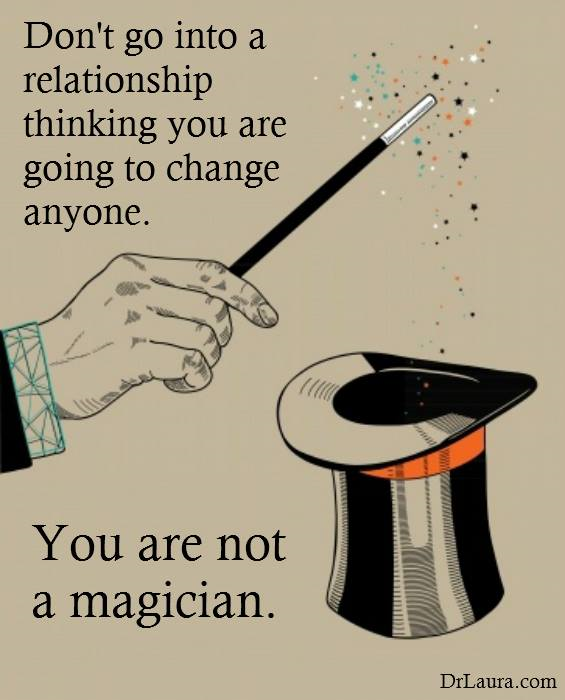
You cannot ever change your partner.

But you can be someone that inspires them to change themselves.

Because ultimately, the only guaranteed way to change a man (or a woman) is to change yourself.

2015/02/img_4385-1.png

Divorce Leaves a Residue

My ex husband’s parents were smokers. Entering their house always felt like walking into a parking garage on a warm and still day, the smoke forming clouds along the ceiling and tendriled wisps climbing the walls. The rooms felt dark as the haze filtered the sunlight and the once-white ceilings felt oppressive with their tar-stained varnish.

My ex used to seal his room from the smoke, employing towels and blankets in an effort to barricade his belongings against the nicotine attack. And, while he was there, we thought it was a successful endeavor. After all, compared to the rest of the house, his room smelled clean and his furniture looked unadulterated.

Until it came time to move. We pulled his sofa, that we had intended to use in our first apartment, into the garage. Hopeful, we peeled off the sheet that had been covering the fabric. We were horrified. Not only did the couch smell like the upholstery in a pool hall, the exposed surfaces were stained brown in contrast with the untanned underbellies of the cushions.

And no matter how hard we scrubbed, the stains and the smell would not fully release. There was a residue left behind.

We left that tarnished sofa behind that day and spent money we didn’t have on an unsullied replica from Montgomery Ward, determined to start our lives together fresh unburdened from the remains of the past.


In a moment of unedited honesty the other day, Brock turned to me and said, “Sometimes I wish you would give up writing about all of this and it wouldn’t be a part of your life anymore.”

And sometimes I wish that too.

That I could have escaped from the past with no residue, as clean and unspoiled as that new sofa. Because the truth is that divorce leaves a residue. A film that no matter how hard you scrub, you can never fully remove. It’s not something that disappears just because you take yourself out of the environment. It resists fading and clings tenaciously to every roughed-over surface.

You can try to cover the damage, hiding it beneath a slipcover of smiling perfection. You can scrub at it until your hands are raw and your the very fabric of your being becomes worn and thin. You can perceive the disfigurement as terminal, and live your life as an abandoned piece of furniture cast off in an unheated garage.

Or, you can see the stains as battle scars. Signs of a life once lived and a love once loved. You can learn how to find peace with the residue, viewing it as the reminder of your past while weaving into the fabric of your future.

Divorce leaves a residue.

And what you do with it is up to you.