A Thank-You Note to Winter Storm Jonas

Dear Jonas –

I was mad at you on Thursday. You see, your predecessor prompted school to release early on Wednesday without much prior warning. The resulting exhaustion from trying to convince excited kids to engage in math instruction and stress from reworking lesson plans had me a bit raw.

And then you showed up. And it was unclear if you were a serious threat or a mere annoyance for Atlanta. And I don’t like uncertainty.

My blood pressure was elevated Thursday night as I obsessively refreshed the website listing school closures. I planned and replanned lessons in my head for every forseeable situation – normal school, half-day with these periods, half-day with those periods and no school but online learning. All with the goal of trying to stay on schedule for the planned test day.

Eventually, I collapsed into a fitful sleep while still awaiting news. The anxious planning followed me into my sleep and caused me to awake just after three.

Apparently the powers-that-be had decided that you were threatening enough that the children should be kept inside. I immediately went to my computer and spent the next hour writing and posting my online lessons.

And once I was done, the anxiety was done as well.

The unknown was now known.

Friday passed without incident. I enjoyed a morning treadmill run before my office hours. I indulged in a weekday lunch with my husband at our favorite Indian buffet. I relished the individual attention I could give to students without interruption via various forms of electronic communication. And I was appreciative that I didn’t have to navigate the streets as the temperature continued to drop.

I awoke Saturday morning to a light coating of ice and snow on the world, the frosting on the cake. The roads were largely unaffected so I merely postponed my grocery run until full daylight.

And that’s when it happened.

The snow, stopped since before I woke up, began to fall in earnest. Whipped by the wind into great swaths of ever-changing forms. I was driving down the road surrounded by the most graceful and fluid dancers, who followed me all the way to the store.

Breath-taking beauty.

So Jonas, thank you. Thank you for that moment that reminded me to be in the moment. Thank you for the lesson about releasing my need to control (I’m afraid I’ll probably need more – I’m in the remedial group on that one!). Thank you for the reminder that my worries easily grow too big for their britches and that I can trust myself to perform even without an abundance of rehearsal.

And thank you for having a bark that’s worse than your bite in Georgia. I enjoyed the snow and I’m glad it’s now gone. As for what you’ve done further north, I doubt you’ll be getting thank-you letters from them. Except maybe from the kids who are getting out of math class:)

 

How to Remove a Mindworm

mindworm

Much like earworms are snippets of a song that refuses to vacate your auditory processing center, mindworms are remnants of thoughts that stubbornly replay through your brain. It’s not only annoying; it’s maladaptive. The stuttering brain becomes stuck on a particular thought and is unable to move on to the next or be receptive to new ideas.

Mindworms are tenacious little buggers. They like to hide when you focus on them too intently only to start their slithering once you allow yourself to relax. They may go quiet for hours or even days at a time, prompting a false sense of security, before making themselves heard once again.

Although not fatal, mindworms are parasites that remove some of our lifeforce. If allowed to wander for too long, they hold their host back from optimal health and wellness.

There are no quick fixes for the removal of mindworms. The development of a vaccine has stalled and post-infection medications often come with pretty severe side-effects. If you find yourself the unwitting host to a mindworm that has overstayed its welcome, try the following:

Exercise: Mindworms feed on cortisol, so anything you do to lower the amount of stress hormone coursing through your body will make the environment less pleasing to them. This isn’t the time for a lackadaisical workout, either. Lift heavy, run fast or take a class that pushes you. After the session, you should feel drained and your mind should feel blessedly empty.

Art: Sometimes mindworms stay around because they have something they want to say. Now, unfortunately, they’re not very direct when it comes to expressing their needs. The best way to listen to a mindworm is to act as a medium, allowing yourself to channel the mindworm’s ideas into a creative application. Once the pastel or brush is in your hand, sit back and let the mindworm go.

Music: Although genetically related, earworms and mindworms do not make happy bedfellows (perhaps because they both demand to be the center of attention). So invite an earworm in. It’s best if you surround yourself with the music of your choosing. Car stereos on the highway seem to be particularly effective, especially if you sing along.

Gum: No, really. Perhaps it’s the rhythmic movement of the jaw or the addition of another foreign object in the head, but gum seems to act as a mindworm deterrent. This is a great strategy to use when you’re busy. After all, you can’t exactly start bench-pressing the conference table in a meeting or blast Metallica at your child’s soccer game, but you can slip in a piece of gum.

Write: Mindworms are a bit narcissistic. They think their message is the most important thing ever. So indulge them. Publish their words in your journal. And then put your own spin on it. You see, mindworms are good at starting a story, but they’re famous for leaving off the conclusion, which makes their tales endlessly cycle. So create your own ending when you write.

Mindfulness Walk: Mindworms are resistant to traditional meditation techniques. In fact, they can easily turn your om moment into a wrestling match. It works better to sneak up on them with your mindfulness. Thus the walk. A mindfulness walk starts with an intention. For example, you can decide to focus on all of the doors in the neighborhood, or on everything that is the color red or on all of the sounds. Then, one foot in front of the other while gently refocusing the mind on the intended target.

These techniques are not only effective for removing a mindworm infestation, they also seem to have a preventative effect. So, make sure to visit them often in order to keep your mind free of these pesky parasites.

Curiosity Cap

Do you ever approach a new situation with the assumption it is going to be terrible?

Perhaps it’s the biting cold of your first winter run. Or the inaugural road trip with a young child. Or a medical procedure that carries the expectation of pain.

The potential list is endless; we greet new experiences with a suitcase full of expectation expressed as worries or complaints.

About something we’ve never done.

We anticipate the discomfort. The annoyances. The pain.

And by doing so, we prime the pump for reality to bear out our assumptions.

Helping to ensure that the anticipated awfulness comes to be.

There is a different way.

Put down that suitcase of expectations and put on that cap of curiosity.

My curiosity cap. And a reminder not to take things too seriously.

After all, this is something you haven’t experienced before, right? Or, even if you’ve done it prior, there are some variables that have been manipulated so that it is no longer the same event.

So rather than lead with a conclusion of full-on suckitude, approach with a sense of curiosity.

I wonder how the cold air is going to feel on my lungs.

It will be interesting to see how the baby responds to travel.

I’m intrigued to see what it feels like to have my body repaired.

And yes, you may find that it is terrible.

But you also leave the door open for the discovery that it’s not.

Are You a Reliable Witness?

When I was in 5th grade, I was in a gifted pull-out program. Two days a week, I got to miss my afternoon classes in order to tackle challenges and puzzles that were outside the state-mandated curriculum.

One afternoon, we were all working hard at our tables on a set of brain teasers we had been given. We barely glanced up as a woman entered the classroom, spoke with our teacher for a few moments and then left.

It just didn’t seem important. After all, our task was to complete the puzzles.

Except it wasn’t.

Twenty minutes later, our teacher revealed the true purpose of the day’s lesson. She admitted the brain teasers had merely been a diversion as she handed out a sheet of paper with, what seemed at first glance, deceptively easy questions.

We worked independently to complete the page, answering questions about the woman who entered our room less than an hour prior: What was she wearing? What did her hair look like? What was she carrying?

As I glanced around the room, I noticed that all the students (myself included) seemed confident in their answers. After all, how hard is it to describe someone you just saw?

Pretty hard, as it turns out.

We came together to share our answers. It got rather heated.

“She had brown, curly hair.”

“No, it was blond.”

“It was brown, but it was straight.”

“Her hands were empty.”

“She was carrying books.”

As we continued to debate, some started to doubt their memories and allowed their minds to shift.

“I thought her shirt was red but, now that you mention it, I think it was yellow.”

The more we analyzed our memories, the more they changed.

The closer we looked, the more blurred the focus.

The woman had gone from inconsequential to significant as we all clambered to be right.

Finally, our teacher turned to the classroom door, opened it and welcomed the woman back in.

None of us had described her correctly.

We went on to discuss the use of witnesses in criminal trials and debated the ethics of sentences being handed down based upon the recollection of a bystander.

And I went on to always remember that lesson. To understand that we really aren’t as aware as we think we are and that when we’re called to remember, we fill in the gaps unconsciously.

And many years later, I found comfort in that lesson. I realized that my painful memories were malleable. That I could consciously fill in the gaps between remembrances to find meaning and purpose.

That at some point, memories fail to be an accurate representation of the past because they are always filtered through the knowledge of the present.

That it’s important to keep your mind open to the perceptions of others.

And that none of us are reliable witnesses to the past.

But it doesn’t matter.

Because it’s more important to be mindful and here in your now.

So that you are a reliable witness to your present.

Prepare For the Worst, Expect the Best and Live For Today

The people of Alaska absolutely captivated me.

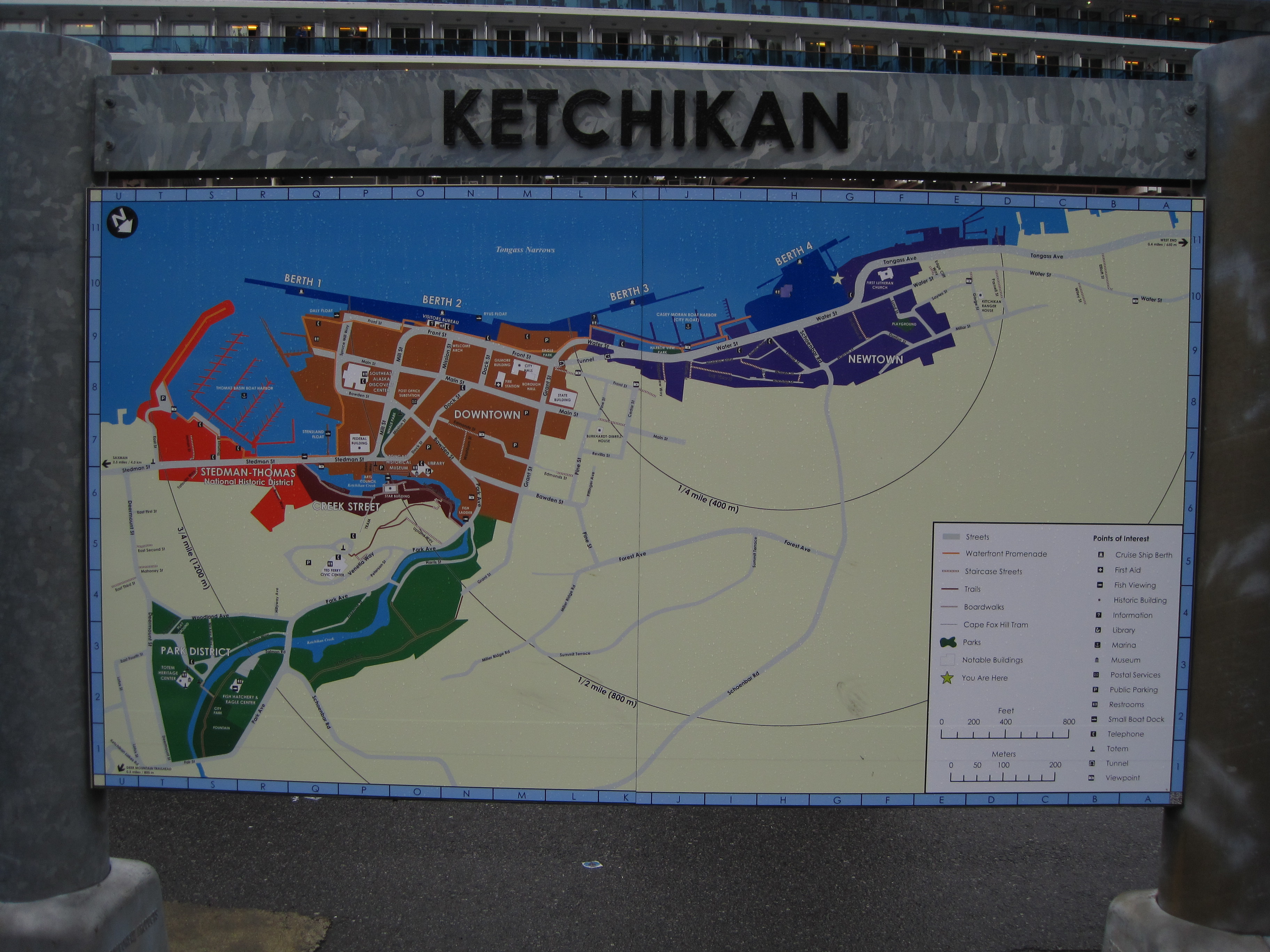
And nowhere was this more true than in Ketchikan, a town of around 8,000 people pressed between the towering mountains of the Tongass Forest on one side and the frigid waters of the Tongass Narrows on the other. Like many Alaskan cities, Ketchikan is only accessible by plane or boat. There are no airports in the actual city of Ketchikan; you must either utilize one of the countless floatplanes or land on Gravina Island and take a ferry across the inside passage into town (this is the site of the proposed “Bridge to Nowhere“).

Our first glimpse of the city from the ship.

At first glance, Ketchikan may resemble many other quaint coastal towns that survive off fishing and tourism.

Pretty small!
Pretty small!

But this isn’t any quaint coastal town. Although the temperate rainforest location helps to moderate the temperatures, this is no pleasure island; an everyday stroll can turn into a fight for survival at any moment. The winds fly through nearby Nichols Passage at hurricane forces through much of the winter months, forcing residents to hunker down and stranding them from any potential way out. The sun never stays long and is usually only visible through the ever-shifting layers of clouds. The forest is untamed and the wildlife is not safely tucked away in some zoo.

Survival is a way of life here.

But it’s not a way of living.

One of the benefits of taking this trip with my extroverted husband is that he engaged in conversation with everybody. We learned that one of the employees for Ketchikan Outdoors was brought there by her mom in middle school and now, as a college student in the lower forty-eight, returns to Alaska in the summer for work. She told us about the transition from a middle school with 1,000 students to one with 200 and the need to take a ferry for any interscholastic sports competitions. We met the owner of the excursion company, who first saw the city on a cruise and made the decision to move there after a second visit where he fell in love with a woman as well as the town. Our guide decided to call Ketchikan home after experiencing its raw and powerful beauty. And our server that afternoon was born and raised in the small town and, after a brief stint away, felt called back home.

Creek Street
Creek Street

Each of these residents spoke in glowing terms about their community. Yet they also remained firmly anchored in reality; life in Ketchikan can be hard.

So they prepare for the worst.

Every 7th grader is required to undergo survival training and complete a survival hike. The 8th graders have to demonstrate their survival skills with an overnight island stay with minimal supplies. Residents carry survival gear in the colder months for even a short trip into town, realizing that the weather turns on a quarter dime in SE Alaska. Nothing is taken for granted as winter approaches, supplies and food gathered and stored.

Full survival gear. Hard to believe I was in a bikini the day before!

Yet they expect the best.

It would be easy to become fatalistic about death here; it takes far too many before their time. Yet even though tragedy is a constant threat, the people of Ketchikan possess a limitless spirit of hope and teamwork. We heard one story of a small fishing boat crashing within sight of the city. The stranded boaters immediately went into survival mode and one was spotted in a tree by a little British lady on her Zodiac excursion. The weather may have bested them, but they had faith in themselves and their community.

The rocks were covered with seals and eagles.

And they live for today.

I think I understand what is so captivating about Ketchikan – it is a place of acceptance and living in the moment. The shifting clouds change the views from each second to the next. The eagles swoop past in a flash and the whales peek through the waves. It’s a place that refuses to be tamed, to be controlled and molded into some imagined ideal.

A bald eagle grabbing a fish just feet in front of us!

Because it is perfect just as it is.

Although I think I’ll limit my visits to the summer months:)

If you ever find yourself in Ketchikan (and I hope you do!), I strongly recommend the Zodiac boat tours by Ketchikan Outdoors. They are a great group of people who run a great operation. We were the envy of our cruise ship!