“If you can’t say anything nice, don’t say anything at all.”
We’ve all heard that wisdom. Advice handed down by a parent or teacher, perhaps in response to unkind words we uttered or as a reminder that we don’t have to share every thought that crosses our minds.
And much of the time, that advise is indeed wise. It’s usually better to scroll past an inflammatory post on social media than to attempt to engage. There is no reason to share your annoyances about your coworker with them (as an aside, I am so happy that the singular “they” is now accepted!!!! no more him/her nonsense!!!). And even in a relationship, biting one’s tongue is a critical skill to develop.
Yet, as is so often the case in life, this advice is written in black and white, while we live in a world of gray.
Sometimes there are things that need to be said. Things that may not be nice.
Another truism guides us here –
“Before you speak, ask yourself: Is it true? Is it necessary? Is it kind?”
And that’s where I often mess up.
Not by saying things.
But by holding them back. Letting them build. Until they erupt, small bits of truth simmered until burnt in emotions and assumptions.
It’s an error in identifying what words are necessary. An error that leads to a muddling of truth and an unintentional dash of unkindness as the initial feelings are allowed to go to rot.
Recently, I’ve made an effort to identify the reasons why I have a tendency to bite my tongue until it bleeds:
Introversion
As an introvert, I tend to process silently (or in writing), only speaking once I’ve had time to think about something. It means I’m not prone to impulsive comments or saying something that is only half-thought out, but it does mean that I can give the impression that I’m complacent when I’m really trying to think about what to say.
Analytical Nature
I naturally tend to analyze (every)things. That combined with an independent streak means that I try to solve the puzzle of my emotions on my own. My brain naturally gathers and examines data points, only sharing the conclusions once they are reached. Unfortunately, the conclusions are often not valid.
I Want to Be Liked
I don’t want to be a bother. A nag. I want to ride the waves rather than make them. As a result, I will often swallow my distress instead of voicing it. Choosing to make myself ill in an attempt to preserve others. Yeah, there’s a little ugly martyrdom there.
Even though my triggers are better, the fear of abandonment can still cause me to flood with emotion, shutting down all hope of rational thought for a time. And when I’m flooded, I tend to retreat. Shut down.
—–
I used to avoid expressing my feelings out of a fear of confrontation. A worry that displeasure would immediately translate to rejection.
I’ve come a long way on that fear, no longer nervous about speaking up.
And I thought that was enough. That courage to speak meant that I would speak when needed.
And I’m having to accept that there is more to it than that. And that even though I’m no longer afraid, I’m still not where I want to be.
I need to learn to get better at identifying what emotions are merely the death throws of a dying trigger (and are best ignored) and which ones are the cries of an injured heart (and need expressing).
I need to get better at not allowing my analytical brain to create spreadsheets of data without at least alerting the other that there is processing going on.
I need to get better at speaking up instead of building up.
At sharing my truth before biting my tongue for so long that we both end up bloody and raw.
The concept of this show fascinates me. It’s taking the concept of arranged marriage, adding the knowledge and support of psychologists and relationship experts and applying the mixture on modern singles who, by the very fact they are willing to take this risk, may not be very traditional. The show’s participants first must submit to hours of interviews and psychological tests in addition to a home visit before they are even considered. Then, when the producers have their potential partners narrowed down, the experts (a psychologist, a sexologist and a spiritual advisor) sift through the candidates in order to determine which ones would make good matches.
Not for a date.
Or even to live on an island together for a month.
But for a marriage.
A legally binding, til death do us part promise, delivered to a person they have never met.
Yikes.
Now, of course this is sensational. And extreme for most of us. But it’s also a very interesting social experiment that has some surprising elements of wisdom that we can all learn from.
Even good people may not make good spouses
It’s interesting to hear the experts debate about the candidates. They each have their own particular insight into personalities and insecurities. And they frequently will classify a person as a really good guy/gal, but pass them by because they are doubtful of their ability to make a good spouse.
There is a difference between being a good person and being a good partner. And that’s an important distinction to be aware of, whether you’re in the role of the good-person-but-not-relationship-ready or you’ve fallen for a good person who is missing key elements of relationship readiness. Sometimes good people need to be good and single, at least for now. And that’s okay.
There’s no such thing as a perfect match
As the experts solidify the matches, they point out areas where the proposed couple may struggle. And that’s after a pool of thousands has been scrutinized, analyzed and organized.
Because when you bring together two imperfect people, you’re going to have an imperfect union.
The participants are counseled before they commit to the experience that their match will not be utopian. And that’s a good conviction to start a marriage with. Because when you don’t lead with the expectation of perfection, you’re less likely to run away at the first sign of disharmony.
Marriage requires sustained effort
The participants go in with the assumption that they’re going to have to work at building a relationship with the stranger-spouse. Whereas, in a typical marriage, we go in with the assumption that the work (dating, etc.) is already done. There’s a dangerous belief out there which states that marriage should not require work and that one that makes demands of effort is somehow lacking in authenticity.
Either those that perpetuate that myth have never been married to a person with their own beliefs and opinions or they misunderstand the definition of work. Because marriage absolutely requires work – mental or physical effort expended with the intention of achieving a desired purpose or result. And if you don’t work at it, it won’t work for you.
Let your support system support you
The participants in the show may have to deal with the endless cameras and individual interviews, but they are lucky in one regard – they have support and a lot of it. Most of us are not fortunate enough to be surrounded by a team of professionals that are all rooting for our marriage.
Yet even though we don’t have the budget of television, we can all choose to surround ourselves with people that support us AND believe in our marriage. The people we encircle our marriage with are almost as important as the person we choose to marry.
Attraction can grow
Some of the matched pairs display an immediate attraction. But most approach their spouse for what he or she is – a stranger. Neither compelling or repealing, but simply an unknown that they are about to pledge their commitment to. But those that agree to this experiment all have a powerful belief that attraction can grow and be cultivated.
Not convinced? Have you ever felt attraction fade due to inattention or a focus on the negative? Why would this only run in a single direction? Whatever you nurture, grows. Rather than gazing over the fence, water your own grass and grow the attraction in your marriage.
Let’s talk about sex BEFORE we talk about marriage
I applaud the inclusion of an expert in sex and intimacy on the show. Sex is important in a marriage and while any amount or type of sex is variable and up for debate, the spouses’ agreement on it is not. As with anything, it is easy to lead with assumptions and shame about sex – “This is what I like, so it must also be what my partner likes.” “The amount of sex I want is normal and anybody who wants more or less is either sex-addicted or frigid.” “I’m uncomfortable talking about sex, but it’s just the act that matters, right?” “Sex is a sign of a healthy relationship.” “A relationship must be healthy before sex can take place.”
Of course, the couples in the show don’t have the opportunity to discuss sexual needs, desires and hang-ups before the marriage. So the experts do it for them. They are careful to avoid pairing someone with more puritanical views with a person who is more passionate and adventurous. For the rest of us, we have to do that talking ourselves. And yes, it is important to talk. Because the added hormones at the beginning of a relationship can hide a lot of incompatibility.
Commit to the marriage separate from the person
On the best days, you will be committed to your marriage AND to your spouse. But they’re not all best days. In fact, some of the days of the marriage will be awful. And those are the days to be even more resolute in your commitment. Not to your partner (especially if you can’t even look at them without growling at the moment), but to the marriage.
And that’s exactly what the participants in the show do. They’ve committed to the marriage (and yes, to the show) before they ever pledged their loyalty to a particular spouse. And there’s real value in that. As long as the spouse is not abusive, let your commitment to the marriage be the glue that keeps you together through the hard times.
Focus on fixing yourself and getting to know your partner
It’s so easy to focus on your partner’s flaws and to pronounce that everything would be better if he or she would simply change. Yet in the show, that option is rarely there since the spouses know next-to-nothing about each other. Instead, they (with the encouragement of the support professionals), work to address their own issues and insecurities while making an effort to get to know their partner. They’re a little less likely to lay blame at the feet of the other.
Those duel processes – improving yourself and listening to your partner without assumptions – are ongoing. People are dynamic. Marriages are dynamic. If you stay static, you’ll miss the magic.
At the end of the show, some spouses do call it quits and decide to divorce. But others see the potential and the progress and elect to stay married.
And at the end of the day, marriage is more about the hundreds of commitments made every day than the single big vow on the wedding day.
It can be quite painful when you sense that your partner is pulling away or retreating within. It’s easy to climb the panic ladder, following a trail of assumptions that determine that the withdrawal is a sign of a fatal condition.
And yes, withdrawal is a sign. A sign that something is unbalanced in your partner’s world and he or she is attempting to reinstate equilibrium. And that’s often an inside job.
So what’s your role when your partner withdraws? What actions are better avoided and which ones will render aid to the situation at hand?
———-
Don’t take it personally.
When somebody pulls away, it’s natural to jump to the conclusion that they’re pulling away from you. Yet that’s often not the case. In fact, here are 7 reasons that people withdraw in relationships. And many of those have nothing to do with the relationship at all.
And yes, maybe this particular withdrawal does originate from the relationship or perhaps it is a sign of a negative pattern of communication. But nothing good can come from reaching that conclusion prematurely.
Don’t smother.
My childhood dog was a free spirit, a wild child that always viewed an open door or loose dirt beneath a fence line as an opportunity for adventure. The first few times she escaped, I would run after her in desperation.
Which only made her run harder.
Eventually, I learned to sit still and she would often come to me.
When we are afraid of losing something (or someone), we often respond by grasping. When we feel suffocated by something (or someone), we often respond by running.
Don’t withdraw.
It can be painful to feel a distance between you and partner. Lonely. Isolating. And some respond to this pain by retreating inward themselves. And yes, it can feel safer behind that door. But two locked doors are more difficult to breach than one.
Don’t obsess.
Don’t provide sanctuary for a mindworm that feeds upon your fears. Your cyclical thoughts only serve to make you miserable; they offer nothing in the form of resolution or peace.
Don’t enable.
If your partner is making poor choices or refusing to seek assistance when it is obviously necessary, refrain from enabling those behaviors. Think tough love. Not sacrificial love.
You’re in a tough spot. A position of helplessness and alienation. So be kind to yourself. Step up the self-care. Rally the supporters. Seek connection and reassurance from safe sources. Never allow one person to determine your worth.
Do seek an explanation.
You deserve to know what is going on. It may be that your partner does not have the words or ability to understand his or her own actions yet. You may need to be patient while being persistent that it is their responsibility to dig into the root causes of the behavior. And just how patient you will be is up to you (see boundaries).
Do be introspective.
While your partner is dealing with his or her own stuff, take an opportunity to examine your own thoughts and beliefs. I often see spouses giving up when their partner refuses to participate in couple’s counseling. When often, this is a great time to seek help by yourself, for yourself. It is a great time to examine patterns and assumptions that you may carry that impact your relationship.
Do offer support.
You and your partner are a team. And team members step up when one is taken down.
———-
Remember that you cannot control another’s actions, only your response. You cannot force your partner to come out of hibernation. But you can decide how you will survive the winter.
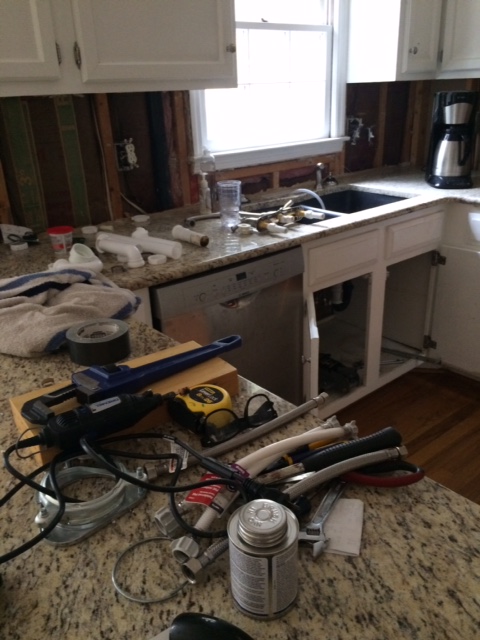
Of course if I was a plumber, I would a) be getting paid to deal with this BS and b) it wouldn’t be my kitchen going on four days without water.
Beautiful new counters underneath a pile of not-the-right-size plumbing parts.
I’m convinced that plumbing is the most contemptible of all of the home improvement projects. It’s not complicated – connect this to that in such a way that fluid flows freely and leaks are eliminated. The problem comes when apparent malevolent spirits installed the original pipework (glued PVC connector on the drain pipe? Really?) and plumbing manufactures seem to find glee in both creating an infinite number of connector styles and failing to design (or, in the case of the big boxes, stock) products that meet customer’s needs.
I’ve only given in once and hired a plumber. And that was after 5 hours in the freezing dark with my then-husband trying to attach a new water line to the house after the blue poly finally gave up the ghost in the dead of winter. It’s such a difficult expense to justify when the elusive part is always promised at the next trip to the hardware store.
Which always seems to result in one more item then needing to be returned.
As well as one more test for your marriage.
Any decently-sized home improvement project has the ability to challenge your marriage in the following ways. Even if you break down and hire a plumber.
1 – Money, Money, Money Down the Drain (Assuming You Have One Installed!)
I think we’ve managed to spend $100 a day at Home Depot over the past week. And that’s just on the little bits and pieces that make the big-ticket stuff work. Add to that the increased cost of prepared foods or eating out and of course, the cost of the cabinet refacing and counter top and it gets scary. Hey, maybe I can turn my kitchen into a haunted house and charge entry – it may not scare the kids, but I bet the parents will be petrified 🙂
Spending money while stretching a budget can be stressful. And that can become even more difficult when you have one partner with champagne tastes while the other is carefully watching the wine cooler budget.
But even, as in our case, when you agree on the decisions, watching the money wash away is stressful. It’s important to communicate fully about your fears and work together to decide how far the budget can be stretched. It’s a lot easier to tolerate the expense when you’re working as a team.
2 – Managing Frustration Without Biting Off Your Spouse’s Head
Home improvement projects are always a roller coaster. They begin with hope and the tantalizing freebies of sample swatches and Pintrest pictures. Then comes the first reality check when you begin to associate a budget and a timeline with your desires.
And then there are the inevitable and numerous setbacks. I can’t even begin to tell you how many times Brock has had to say, “I have bad news” over the last week.
And the project is still in its early stages.
It’s impossible to not be affected by the bad news, but it is so important to work to manage that frustration without gearing up for a fight with your partner. The fact that the bolt they’re trying to attach doesn’t fit is not a personal failing. Don’t treat it as one.
And the best way to deal with frustration? Humor.
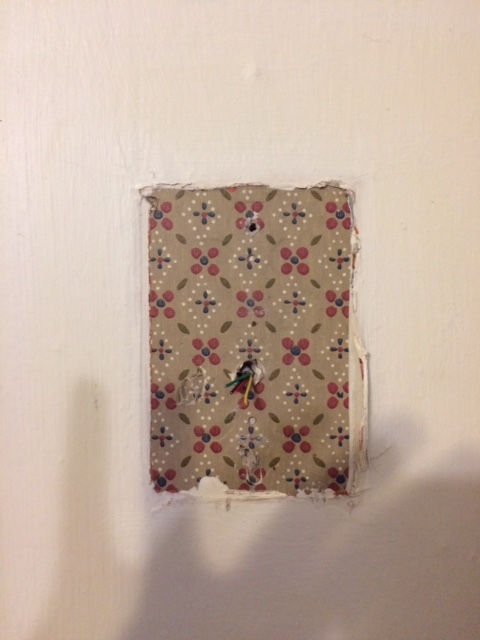
A hint of kitchen past once hidden behind a phone jack. We joked about removing all the paint and restoring the wallpaper to its old glory:)
3 – Flexibility Demands Even Greater Than Those Required by Yoga
It’s funny how you much you can learn about someone by watching how they handle disorder. Once I emptied the bottom cabinets, I declared the kitchen pretty much closed until the implements were returned.
Brock, on the other hand, simply dug through the kitchen items in the other rooms, found what he needed and set to making spaghetti.
Proof positive that he is the more flexible one when it comes to home environment.
I’m still learning:)
4 – Coping With Change and a Dearth Of Coffee
I’m used to moving through my early morning routine driven by pure muscle memory and habit. I can make the coffee and my breakfast with no thought and little attention.
But now all of that has changed. Making coffee now requires a trip to the bathroom and a small cup to use as an intermediary to fill the pot. In order to dispose of the old grounds, I have to first find the small compost bucket, which seems to enjoy playing hide and seek with the other items we are constantly looking for. And for now, the used mugs are sitting unwashed while we work on getting the water running again.
Ugh.
Change is hard. And change in your home with your spouse is harder still. Be patient with each other as you’re working through new patterns and new habits. It will smooth out. Eventually.
5 – Lack of Personal Space or Please Get Your Elbow Out of My Ear
Our home is not small but the available footprint has decidedly shrunk now that the kitchen cupboards have vomited their contents into the dining and living rooms. And the kitchen itself? It’s like playing hopscotch on a moving ship.
And it’s not only the intrusion of stuff where it doesn’t belong that lends to a sense of claustrophobia. It’s also the close – very close – proximity you have to be in with your spouse while engaged in exasperating or tedious labor that seems to strive to reach Twister proportions.
I’m pretty sure my elbow did end up in my husband’s ear last night as we were both crammed under the kitchen sink. Tiger sat nearby, looking upset that he wasn’t invited to what he saw as a cuddle party.
Anytime space is at a premium, tempers can more easily flare. Douse them with good music, good laughter and a favorite home improvement beverage.
6 – Learning Your Partner’s “Home Improvement” Language
Love language, smudge language. We all know what is really important in a marriage is learning your partner’s home improvement language.
“Can you hand me that wrench thingie over there?”
I glance over there and see a total of five wrench thingies, none of which seem appropriate for the task at hand.
“The one that looks kind of like the old channel locks but newer.”
Turning my gaze, I spotted the needed implement at a different over there.
Part of learning you partner’s home improvement language is learning their vocabulary.
But that’s only the beginning.
In order to be fluent, you also have to know their strengths and weaknesses. Their skills and when it is best to pretend that the power tools aren’t working.
It’s pretty cool that on this project, Brock and I were able to divvy up tasks by strengths with little conversation. We both know that he is going to be the one to deal with the contractors and make sure that stuff gets done even when there are hiccups and I’ll be the one to paint the ceilings and find the new storage items. You know, the ones that go over there.
7 – Admittance of Wrongdoing and Acceptance That Watching HGTV Does Not Make You An Expert
“I need help with this one. I just can’t seem to get these screws in,” I said, passing the pieces of the new bar stool over to Brock. He managed to line them up and tighten them down, only to look up from his work and realize that I had attached the seat on upside down.
Oops.
When undertaking a project of any magnitude and tackling projects with a skill set that doesn’t get exercised enough to go pro, mistakes will happen. I have quite a bit of knowledge about home repair (more thanks to my ex than television, but I do have to admit to some HGTV viewing), but I have been the assistant more than the surgeon on these operations. So sometimes often my results leave something to be desired.
And it turns out the screws went in much easier once the seat was turned around the right way. Who knew?
8 – Biting of the Tongue And the Avoidance of “I Told You So”
Brock never made me feel stupid or inept because of my bar stool debacle. And I happily returned the favor a couple days later. When working on the home, you and your spouse are a team. And tearing one member down only serves to lower the performance of the entire team.
It can be tempting to call out mistakes, especially when they compound frustration by adding to the time or money needed for a project, but it is a temptation best avoided.
Because once the scolding begins, it rarely stops.
9 – Compromise And Learning to Love (or at least tolerate) Your Partner’s Taste
I wanted to simply swap out existing trashcans and relocate the kitchen one to a corner by the fridge. Brock balked, expressing a distaste for my chosen location.
And once I realized that his desire to not have the can there was greater than my desire to use the spot, I spent a couple hours locating a new can that can fit in a location that we can both live with.
Home improvement is one of those times when you have to let go of always getting your way. Stand up for what is important and compromise or even give in on the rest.
At the end of the day, your spouse’s happiness is way more important than where you choose to throw away your trash.
10 – Getting It On (When All You Want to Do Is Go to Bed)
These are the kind of sexy texts we’re sending to each other right now. Don’t be afraid to scroll down; it’s entirely SFW:)
Is this the one we need?
Unless you’ve always harbored a fantasy about carpenters or electricians, there’s really nothing about home repair that will get your engines revving. In fact, it can easily have the opposite effect when you’re both tired, grumpy, sweaty and probably covered in some sort of very unsexy goo.
The truth is that sometimes you have to wash the plumber’s putty out of your hair (or scrub the adhesive off your hands!) and take a bedroom break. The kitchen sink will wait (and Home Depot is open late).
11 – Dealing With the Unexpected Without a Breakdown
When the trip to Home Depot on Saturday was a dud and we discovered the needed part couldn’t be delivered until Tuesday (why can Amazon ship me shoes on the same day but shank extenders for my faucet take four days????), I almost lost it. This means we’re not only looking at several more days of a waterless kitchen, but it also means that we may have another date night under the kitchen sink on a work day. I prefer my cupboard snuggles on the weekend.
And then we looked at each other, shared looks of despair, frustration and finally resolve.
We’ll get through this. Together.
And Why It’s Worth It –
There is nothing like the celebration of reaching a shared vision through joint effort and teamwork.
Assuming you’re still on speaking terms, of course.
Scan any list about the most important elements of a happy marriage and effective communication will be somewhere between “shared values” and “physical intimacy.” Its ubiquitous inclusion is not because relationship writers are lazy. It’s because communication truly is key in any relationship. Especially one where you face each other every day prior to morning coffee, tackle everything from kitchen remodels to retirement plans and expose your greatest vulnerabilities and dreams.
The reason that communication can become a point of contention in a relationship is that while talking is easy,
Listening is hard.
And taking responsibility for our own emotions and responses is harder still.
But that doesn’t mean that everything to do with improving your communication has to be hard. Here are ten easy hacks to start improving the communication in your marriage beginning today:
Use Figurative Language
Feeling misunderstood is extremely frustrating. And it’s easy to get caught up in blaming your partner for refusing to listen. But maybe they’re listening and simply not relating. Not because they don’t want to. But because they don’t have anything to latch on to.
So instead of getting irritated, try getting creative. Reach back in your mental archives and pull up those metaphors and similes from your school days. Instead of explaining what it is, try painting a picture of what it’s like. You’re not trying to replicate every detail or match every trait. You’re just working to establish an anchor point for understanding. You can fill in the gaps later.
Follow the Percent Rule
I am a huge fan of the 80/20 rule – do the “right” thing 80% of the time and cut yourself some slack the other 20% of the time. Although this is most often applied to nutrition, it works with communication as well.
Share 80% of the positive thoughts you have about your partner or your relationship. (Yes, it would be nice to aim for 100%, but life, you know? So strive for 80%.) This means every time you admire your partner’s butt as he or she walks away, each time you notice that the garbage has been taken out and whenever you see him or her tackle something with ease, you speak up. Or write a note. Or send a text.
And the 20%? Share only 20% of your negative thoughts. This means you may have to choose them wisely. Don’t waste those words on a gripe about the scattered socks unless that’s really something that you to express and you want addressed. These words should be reserved for problems that can be solved together, not complaints for the sake of grumbling.
Pay Attention to Physical Comfort
One of the worst grades I ever made on a college exam was on a chemistry test that was administered in a frigid room while I sat on a cold, unforgiving metal stool. My body was in such discomfort that my mind wasn’t operating anywhere near its best.
Conversations operate the same way. There’s a hierarchy of needs and a full stomach, a rested body and an acceptable environment come before listening and responding effectively.
So by all means, go to bed angry if you need to. Staying up and staying engaged in the discussion will only backfire.
Ask More Questions
Do you find yourself responding defensively or getting angry after a statement by your partner? The instinct is to respond with a sledgehammer, shutting down that line of discussion completely and utterly.
Instead of smashing the claim (and you partner) into smithereens, try increasing the amount of questions that you’re asking. This strategy has a two-pronged benefit – it helps give you added information to aid in your understanding and it validates to your partner that you’re listening to them.
Use a Candle
Do you or your spouse have trouble initiating difficult or complex conversations? Try this simple idea.
Tell Stories of Your Shared Past
One of the ways that researchers are able to predict divorce in a couple is the relationship origination story that they tell. Happy couple tell happy stories, making light of or brushing over any rough patches on the way to the alter. Do they tell happy stories because they are happy or does the mere retelling of a happy story cultivate additional happiness?
I would wager it goes both ways.
Make a habit of telling favorable tales about your shared relationship history. You’re making deposits in the marital bank and reinforcing your bond.
Write It Out Before Talking It Out
Have you ever uttered, “You make me feel…?” No shame. I’m guilty too. We say that because it’s easy, skimming the surface – you did this, I felt this – instead of digging deeper – you did this, it reminded me of that, and I felt this.
One of the biggest things you owe your spouse is to take responsibility for your own stuff. And that starts by being aware of your stuff. The connections between your present and the luggage you brought with you from your past.
So talk to your journal before you talk to your partner.
Because writing your thoughts is a great way for you to see those connections between what was done and how you feel. Because nobody else can make you feel a certain way.
Engage In a Shared Task
The body tells our minds how to feel. If you clench your fists, you will respond more aggressively in conversation. If you roll your shoulders back, you not only appear more confident, you speak more confidently.
So when you want to communicate to establish a connection, begin with a physical association through a shared activity. This doesn’t need to be complicated – washing the dishes, taking a walk, shopping for groceries all count as joint tasks.
Just another reminder that you’re in this thing together.
Use Texting Wisely
In a marriage, texting should only have two uses: 1) Planning or 2) Play.
Logistics comprise a significant portion of any relationship. And texting is a great way to work out the details of shared lives in real time.
But a marriage that only shares plans isn’t much of a marriage.
And phones are great for sharing more than just reminders and schedules.
Flirt. Seduce. Banter. Joke. Play.
And ban anything negative or complicated from your texting vocabulary. Some things are better addressed in person.
And the number one hack you can utilize to improve your communication?
Release Expectations
So often the reason that a conversation heads south is that we react to what we expect to hear instead of what is said. We construct a response before we even hear our partner out.
In other words, the battle is really within ourselves.
The single most important change you can make in your communication is to approach with curiosity instead of conclusions.
Listen.
And you just might learn something new about your partner.





 Lessons From the End of a Marriage