Comps

In residential real estate, the value of a property is often found through market comps, the comparison of the property in question to other, nearby residences that are similar. Of course, no property is identical to any other, so adjustments are made to the sales prices of the comps to arrive at a value for a given property. It’s as much art as science, learning the values of the various adjustments, adding here and subtracting there in order to create a level playing field.

I like this strategy – using comparisons yet also recognizing individual character and worth. In fact, it’s not a bad game plan in other areas as well, as I discovered this past week.

We just returned from our second (hopefully) annual ski trip. Last year, it was just Brock and I. This was perfect, as I was very nervous about tackling the sport. For some reason, going downhill is panic-inducing for me. Like, limbic system lockdown panic. This only happens when I am the one in control of steering and slowing – rollerblades, bikes, running and even driving. Roller coasters and sitting in a passenger seat on a fast descent are no problem – in fact, I love them.

A huge improvement over last year's newborn giraffe posture! :)
A huge improvement over last year’s newborn giraffe posture! πŸ™‚

It would be easiest for me to avoid those situations that require me to trust my ability to control my speed and direction. Easiest, but also limiting. And, if there is one takeaway lesson from my divorce, it is not let fear ever limit me again.

Last year’s trip was the first time I ever really tackled this fear of the downhill head-on. And it was quite a meeting. Seriously, check it out, if only to laugh at the pictures of me looking like a newborn giraffe attempting to take its first steps:)

This time was a little different. I knew a little more what to expect, which tempered some fear but also provided scaffolding for expectations, which I had avoided year one. Furthermore, we were not alone this time; we were joined by three friends, two who as accomplished skiers and one who was brand new to the sport.

On the first day, I went with Brock straight to the easiest green run that I had skied last year. I was nervous as the lift neared the top, wondering if the feeling of my skis on the hill would be familiar or if my body would remember how to move. It wasn’t bad. I bailed soon after my skis hit the snow, which I also did every time last year. Once I stood up and took a few deep breaths, I was ready to tackle the slope. I never fell, but I sat down (my reaction when panic set in either due to excessive speed or fear that I couldn’t steer around someone) several times. I went down that same slope several more times that afternoon, each run a bit better than the previous.

Yup, that is a hill.

But I still hadn’t mastered my nemesis. That run has a short, steeper portion about halfway down. It’s a bit tricky, not only due to the increased decline, but also due to the curve, steep, treed drop-off and the heaps of other beginners who didn’t make it down in one attempt. Each time, I would stop at the top of the hill and wait for a clear (or at least clearer) path. Each time, I would make it about halfway down the slope before panicking and bailing. As the attempts went on, I grew more and more frustrated with myself.

It didn’t help that this time, I was also comparing myself to another – the brand new skier in our group. By about run number three, he was able to make it down that entire green slope without falling. I saw him, another novice, as comparable to myself. So when I fell short, I felt defeated.

I carried that feeling into day two. That, plus a serious sleep shortage and a not-too-happy belly, led to a limited day. But it still had its bright spots.

In the morning, I again did “my” run, this time with one of our friends who is an excellent skier. He was trying to encourage me to give up on the snow plow method of braking (which is what I was taught the previous year) and instead use turns to control my speed. By the end of the run, I was starting to pick up his suggestions and become comfortable in their application.

Brock then joined me on my next run. I had two firsts – I made it off the lift without bailing and I made it down my nemesis without ever touching the ground (which my bruised butt appreciated!). Once I realized I made it down intact, I was distracted and fell soon after. I was surprised to feel tears on my cheeks as I stood up. Tears not from pain, but from the satisfaction of facing and conquering a fear. Not unlike the tears that fell during the marathon.

At that moment, it didn’t matter that there are many that could ski that hill backwards and blindfolded. It didn’t matter that our novice friend mastered faster than me. All that mattered was that I faced my fear, stayed with it and learned to trust my ability to make it through. I had been using comps to judge myself, but I had failed to make adjustments. Unlike our friend, I had some repair work to do before I was ready enough to gain confidence on the slopes. Once I allowed time for those restorations, I was right on track.

By midday, I had graduated to a more difficult and longer beginner’s run. I again made it off the lift (this time one with a VERY steep ramp at the offload) without bailing. And, although I fell several times, I handled each hill better than the last and allowed my speed to pick up more and more. At one point, alone on a lift, I thought of the trust fall activity where one person with eyes covered, falls backwards, counting on a partner to break the fall. Until that day, I hadn’t been letting myself fall. On that day, I learned that I could let go and trust myself to get back up.

By the third morning, I approached the slopes with confidence rather than trepidation. I made it through six beginner runs without falling or bailing (yes, including my nemesis!). My legs were giving out but I could feel that it was no longer as taxing on my mind. I was no longer facing a fear, the hills had become known. Maybe not allies yet, but no longer adversaries.

During the entire trip, Brock had been pushing me to try an intermediate blue slope. I kept pushing back, convinced I was not ready. I think I surprised him when I met him at the bottom of the slope and asked him to run a blue with me. I knew I was ready yet I also knew it would be a challenge. It didn’t let me down. Well, actually, I guess it did, as my flawless beginner runs gave way to multiple tumbles (including a spectacular face plant).

But you know what? I never panicked on that run. I never got frustrated. I didn’t compare myself to the other newbie who had been skiing blues for two days by that point. All I thought about was the progress that I had made.

Because regardless of the comparisons we make to others, we are all unique properties with our own areas of strength and weakness. Rather than trying to compare yourself to the others, work on your own renovations, making yourself the best you can.

As for me, I may never be the best skier around, but I am the best skier I can be. At least until next year, when I plan on mastering those intermediate slopes:)

That ain't no bunny slope!
That ain’t no bunny slope!

The Anti-Victim

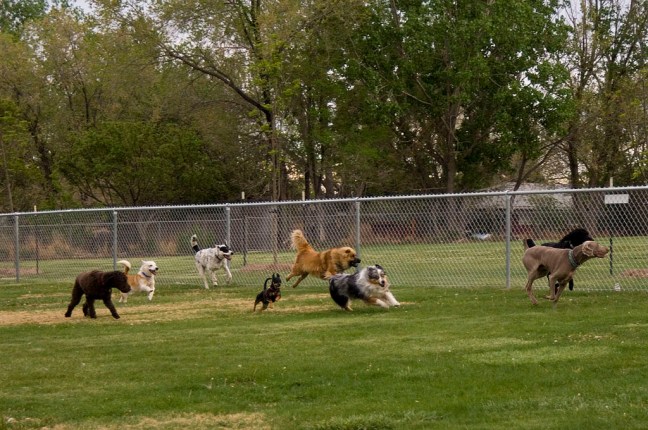
Whenever we take Tiger to the dog park, I like to step back and observe the interactions of the dogs and the owners. On the best days, all are relaxed and a singular, calm and happy energy flows through the park. On other days, the energy is divisive rather than unifying, a sense of unbalance and unease transmitted from creature to creature within the fence. It only takes one anxious and unstable dog (or more often, owner) to create the seeds of chaos.

When an unbalanced dog enters the arena, the other canines are quick to assess. Most of them will seek to avoid the negative energy. While others try to correct or eradicate it through physical means, usually growls and nips. This is when the observations really get interesting. Much of the time I see the owner of the unstable dog step in to rescue his or her dog from the perceived attack followed by a coddling session. This affection given while the dog is anxious only seeks to reinforce the behavior. It is teaching the dog to be a victim. It is also preventing the dog from learning how to solve its own problems as it comes to rely on its owner stepping in and white knighting the situation.

In more successful outcomes, the owners of the involved dogs will watch the interactions, looking carefully for a potentially dangerous situation that requires intervention but remaining hands off as much as possible. When this happens, the unstable dog tends to a minor beating but it also learns. It learns where it stands in the pack, it learns how and when to fight back and stand up for itself and it learns that it can solve its own problems. After a few moments of rough and tumble and vocalizations, all involved usually trot off happily and the energy balance is restored. The instability has been corrected.

Now humans are obviously not dogs. We don’t live in hierarchical packs and we don’t usually teach through teeth and growls. And luckily, our greetings do not usually involve butts and/or noses. But we can learn from observing our canine friends, whose lessons come from a much simpler world than ours.

People perceived as victims in our society tend to face one of two reactions – blame or enable, neither of which help to change the energy balance in the interaction.

I’ve written before about the danger of victim blaming. This perspective is used to justify the attack on the victim, shifting all of the responsibility onto the damaged party. Most recognize the fallacy in this thinking and reject the idea.

But we are much more willing to accept imbalance in the other direction. When the victim is enabled, it nurtures unstable behavior. It shifts all of the responsibility to the other party. It tells the victim that he/she does not have learn how to solve his/her own problems; someone will step in for the rescue.Β In essence, we are like the dog owner swooping in to pick up the anxious dog before the lesson is learned.

Whatever you nurture, grows.

When we enable victims, we cultivate victims.

So, then, what do we do? How can we support victims while encouraging them to no longer be victims?

Watch Before Intervention

Just like the informed owners at the dog park, watch the interaction before donning your Superman costume. Be ready to intervene if the situation becomes dangerous but give the participants a chance to work it out for themselves first.

Support Rather Than Nurture

When interacting with the victim, especially if he/she is anxious or unstable, provide support and reassurance but do not nurture the anxiety. When someone is anxious, it is better to be clinically kind (think good bedside manner) than motherly.

Encourage Growth and Stability

When the victim is not in crisis, help him/her address the underlying issues. Teach them how to remain calm. Show them how to be centered and in control of themselves. Encourage them to take responsibility for their choices and reactions.

Empower the Person, Not the Behavior

When working with someone who has been victimized, be careful not to permit the behaviors that accompany the victim state as that serves to sanction that behavior. Rather, seek to empower the person behind the behavior so that they can learn to emancipate themselves from victimhood.

Blaming and enabling only serve to create more victims as the power is held unevenly and instability is rewarded. Whereas, if we can learn to cultivate anti-victims through support and encouragement, the great dog park of our lives can be filled with more wagging tails and fewer growls.

This post is Tiger approved.

photo

I’m a Sucker for Science

I’m a sucker for science so when I saw this article by Lifehacker – The Science Behind Why Breakups Suck (and What You Can do About It), I read it with great interest. I’m especially interested in their description of the physical response to rejection stimulated by the parasympathetic nervous system, as this relates to the PTSD-like symptoms that some experience after a breakup. It’s an interesting article which serves to validate the intensity of emotions after the end of a relationship and gives some tangible strategies to help the mind and body recover from the loss.

I would love to see further research on the impact of rejection and relationship trauma on the brains of previously healthy adult subjects. With my completely subjective and n=1 experiment, it seems like it can lead to long term changes in the brain’s ability to process.

What are your thoughts? In what areas would you like to see research?


Opportunity

According to Cesar Millan, every bad moment is an opportunity for rehabilitation.

He doesn’t panic when a dog lunges.

He doesn’t get angry when they try to bite.

He doesn’t give up when the dog snaps.

He simply sees the moment as an opportunity.

A moment to show the dog another choice. A different way of responding. A different way of being.

I could have used Cesar the other day.

No, I didn’t try to bite anyone.

But my past tried to bite me.

Brock and I signed up for a house fund registry which meant that a significant portion of our wedding gifts were in the form of money in a joint Paypal account. Β We had the agreement that all funds gifted would be applied towards the house with joint decisions. All good.

And then, one morning when I checked my email between classes, I see that $500 had been withdrawn from the account.Β The email didn’t tell me where the money went or what the intent was behind the transfer.

It just told me that money had been taken.

It just triggered panic in my gut.

I had to endure the entire day before I would have time to log in to Paypal to see the intended destination of the funds or to ask Brock about the transfer.

My past tried to tell me that this was a nefarious move on some level – either trying to hide money or deciding to move forward on a purchase without discussion.

My past made it a bad moment.

My present recognized it as an opportunity for rehabilitation.

In my former life, I would have a) found a way to call my husband right away and demand to know what was going on (see Assumptions) or b) let my panic and anger build through the day as I imagined all of the potential scenarios that could be unraveling.

But this was an opportunity to make a choice.

This was a chance to respond differently.

I started by relaxing. Telling myself repeatedly to take deep breaths to calm the panic in the gut (that would make a good band name:) ). I reminded myself that my response was from the past, triggered by my fears of being betrayed again. My reaction had nothing to do with Brock or the actual situation at hand. I decided to believe that everything was okay. But I also made the decision to check once I got home. Not with Brock, since it was really my problem, but with Paypal.

Trust but verify.

By the time I arrived home, I wasn’t panicked. I wasn’t angry.

I didn’t even run to my computer to log in to Paypal.

But I also didn’t avoid it either.

When I finally did look at the account, I was calm. Rational. Thinking with my present mind rather than with the alarmed mind of the past. I could see clearly and interpret the numbers.

The $500? It was moved into our joint savings account. The amount was set by Paypal’s limits.

I walked down the hall to where Brock was sitting at his computer, wrapped my arms around his shoulders.

“Thank you for starting to move the money into our savings.”

I never told him about my panic. That’s not his responsibility.

I’m the one who has to whisper my own life and see opportunity for rehabilitation in every bad moment.

Lesson learned:)


Re(s)training Order

I had to take out a restraining order yesterday.

Nope, not on my ex.

Or some crazy blog stalker.

But on myself.

You see, I have a certain behavioral tendency that I don’t like and that I want to change. And I had a chance to practice yesterday.

I came in the door at my usual 5:00. Brock and I exchanged a quick hug and a few words before he ran off to the gym and I ran off to..well, to a run. Our time was brief, but totally normal.

I came back from the run around 6:15 to find Brock tackling the garage, the one area in the house that was still unusable. He was working quickly, I guess to try to beat the clock before he had to leave for ju jitsu. But more than that, he felt distant. Unreachable. Of course, that’s my mind putting its own spin on it:)

I hung around for a few minutes to try to help before giving up. I retreated upstairs to take care of Tiger and some other evening chores.

My instinct is to press to find out what’s wrong. To question. To poke at it. I’m looking for reassurance that it’s not something to do with me and I am also looking for something I can fix.

I panic. I don’t know why. We all get frazzled. We all get overwhelmed. Lord knows, I come into the house plenty of times still carrying the frantic energy of my day and some of that bleeds out even though it has nothing at all to do with Brock. I also am very familiar with the fixation that can occur when trying to accomplish a task quickly. Hell, I did it today. I was short with a coworker when she interrupted me while I was trying to complete a study guide in the 5 minutes before the bell.

I get it mentally. But my emotions are a slow learner.

I find myself taking very frequent temperature checks of the relationship. Which is good. But it also means that I can get false readings or see a trend when there is nothing there.

I know this is a remnantΒ of the divorce. My first marriage ended and I saw no signs. I’m petrified of missing signs again. I can be not unlike a lost driver with poor eyesight (okay, that would frequently be me:) ), slowing down and squinting at every street sign, afraid of missing the one spelled out in the directions.

But this isn’t my first marriage. I missed signs partly because they were covered and partly because I didn’t believe they could exist. That’s not the case now. I can relax. Not into full autopilot but also not the intense drive of one on a new and treacherous course.

So last night, I took out a restraining order on myself. I asked once if he was okay and then I disengaged. I trusted. I relaxed. I let him be and I let it be.

And, you know what?

It was okay.

A friend of ours came over while he was still at ju jitsu. The friend and I spent time on the porch (shocking, right?) talking about his recent trip and his relationship. By the time Brock came home, all was well. The garage was done, another item ticked off the list. Ju jitsu was enjoyed. And he was back.

Not that he ever left.

With practice, I’ll teach my brain not to create mountain ranges (yeah, I go big time) out of molehills. I’ll continue to check the temperature but also work to realize that sometimes a reading has nothing to do with anything (for some reason, this makes me think of the scene in Ferris Bueller where he uses the heating pad to fake a fever. yup, child of the 80s here). I’ll work to take the ego out of it (what, you mean something may notΒ have to do with me???) and think of times when I am frazzled, focused or distant. I’ll apply restraint and keep myself from poking at it like some sticked-arm kid with a flattened squirrel (gross, but just about as pointless).

Just like I can still teach my old cat some new tricks, I can still learn as well. Although my retraining doesn’t necessitateΒ the use of kibble:)