On the Importance of Being There

If I was a giraffe, I’d be dead.

I guess it’s a good thing I’m not a giraffe.

I actually used to be scared of the protracted-neck beasts.

All because of my 8th grade gifted social studies teacher.

I was confident walking into his class that first day. I was a good student and social studies had always been pretty straight forward. I lost that confidence within the first few minutes when he explained to us that his goal was to teach us that we weren’t as smart as we thought we were.

He was tough. He was sarcastic. And sometimes he was cruel (I’m not sure the devil’s horns and tail on test days were really necessary). But he reached his goal and as a result, all of learned the value of struggle.

With some scars to show for it.

For me, one of those scars was a particular aversion towards giraffes because of this teacher’s strange resemblance with his orange – hued frizzy hair that had a tendency to approximate small horns and a long, lanky build.

And then I learned about some of the strange traits giraffes possess. Specifically the importance of a series of super-strong valves in the their neck in order to prevent a fatal stroke when they lean down to grab a drink of water from the large volume of blood found in their necks. I mean that is some crazy weird evolution going on there.

And if I was a giraffe, I’d be dead. Because the valves in legs are anything-but-strong. And over the last two days, I’ve had the offending vessels in my thighs lasered into oblivion.

The doctor (and I) insisted that I would be fine driving myself home after the procedures.

My husband insisted that he meet me for the appointments and drive me home because, “You’re my wife, I have to be there for you.”

As though it’s a given that a husband will always be there for his wife.

Being there when your spouse needs you is so important. And being there when your presence isn’t absolutely required but appreciated may even be more important.

While needles and lasers were being fed through my legs, all I could think about was how grateful I was that my husband took a break from his schedule to be there for me. And that I live in a time where medical technology can hopefully help me.

And that I wasn’t born a giraffe:)

Here’s to being there, learning through struggle and discarding irrational fears!


What Are Your Marriage Deal Breakers?

dealbreaker

Brock asked me once if I would have given my first marriage a chance if my ex had come to me instead of disappearing.

“It depends,” was my response. By the time the end was imminent, there had been so many lies and so much betrayal that I don’t think we could have moved beyond it. But if had approached me earlier?

Maybe.

One of the reasons I married Brock was for his, “Hard work can fix anything” atittude. He’s not one to easily give up on anything. I like that. And for the most part, I share that attitude.

But I’ve also experienced enough to know that effort can’t fix everything. Especially if the effort is one-sided.

From Til Death Do You Part:

I see the vows as like the wheels on a bicycle. Ideally, both are fully functioning and working in concert. If one tire is a little flat, the other can help support the weight for a time until the tire is re-inflated. If one wheel is bent, the ride may not be over as long as the metal is hammered back into shape. Yet if one wheel is removed, the bicycle is useless no matter how hard the remaining wheel works. And it’s time to either find a new wheel or learn how to ride a unicycle.

There are certain dire situations where my reaction would be to immediately end a marriage instead of staying and working to fix it.

The following are my marriage deal breakers:

Reoccuring Infidelity or Infidelity Without Accepting Responsibility

I don’t believe that the occurance of infidelity should automatically result in a marital split. I have heard of so many cases where the crisis, once the underlying issues have been confronted and addressed, has made a couple closer in the end. Yet in order for the marriage to have a chance, the cheater has to take responsibility for their actions and make the necessary changes so that it doesn’t happen again.

It’s hard work. It’s messy work. And it’s work that has do be undertaken by both spouses. If the infidelity became a pattern or the responsibility was shrugged off, I would walk.

Violence

The need to feel physically safe is a basic one. And in a relationship, a physical reaction to a disagreement or frustration is never okay. I can’t imagine ever feeling safe again (much less acttracted to) somebody who had struck me.

Maybe it was a one-time thing. An overreaction while being emotionally consumed. But that’s not a chance I would want to take.

Habitual Lying

Much like with infidelity, I don’t believe that a single (or occasional) lie is a reason to hire a lawyer. Even if it’s a major lie, I would try to understand the motivation behind the untruth before calling it quits. But if the lies overlapped like shingles on a roof keeping the truth out, my inclination towards sympathy would be erased. Once somebody has allowed lying and deceiving to be their way of interacting with the world, they have a hard time living in truth.

They may tell you they’ll stop lying. But history proves that’s a lie as well. I refuse to ever again live in a land of make believe that somebody is projecting for me. Especially if it involves my financial security!

Abandonment

It seems self-explanatory, doesn’t it? Yet I had people question my decision to divorce my ex – who disappeared, married somebody else and refused contact. I mean, really? I guess I can kind of see it if the marriage provides insurance benefits or something (I’ve met people where this is the case and they stay married for a long period of time in name only).

Even with the definitions of marriage changing, it still takes (at least) two to make it work. When one goes, it’s gone.

And then there’s the ones that may reach deal breaker status – addiction and mental illness.

After my ex left, I learned he had been struggling with both of these. And not handling either well. I don’t see addiction or mental illness as automatic deal breakers. In fact, I view them more as a time to increase effort (both in self-care and support for the spouse)  than calling it quits. Of course, in order for that to happen, the struggling partner has to be open enough to reveal their struggles. If it’s hidden, the combined efforts can’t happen.

These two issues can be devastating – both for the affected one and for the impacted loved ones. And that’s why it’s a murky area. If the addict or mentally ill person consistently refuses to get help and continually acts in ways that threaten the well-being of the family, there may come a time when distance is the best option for all involved.


So, back to Brock’s question – Would I have tried to work through the issues in my first marriage?

Yes, if he had come to me about his battle with depression and drinking before the lies overwhelmed our lives. Yes, if he was ready to accept responsbility for his actions and willing to accept help. Yes, if he was wanting to increase effort rather than run away. Yes, if we would have been fighting together for a shared goal.

But I refuse to fight alone.
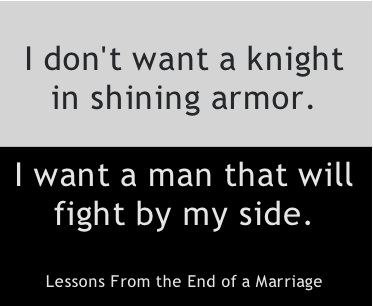
Knight

And so I chose a spouse the next time around that isn’t prone to those dealbreakers. That isn’t afraid of hard work. That doesn’t mind getting messy. That fights with me for our marriage.

And I’m glad that most stressors in a marriage are not of the deal breaking  variety.  I hope to never see those again.

Those are my marriage deal breakers. What are yours?


Why the First Reaction Is Often Not The Real Reaction

“What am I going to tell my mom?” were the first, shameful words out of my mouth when I learned my boyfriend’s ex-girlfriend was pregnant.

I was 14. He was 16. We had only been dating a few weeks. I was still years away from being ready to be sexually active. He welcomed that because he had felt pressured to have sex in his previous relationship.

There was no infidelity involved; the conception had occurred towards the end of their relationship and before ours began.

So really, the news had nothing to do with me.

But that wasn’t my initial reaction.

I had been put on birth control pills a few months prior to manage painful cycles and I was afraid that doctors (and others) would assume that they were also (or even only) desired in an attempt to prevent pregnancy.

And in that moment, my reactive brain thought that this evidence that my boyfriend had been sexually active before me would lead people to assume that he had been sexually with me.

And in that moment, I said something I shouldn’t.

My boyfriend looked shocked. Hurt.

And rightfully so.

It took some time, for him to recover from my misstep and for me to process the news, but eventually I responded with the compassion that I really felt and he realized that my first reaction wasn’t my real reaction.


The first reaction upon hearing big news is impulsive, bypassing any usual filters and mental processing. The initial response is most likely selfish because that is where our thoughts go when controlled by our more primal and reptilian brain. Those opening words are spoken by fear, untamed by rational thought and often amplified by shock.

And those words are frequently a blow to the person who spent time and energy gearing up for this conversation. They may have spent countless hours dissecting their message and carefully selecting the right words with which to deliver it.

Only to be struck with the hammer of the first reaction.

But the first reaction is rarely the real reaction.


If you’re preparing to deliver big news,

  • Remind yourself before the conversation that you’ve had hours/days/years to process this information and that it is brand new (and perhaps a huge surprise) to the person you’re telling.
  • Try to find a way to phrase things so that the information is more of a ramp and less being slammed into a brick wall. This may take more than one conversation.
  • Prepare yourself ahead of time that the recipient of the news may respond poorly. Inappropriately. Even painfully. A little reminder ahead of time can help you not take it personally in the moment.
  • Be patient. Don’t make any major decisions based upon the person’s initial reaction. Give them some time and some space to deal with this on their own before they’re ready to deal with it with you.
  • Gather your support ahead of time, whether this is a person who already knows and has processed the information or simply a favorite walking path. The person just hearing the news won’t be able to be your support person immediately. Don’t expect that of them.

If you’re reciving big news,

  • Breathe. Be aware of your physical responses and work to regulate them. Your fight or flight response has probably been triggered. But you don’t need to do either just yet.
  • Realize that when information is new and unexpected, it is not understood and our brains often catastrophize it just in case. The way you feel about it right now is not the way you will feel about it tomorrow.
  • If you say something you don’t mean, apologize. Sincerly. And then stop talking. The other person has a built-up need to talk right now and your job is to listen and work towards trying to understand what you’re hearing.
  • Understand that a lack of a response in that moment is not an expression of acceptance or approval of the information. Communicate that you need more time to think about this. And then follow up.
  • Remember that no matter how hard this news is to hear, it’s better to have it on the table than covered and rotting beneath the floor. Now you know and now you can process your real reaction.


Fixer-Upper Relationships – What You Need to Know!

What area do you want to live?

How much do you want to spend?

And how much work are you willing to do?

Those are usually the first three questions a real estate agent asks a person in the market for a new house. And perhaps the response to the last is the most telling.

Some people look at house that has some functional deficits or is in need of a complete overhaul as chance to create what they what. A challenge, yes. But also an opportunity.

Others want to move into a ready-made house. Open door, insert family. Perhaps because of limitations of time, money or skill, they are reticent to consider a property in need of renovation to bring it up to their expectations.

Those in the second group usually get their wish at first. They find something brand new and stylish or luck into finding and falling in love with the renovations that previous tenants have undertaken.They quickly add the finishing touches that make the house a home and settle in. And for a time, all is well.

It happens gradually. The AC goes on the fritz. The paint colors no longer inspire. The wood floors start to show some wear and practically beg to be refinished. A passing storm pummels the roof, leaving tears in the once tightly-locked shingles. Or maybe it’s less the structure and more the space. That inconsequential guest bathroom is no longer large enough once the kids arrive. You find yourself cursing that awkward corner in the kitchen.

The house that was once move-in ready has started to demand attention.

To need fixing.

For those that truly fear repair, they may use this as an opportunity to leave the old house and find a new and perfect one.

For those that fear change, they may simply turn a blind eye to the house and ignore its needs (as well as their own).

And the others? They begin to see that at some point and in some ways, every house is a fixer-upper. And that rather than trying to find the perfect house, it’s more about finding the house whose quirks are permissible and putting in some elbow grease to make the rest shine.

Those same contrasting viewpoints follow into the dating world.

—–

Some people are looking for that perfect person with an expectation that if it’s right, it will just work. No effort required. Any sign of cracks or peeling paint is seen as a problem and may result in a new search or a blind eye turned.

I had that view the first time around. And it made any discord or disagreement a very scary thing. A potentially fatal flaw in the foundation. While dating, I first looked for move-in ready men, those that seemed to have all their cobwebs dusted and scuff marks polished.

They never lasted.

What I only realized later is that every single relationship falls into the fixer-upper category.

That’s right. There is no such thing as a move-in ready relationship.

Because even those people that appear perfect on the surface have flaws just below. Every person has areas where you will be easily compatible and those where you will have to figure some things out. Just like how you figured out how to finally utilize that awkward corner in the kitchen. Every person brings their own childhood issues to the table and sometimes they will come to the forefront.

We are all fixer-uppers.

We are always fixer-uppers.

That’s not a flaw; it’s an opportunity.

And the opportunities are multiplied when those two fixer-uppers move in together.

Every relationship will face wear and tear and require some elbow grease. Every partnership will be tested and may require occasional reinforcement. There will be times when you feel hemmed in by the walls and other times when they feel comfortable and cozy and welcoming.

It’s about choosing the one whose flaws you can live with and learning how to make the rest shine. It’s about going in with realistic expectations that everything changes over time. It’s about maintaining perspective during those stints when everything seems to be breaking down and expressing appreciation when it goes well. It’s about learning together, trying and trying something new when that doesn’t work.  It’s about learning to tell the difference between do-it-yourself repairs, those that require a professional and those that signal that it should be condemned.

And it’s about choosing every day to put in the effort. To build. And rebuild.


Lightbulb Moment: Why I Now See My Husband Differently

“I’m going to get this done for you today,” my husband said after asking me to mix the epoxy that would soon coat the garage floor.

“What do you mean, ‘for me?’ I really don’t care much at all about the garage or the shed, so it confuses me when you say you’re doing them for me. Those are the things that you care about.”

He thought a moment before responding.

“I want you to have a house you love. That you feel proud of. Everything I do around here is ultimately for us. For you. It’s like planting is for you. You do it because you enjoy the process and the result, but you also do it to make this home better for both of us.”

I thought back to my efforts to paint the living room before he returned home, my search for the “perfect” end tables to complement the new sofa and my carefully arranged and found frames on the new picture ledges. In each of those cases, I was thinking of what he would like. Because even though none of those details are ones that are particularly important to Brock, he enjoys and benefits from me tackling those areas that he would likely ignore if left to his own devices.

Yet, when he was engaged in similar projects, I tended towards annoyance at being interrupted for help (his projects always seem to happen when I’m in the midst of my own thing) and an utter lack of comprehension at his motivation.

Lightbulb moment.

What I sometimes perceive as a self-serving undertaking is often initiated as an act of service.

And now every time I pull my car over that newly epoxied garage floor, I whisper a quiet, “Thank you.”