The Importance of Choosing Your Tribe

Even in the best of times, the need to belong is a powerful force. And in the worst of times? There is nothing more important than finding your tribe.

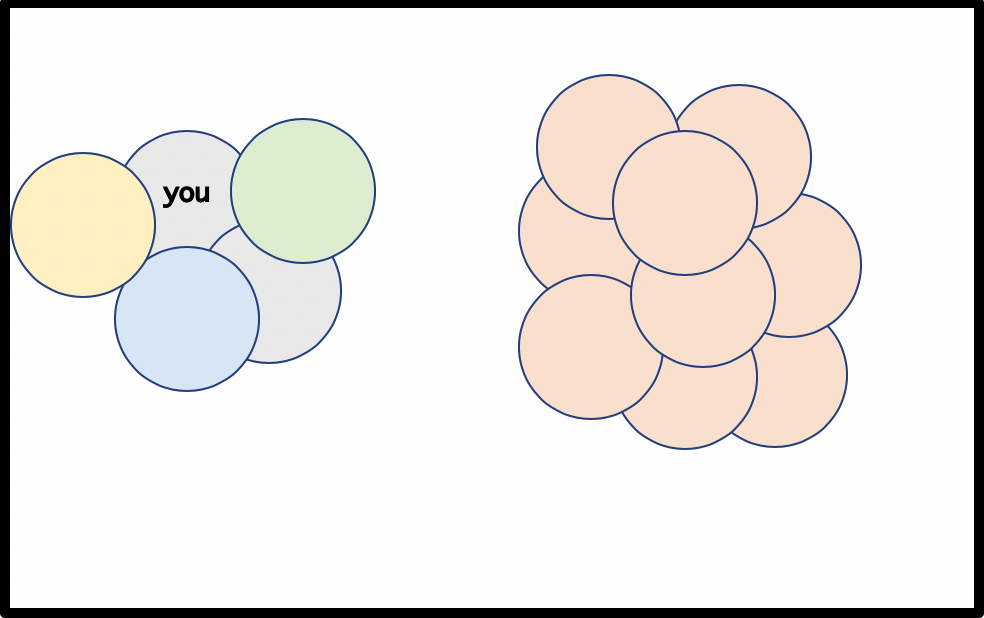
When something tragic happens, it often leaves us feeling like this –

We feel isolated. Alone. It’s as though pain has its own language and nobody else speaks that tongue.

And then one day, either by chance or from actively searching, you find this –

And it feels amazing. You’re not alone after all. Somebody else knows the words that pain whispers through the long nights.

Over time, you meet more. “I’ve found my people. My tribe,” you think to yourself, enjoying the much-needed connection and solidarity. Some are further along in their journey. Others, like you, are still taking their first shaky steps.

You feel supported. Accepted. Instead of your pain making you an outcast, it is now your admission ticket to the new club. “You’re one of us,” it says.

tribe

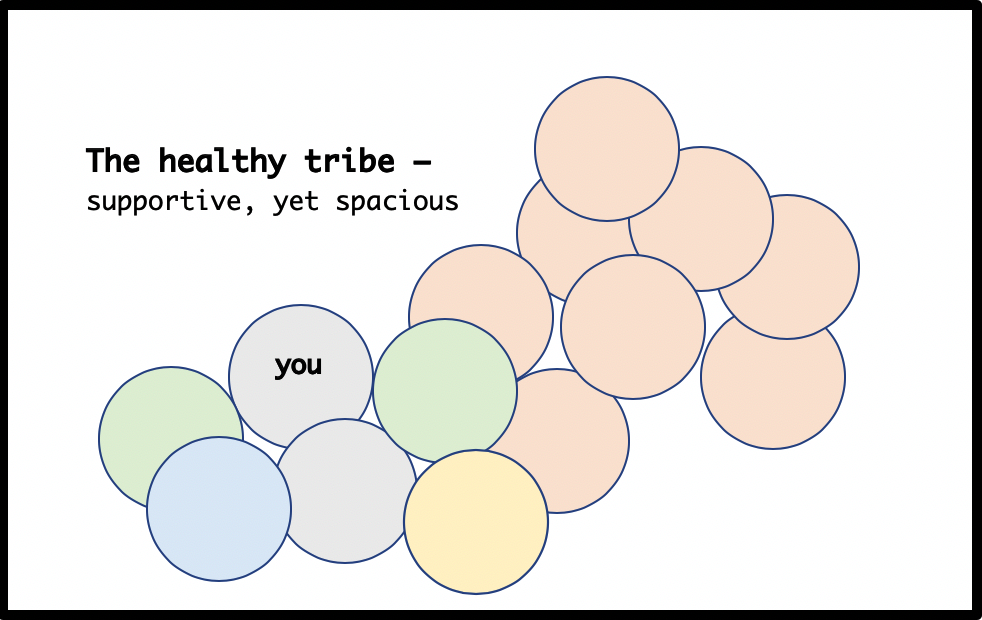
In a healthy tribe, the members offer up both encouragement and tough truths. They come together out of shared pain, but more importantly, they grow together out of a desire to move through the hard times. The connections strengthen the individuals while at the same time, allowing each person the space and freedom to explore their own path, accepting the idea that life is not one-size-fits-all.

tribe

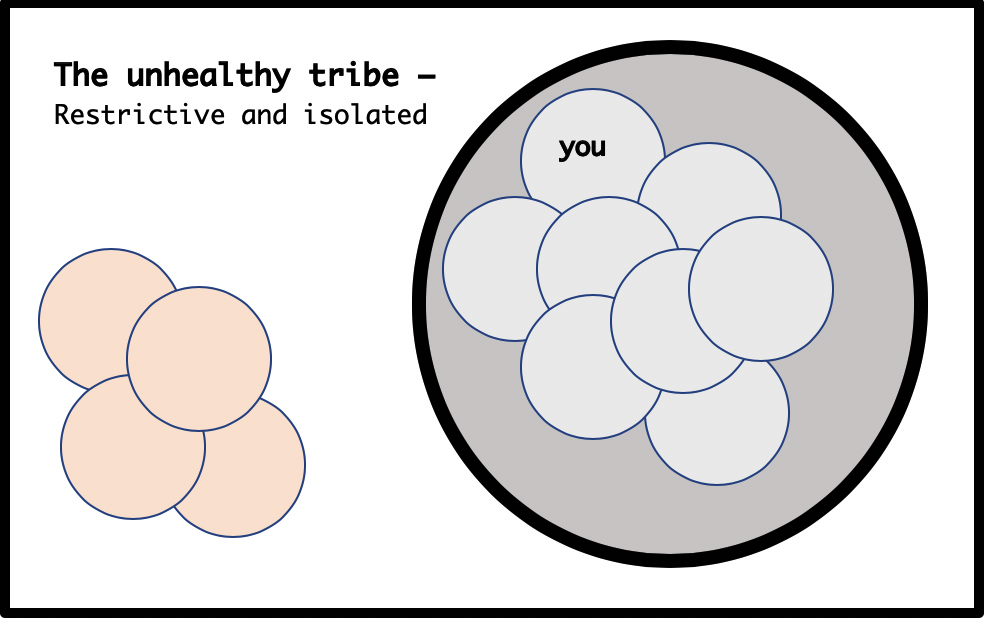
Yet sometimes, a poorly-chosen tribe can hold us back. Misery loves company, so when we’re in pain, we have a tendency to attract more pain. So it’s easy for a tribe to become focused on what brought the members together and amplify each other’s cries within the closed-off space. Furthermore, an unhealthy tribe feels threatened by progress so the group works to create an “us vs. them” culture to keeps its members contained.

tribe

There are few decisions more important in life than choosing your tribe. Since we become the people we spend the most time with, your tribe becomes your identity.

Before you choose your tribe, ask yourself these questions:

  • Are they focused on destruction or creation? In other words, are their energies directed towards tearing other people down or building each other up?
  • What is their goal – progress or commiseration? The latter has its place, but it’s generally not a space you want to occupy for the long run.
  • How do they view dissent or individual growth? Are you encouraged to speak your truth and explore your path or are you expected to toe the line?
  • When you spend time with your tribe, do you feel encouraged or defeated? Do they provide you with hope and promise or fill you with dread?

One of the best feelings in the world is the joy and connection that comes from finding your tribe. Choose wisely, and your tribe will be your greatest champion.

Playing Make-Believe With Your Healing Progress

“I just want to be healed already!” I said out loud to myself once I closed the car door. I had just finished a Sunday afternoon run where I was caught off guard by tears that came uninvited. Feeling defeated, I let the sobs overtake me as I slumped over the steering wheel. “Great,” I thought, “I was a failure as a wife and now I’m failing as a divorcee.”

A mere hour later, showered and presentable, I responded to a friend’s inquiry about my well-being.

“I’m doing great actually. I barely even think about it.”

Of course, that wasn’t really accurate. I said it because I so desperately wanted it to be true.

To some extent, I think we all play make-believe with our own healing progress at some points. Whether driven by internal motivators or because we fear external judgments, we pretend to be further along than we actually are.

So why do we pretend to be over it when we’re still in the thick of it?

We pretend to be healed because we want to leave it all behind us.

We know that when we’re going through hell, we’re supposed to keep going. But the temptation is strong to try to simply close the door on that hell and pretend as though it never happened. We tire of being known as “the divorcing one,” we groan whenever the lawyer’s missives intrude and more than anything, we just want life to be normal again.

We pretend to be healed because we feel pressure to move on from others.

In the beginning, the sympathy and concern pour forth with abandon. And then the empathic and inquisitive words begin to wane until they are all-but absent. Our pain, so prominent and attended-to int he beginning, has been tossed aside like yesterday’s news. It’s not that others no longer care, it’s that either they have reached compassion fatigue or they are unaware of how long it can take to heal.

We pretend to be healed because we are impatient with the healing process.

Healing from divorce is a marathon. No, scratch that. It’s an ultramarathon. It goes on and on and on. And every time you think you’re over it, the finish line seems to have moved just a little bit further away. All of that is not even taking into account the Chutes and Ladders nature of healing, where every arduous climb can seemingly be undone in an instant.

How to Be Patient With a Procrastinating Healing Process

We pretend to be healed because we feel ashamed for still struggling so much.

“It’s been five years and I’m still really struggling,” the voice whispers to me over the phone on an introductory coaching call. Unspoken, but evident behind those words was, “I’m ashamed that I’m still struggling so much after all this time.” A shame that had led this particular person to pretend to be “over it” with everyone around them. It was only to themselves on the long nights – and now to me – that they could admit that healing was still ongoing.

We pretend to be healed so that we can adhere to some prescribed timeline.

We have a tendency to put too much importance on anniversaries – assuming that as soon as some arbitrary date rolls around, we will have magically shed our pain. You wait for that date with anticipation, as though it’s a graduation and you will receive your freedom. And then when the day passes and the relief hasn’t come, you decide to simply pretend that diploma stating your completion of healing.

Healing does not speak calendar.

Lisa Arends

What’s the problem with pretending to be healed?

When we don’t give ourselves the space or the time to heal, we risk stalling or even complicating the process. Much like with a wound to the flesh, ignoring it or sealing it in without first washing it out can lead to a larger problem than the initial injury.

Furthermore, when we are playing make-believe, we are preventing others from being able to render aide and we are closing ourselves off from receiving help. It can be scary to admit that you’re not okay. But often the only way to get there is by first admitting that you’re not.

There are no “shoulds” when it comes to healing. You’ll get there on your own path and on your timeline. Be patient enough to take the time you need. Be brave enough to speak your truth. And be humble enough to admit when you need help.

6 Powerful Ways to Create Your Own Closure After Divorce

closure divorce

I was seeking closure within hours of the unexpected text my husband sent informing me that he was leaving. Feeling powerless at the lack of communication and information, I sat in front of the fire pit feeding photos, notes and letters into the hungry flames.

I hoped that the ritual would help me find acceptance that it was over.

But my pursuit for closure had only just begun.

—–

Months before walking out on me, my husband ended a job. He gave them two weeks notice, had a sit-down meeting with the owners where he explained his reasons for leaving and he maintained open lines of communication so that business matters could be transferred smoothly.

I received none of that courtesy. And for the better part of a year, I fixated on that fact, convinced that I needed him to provide explanations and even excuses that would allow me to close the door on our marriage.

I became obsessed with understanding the “why” behind the marital explosion, certain in my belief that this was key to moving on. I played around with labels –  narcissist, sociopath, addict – in a bid for understanding. But none of those designations brought peace.

I was frustrated. Furious, actually. I felt as though he had stolen my voice by sneaking out without contact and that he carried my chances for closure with him. It was the heartbreak that kept on giving.

Finally, I grew tired of the snipe hunt for closure as the legal proceedings wound down without any real answers or resolution and he continued to act as though our marriage had never happened.

And so I shifted my focus, putting my energy into me instead of funneling it into the black hole that he had become.

And the strangest thing happened.

I found peace.

And isn’t that what we really mean by closure?

Closure is an acceptance of what has happened, a sense of power over ones own well-being and a feeling of moving on.

And none of those require the participation of the other person.

You have everything you need to create your own closure. Here’s how –

  1. Understand the Limitations of Explanations

It’s easy to get caught up in the belief that as soon as you receive an apology, you’ll be able to move on. Or that once you hear that you were the love of their lives, you can let go. Be honest with yourself. Is thereanythingthat they can say that will erase the pain? Are there any words powerful enough to bring everything to an emotionless close? The words you seek are the ones you need to hear, not the ones that they need to say. Once you accept the limitations of any explanations that your former spouse can give you, it’s easier to move on without them.

You Don’t Need to Understand in Order to Move On

  1. Find or Create Meaning

We naturally seek to find order and purpose in our surroundings. And so when something, such as divorce, is discordant, it causes pain and confusion. Look within the ruins of your marriage for some hidden gifts. Maybe you now have an opportunity to move back to the city that always felt like home. Perhaps you’re finally getting in touch with who you are. Or it could be that this rock-bottom is turning out to be an impressive foundation for a new and improved you. If nothing is immediately evident, create purpose in your post-divorce life. When something has meaning, it’s easier to accept the changes that had to place to get there.

  1. Write the Letter You Want to Read

I know this sounds strange, but I promise it is one of the most powerful exercises you can do. Write a letter from your ex-partner to you, saying all of those things that you need to hear before you can move on. Don’t censor yourself, allow the words to flow and probably the tears too. And once it’s written, read the letter. And then read it again. Keep reading it until you believe the words within. After all, what you’re looking for is really just proof that you were loved, that you will be remembered and that you are worthy of love again. And you don’t need anybody else to tell you that.

Powerful Ways to Use Journaling After Divorce

  1. Start Your Next Chapter

Life isn’t like a book; you can start the next chapter even while you’re still wrapping up the one before. Don’t fall into the trap of waiting to live until you’re healed. Invest your energy into your life and allow the healing to happen alongside. A big part of closure is releasing some of the pain from the past. And a great way to lessen pain is to focus on cultivating joy.

  1. Don’t Obsess About Closure

Are you stalking your ex’s Facebook page in a quest to see them looking miserable? Are you endlessly dissecting the end of your marriage looking for explanations and reasons? Are you giving the detritus from your marriage more power than it deserves, destroying pictures and hiding trinkets? This obsession with finding closure will only serve to delay it. Closure comes from living in the present, not from being consumed by the past. If you’re struggling with this, try instituting boundaries – delete social media accounts, have a plan for distraction when your mind wanders into dangerous territory and redecorate your space to create a clean slate.

  1. Don’t Take it Personally


I eventually realized that my own roadblock to finding closure was that I was taking my ex’s actions personally. He not only did these things, but I was convinced he did them to me. Because of me. Over time, I started to understand that I was just collateral damage in his own battles, not a target to be obliterated. And that was a powerful realization. When it’s no longer about you, it’s much easier to let go and to move on.

You have the power to flip the sign on the past to “closed” as you step powerfully into your new life.

And on the other side, here are three times where you shouldn’t seek closure.


Five Healthy Ways to Fill the Void After Divorce (And What to Look Out For!)

From the chilled and vacant bed to the endless evening hours to the loss of a trusted confidant, the void left in your life after divorce can be both vast and agonizing. The emptiness begs to be filled, the cracks call for smoothing over and you try to distract yourself from staring too long at the vastness of the crater in your life.

Watch Out For These Unhealthy Ways to Fill the Void-

In an attempt to soothe the initial pain from divorce, many of us first turn to one or more of the following unhealthy (and ultimately ineffectual) methods of trying to fill the vacuum:

Filling Your Belly to Try to Fill Your Heart


When you’re feeling gutted and vacuous, it can be natural to turn to food for relief, mistaking the temporary physical fullness for emotional satiety. There is a very real link between emotions and food – we often speak of “comfort foods,” bring food to those in mourning and bond with others over a meal. Yet the real comfort comes less from the sustenance and more from the nourishment of the connection with others.

When you attempt to feed an emotional hunger with food, you will never be completely satisfied because you are addressing the wrong area of need. Repeatedly turning to food may have a detrimental impact on your health and will also serve to widen the disconnect between your mind and body.

Avoiding Reality With Alcohol or Drugs


Emptiness is uncomfortable. A sense of free falling through space is frightening. In those dark and lonely hours when you’re alone and worried that you’ll always be alone, it can be tempting to numb the pain and quiet the fear through chemistry.

And there will be relief in the moment, those blissful moments where you are able to forget reality and embrace a dream world. Yet reality always bursts back in, throwing open the door and blinding you with its harshness. Trying to avoid it only delays the inevitable confrontation and acceptance.

Bolstering Confidence With Shopping


It’s no wonder that shopping is a common pastime for those that are feeling down – the hunt of a good bargain and the acquisition of new baubles rewards us with a feel-good burst of dopamine. Those who have experienced an esteem hit after infidelity and/or divorce can be especially drawn to the appeal of covering the vulnerable skin with fancy clothes, new cars or a designer house.

Shopping gives us an opportunity to briefly occupy a fantasy world where the advertisements and markers have us convinced that material goods are associated with a particular life. But the thrill is always temporary, the boost short-lived. Chasing the tail of this dragon can ultimately be devastating to both your wallet and your well-being.

Distracting From the Pain by Dating

When you’re facing the heartbreak and the hollowness that follows the end of a relationship, there can be a powerful craving to experience the excitement and potential of new partnerships (even if they only last the night). Giving in to this desire too soon is like going to the grocery store hungry; you are not going to be able to make good decisions.

Additionally, when you’re still vulnerable, dating can often serve to highlight the void you feel as you realize that this person in front of you is really a stranger and that your early feelings are more hope and projection than actuality. It’s often better to wait to re-enter the dating scene until that compulsive desire to replace your partner has faded.

Passing the Time By Consuming Media


What is easiest is often not what is best for us. And nowhere in modern culture is this more apparent than in the consumption of media. In a moment of loneliness, we may turn to Facebook for the sense of connection, yet studies show that browsing the platform leaves people feeling even more isolated. When we’re feeling low, we easily give in to a Netflix binge, expecting to feel more rested. When instead, television (especially when consumed in binges), only intensifies feelings of sadness and fatigue.

Instead, Try These to Fill the Void – 

The previous strategies may work for a short period of time but ultimately, they will cause more harm than good as they prevent you from healing the wound from within. Instead of leaning on those quick fixes in an attempt to fill the void left from divorce, try building yourself up through the following strategies. Be patient – these methods may take longer to work than the unhealthier ones, but their results are lasting and authentic.

Finding Purpose Through Work


With divorce, you lose one of your major life roles, that of husband or wife. It can be an uncanny feeling as you wonder what position you now occupy and what purpose you now serve. Depending upon your particular circumstances, this can be an opportunity to allocate more of your energy into your career.

You may find that the changes in your life allow you to take bigger risks or to break out of your standard mold. Changes in your home life may have given you extra time to commit to your job or financial matters may necessitate that you undertake a new endeavor.

Often, when you’re feeling like a failure in your personal life, successes at work take on even greater meaning. Use this opportunity to recommit or reinvent your work persona. Strive to carve out a position where you feel needed, appreciated and interested.


Building Strength and Poise Through Movement


Divorce has a way of making you feel weak. Powerless. And exercise in any form is an excellent way to begin to reclaim your strength and feeling of control over your life. The best form of exercise to undertake is the one that you enjoy and that you can pledge yourself to.

It’s harder to feel powerless when you accomplish the goals you have set for yourself. It’s harder to feel vulnerable when you feel the increase in your performance capacity from week to week. As you throw yourself into movement, focusing on form and breath, the void no longer seems so vast or so dark.

If you’re struggling with sadness and isolation during unstructured hours, use exercise to build a framework around those times. If you flounder without accountability, sign up for group or team exercise so that you have others to answer to. And if you’re feeling disconnected from your body, opt for yoga or weight training so that you can again reconnect with yourself.


Reclaiming Vitality Through a Passion Project


What endeavor encourages you into a state of flow, where your entire focus is on what is at hand and time seems to stop? What activity did you used to enjoy in your youth or dream about turning into a career? What is something that you have always been curious about trying but practicality and circumstances have stopped you? These are hints about your passions, your interests that both consume you and fuel you.

The period after divorce provides a wonderful opportunity for pursuing or restoring a passion project. I know of people who have picked up the violin again, started stand-up comedy, written a book or chartered a non-profit charity. Others, selecting a more physical approach, sign up for a marathon or strive to earn the next belt level in Jiu Jitsu.

The “what” matters less than the enthusiasm you have for the enterprise. When you throw yourself into something that you enjoy and find success in, you breathe life back into the hole in your heart. When you’re passionate about something, you focus more on creation rather than any residual emptiness.


Rising By Lifting Others


When we’re feeling alone and eviscerated by divorce, we can easily become a captive of our own minds. The thoughts cycle and the self-pity begins to grow in our emotional isolation. Perhaps the best way to both put problems in perspective and help jettison us from our thoughts is by empowering others.

If you have children, strive to help them become strong, independent and compassionate people. Reach out to your friends and family that are in need and find ways to help to liberate them from their struggles. Help strangers through your church or a volunteer organization, selflessly sending positivity into the world. If you find people overwhelming, consider helping by adopting an abandoned pet or volunteering in an animal shelter.

Giving to others helps you feel better about yourself and also allows you to shift your focus away from your pain. As you give to others, you will find that paradoxically, you become filled yourself.


Generating Legacy Through Creation

Some of the most beautiful and lasting art, music and prose has been born of heartbreak. Even if you’re not destined to be the next Shakespeare or next year’s Beyoncé, you can still use your pain as an impetus for creation.

Even if it never sees the light of day, the mere act of using your sorrow as a conduit through your medium of choice helps to transform your relationship with the heartache. As you create, you’re building scaffolding throughout that void left from divorce. Scaffolding that you can then use to begin to climb your way out of the darkness.

Is the Time Spent In a “Failed” Married Wasted?

failed

When my math students first start to tackle more difficult algebra problems, they retain their elementary focus on determining the single correct answer. While this difficult work is still relatively new to them, they have a tendency to completely erase or even tear up an entire page of work that led to this incorrect value of “x.”

One of my goals during this time is to help the students focus on the process. Once they recreate the steps that led to the wrong answer that made them quit in frustration, I’m able to show them that, more often than not, they completed every step correctly with one simple mistake that led to the wrong answer. I point out the correct reasoning that I see in their work and also highlight the errors that led them astray.

They learn that it’s not only about the end goal; it’s also about the process. And by analyzing their work that led them to the wrong answer, they learn how to recreate what they did well and how to avoid the mistakes.

I see marriage as much the same.

It’s easy to see a “failed” end as a sign that all the years invested were wasted. It’s easy to get frustrated and to want to erase all of the memories or tear it up in anger. It’s easy to focus on the mistakes and neglect to see all of things that went right.

Is the Time Spent in a “Failed” Marriage Wasted?

“I’ve wasted half my life,” I wailed to my friend from my spot curled up against the doorframe on her checkered kitchen floor.

She turned from loading the dishwasher, “Don’t ever say that. Nothing is ever a waste.”

At that time, I certainly didn’t agree with her. After all, I had just realized that some or all of the past sixteen years had been a lie. I learned that the man I pledged my life to had been manipulating and conning me. I was in the process of losing everything I worked so hard for – from the house to the savings to even the dogs.

I felt defeated.

It was not unlike spending money and time anticipating a lavish vacation only to come down with the stomach flu upon arrival. Only this vacation spanned the better part of two decades and wiped out more than just my appetite.

I wondered how I would ever come to terms with squandering sixteen years. After all, I could rebuild my finances, find a new home and even a new husband, but time was one thing I could never get back.

I was angry at myself for what I viewed as a bad investment.

I gave most of my teenage years and all of my twenties to this man.

Years that now felt wasted. Opportunities passed by and paths never taken.

I felt like I had been led blindly down a dead-end road. A worthless journey to nowhere. And it was an expensive trip.

I grew angry, blaming him for stealing my years. My youth. My potential.

I was angry at him. But even more, I was angry at myself for investing my time and energy into a relationship that didn’t survive. I felt stupid as I thought back to the decisions that I had made with the assumption that he would remain my husband. Decisions that I had been at peace with became regrettable as soon as soon as the marriage ended.

Thinking back to the Choose Your Own Adventure books of my youth, I wished that I could somehow go back and do things differently. Remake those decisions for meand not for the sake of compromise or for the marriage.

But as far as I know, time travel is an impossibility. And I realized that by ruminating on what I could have, should have done differently in the past, I was wasting my days in the present.

I had to begin by forgiving myself for making the choices I did with the information that I had at the time. It may have been a bad investment, but at least it was made in good faith.

I reframed the “bad investment” as a nonrefundable deposit.

The time was spent and could not be unspent. Instead of viewing it as an unwise investment in a failing endeavor, I decided to define it as a deposit on a better life.

Since the price was steep, it was up to me to make sure that the deposit wasn’t wasted. And so I got busy building the best life I could possibly create.

I started by addressing all of those assumptions I had reached about myself over the years, all of those things I grew convinced that I could not do. Additionally, I considered all of the feats I had always wanted to do, but never seemed to make time for. And one by one, I crossed them off the list. With each new adventure, I focused less on the time “wasted” and more on the challenges met.

Next, I tackled the gaslighting, the false words my ex-husband spoke about me. And as part of finding my truth again, I worked to refute each negative claim in kind. Not through words, but through actions. In doing so, I started to break free from the emotional abuse and come back to myself.

I found love again and, even though the journey back to trust was a rough one, I am beyond grateful that my serpentine path led me to this place.

And finally, I sought ways to use the experience to help others. To transform the negative into a positive. And with each person I reached, the time invested became a worthwhile contribution.

Each of these endeavors reduced the resentment for the price I paid and replaced it with gratitude that I had the opportunity to live a better life.

I remembered and appreciated the good times.

When my resentment for the time invested in my first marriage was at its worst, I was focusing on the horrific end to the relationship and the financial and emotional fallout. It was no wonder then that the time felt wasted – I was basically seeing the exchange as sixteen years of my life traded in for $80,000 of my ex’s debt, an inevitable foreclosure, having to rehome three dogs and months of medication to function. It’s not a trade I would recommend to anyone.

But that analysis wasn’t really accurate. Because the marriage was more than just its ending. As I started to allow myself to remember the good times we shared, I no longer felt so cheated out of those years.

In fact, whenever the feeling of bitterness over the trajectory of my life would rise to the surface, I would tamp it back down with good memories of the past and gratitude for the opportunity to live through it.

I vowed to learn from the time spent in the relationship.

When I started dating again, I defined a “successful” date as one in which I learned something – about the man, about myself or about life in general. By that metric, every single date (even if I was stood up!) was a success.

And that’s how I decided to frame the years in my marriage as well. In those sixteen years I shared with my ex (reframed from my initial response that I “gave” him those years), I learned everything from how to be an adult to how to veneer MDF. And I took all of those lessons with me.

Those years spent in a “failed” marriage are simply a part of my story.

Because nothing is ever wasted if we enjoyed it in the moment.

Nothing is ever wasted if we learn and grow from the experience.

And nothing is wasted because it helps shape who we are today.

To see those years as wasted was really a reflection of how I saw myself after the piercing pain of rejection.

But those years weren’t worthless and neither was I.

Those moments may not have been deposited into the life I expected, but they turned out to be an investment into an even better future.

Choosing to see those years as anything-but-wasted was a gift of forgiveness to myself. I made the best choices I could have at the time. And now I know better and I choose better.

And I choose to make sure to live a life that I will never feel is wasted.

Wondering why I choose to put “failed” in quotes? It’s because I don’t see divorce as a failure. Learn why.