An Objective Look At Your Relationship

When we’re on the inside of a relationship, it is often difficult to be objective. After all, we don’t just observe, we experience. We feel. And sometimes we only see what we are prepared to see.

So it can be helpful to have a metric with which to assess the health of our relationships. I like these lists. They’re succinct yet they’re complete. They can give you a sense of the overall health of your current relationship, help you understand what went wrong in a past relationship or highlight areas where you can improve.

Check out both. Although there are some areas of overlap, healthy is not simply the absence of the unhealthy traits.

50 Signs of an Unhealthy Relationship

50 Signs of a Healthy Relationship

One of the more important aspects of a healthy relationship is respecting (or even celebrating) your differences. Brock tucked a rose into the vase of tulips that I purchased for my desk. I love the wild abandon of the rose against the more restrained temperament of the tulips. And it is a perfect image for how Brock and I are different and together make life more interesting.

photo-149

Opinion

I realized something last night.

Brock asked for my opinion. It was about something where I have no expertise and that ultimately comes down to his personal decision.

But he still asked for and valued my opinion.

He does this frequently. In fact, often enough that I sometimes get annoyed.

“Why do you want to know what I think? It’s your decision. It comes down to what you want.”

But last night, I realized something.

That him asking for my opinion (even and maybe especially in areas where I have no particular insight) is a sign of respect. Of openness. Of equality.

And the reason that I get annoyed is that I’m not used to that from my husband. At least not the first one.

There were decisions we made together – options that impacted us both. And then there were decisions he made on his own. And he never wanted my input on those one way or another.

I was used to that independent streak, especially because I carry quite a strong one myself. When we weren’t involved in a joint venture (which was often, including the weekly grocery trip), we were usually operating solo.

So that means when I hear, “Lisa, can you come give me your opinion on something?” when I’m in the middle of my own project, I can get a little irritated at the interruption.

Until last night’s realization.

He’s not asking me because he really needs my input; he’s perfectly capable of making decisions on his own (and often better than I am in the midst of a crisis).

He’s not interrupting me because he either doesn’t value my current project or with any intention of annoying (not even remotely part of his character).

He’s asking for my opinion because he cares about my opinion. Even when it’s about something that is his own decision to make.

And that’s worth an interruption any day.

On a related note, I called my mom for her opinion about a project I am working on. She was thrilled:)

The Two Words You Should Never Say

We often utter these two words under the guise of empathy and compassion.

We say them almost automatically when something said triggers a memory in ourselves.

But when we say these words, we are not being empathetic. Or compassionate.

We are being egotistical and worst and narrow-minded at best.

Assuming that we know more and that others’ experiences parallel our own.

“I understand.”

Those two words are dismissive and minimizing.

Rather than provide comfort, they lend an air of superiority that leaves the “understood” one feeling invisible rather than appreciated as it reduces an entire lifetime of experiences and reactions to a mere sketch comprised of conjecture.

“I understand” is built upon a foundation of assumptions.

It assumes that everyone perceives as you do.

Feels as you do.

Responds as you do.

But they don’t.

You can relate. You can identify.

And you can certainly empathize.

But you will never understand.

It’s worse than simply putting words into someone’s mouth.

It’s also putting thoughts into their heads.

And feelings into their hearts.

We feel understood when somebody listens to us, not when they talk at us.

We feel understood when somebody accepts our perceptions rather than when they try to convince us of their own.

We feel understood when somebody honors and respects our differences instead of trying to reduce us to a common denominator.

And paradoxically, we often feel the most understood when somebody admits that they do not understand. And instead of offering words, they give the gifts of presence and kindness.

Because we don’t ever understand what somebody else is experiencing. But we all know what it’s like to be scared or hurting or confused. And we all know how important it is to feel understood and accepted.

So rather than saying you understand their situation, demonstrate that you understand that you cannot fully comprehend their pain yet you can support them just the same.

Be receptive rather than prescriptive.

Ask instead of tell.

And listen more than you speak.

For more on the idea of assuming understanding, read this post on The Good Men Project.

Detachment Styles

Much has been written about attachment styles, starting with ways that infants bond with their caregivers and then extrapolated to how people respond in their romantic relationships.

Here is a summary I made of the four primary attachment styles (information from Psychology Today):

attachment stylesIf you are not familiar with attachment theory, it’s worth a look. It’s amazing how much of how we respond in relationships can be described within this matrix.

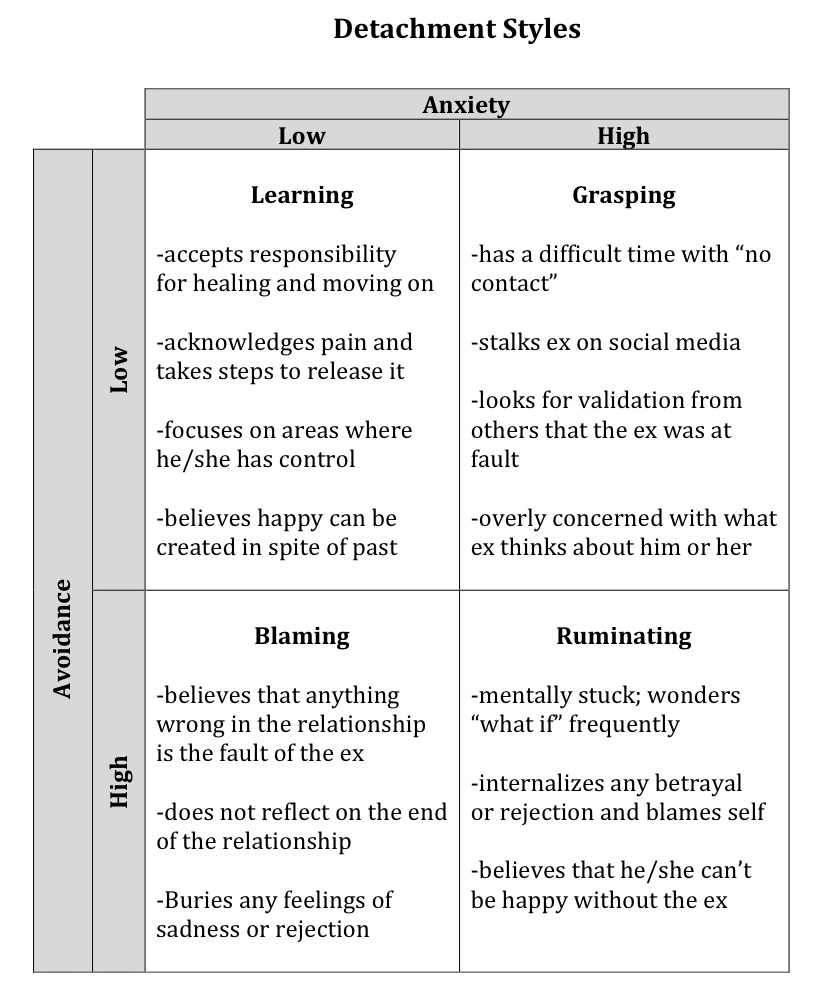
Of course, the way we respond at the end of a relationship also depends upon our personal makeup and early experiences. I created a chart of detachment styles based upon the same criteria.

detachment stylesAs with with attachment styles, you will likely recognize yourself in more than one category or realize that you have moved from one box to another over time. These are not fixed traits; you can change your position with intention and effort.

Breaking up happens. How do you want to detach?

One Marriage, Two Lives

Brock and I watched American Sniper last weekend.

We both walked out in tears.

It’s a powerful movie.

And one that highlights many uncomfortable truths.

I’m not going to get into the story. Or the controversy.

But I do want to address one common issue the movie emphasizes.

That people who share one marriage often lead very different lives.

In one poignant scene, the sniper is riding in the back of an armored vehicle through the streets in Iraq. He’s on the phone with his new wife, who was walking out of the doctor’s office where she had just learned the sex of their new baby. On his side, shots are fired. The phone falls and is trampled as soldiers respond to the immediate threat. On her side, she wails as she hears the shots fired across the world. She screams for her husband while clutching her unborn child.

One marriage, two lives.

A military marriage with one spouse deployed is an extreme example of spouses living in different worlds. One occupies the domestic world where daily concerns are often limited to the mundane while the other is living on the edge of hell. The one left behind is desperate to connect, wanting to know about the experiences. Whereas the one who has returned has witnessed scenes that no one should ever see and works to shield his or her spouse from what they saw. It’s no wonder that military spouses often have trouble relating once they are reunited.

This phenomenon is not limited to military marriages.

Lives diverge when distance separates partners for protracted periods of time. Whenever one spouse has job that reveals the darker side of humanity, they may be more likely to erect a screen, safeguarding their partner from reality. When one partner assumes most or all of the parenting duties or when one is fully responsible for securing a living, they have to make a continued effort to maintain a connection between their worlds. And even a couple that shares much of daily life risks growing apart if they fail to check in with the other.

In every marriage, there are two distinct people with two distinct lives.

In every successful marriage, there are two people who actively work to build and maintain a bridge between those two existences.

So that rather than one marriage splitting into two lives, it’s two lives joining into one marriage.