The Best Way to Get Over Someone?

It’s common advice –


The best way to get over someone is to get under someone else. 


And in many ways, this suggestion makes sense. After all, what better way to remind yourself that the one you lost is not the only one than to sample what is available? At the same time, like any advice, this strategy may not be right for you and could even compromise your healing process after divorce or a breakup.

Here’s what you may want to consider before following this advice:


The Pros of Getting Under Someone Else:


Reminds You That There is Life After Divorce

Divorce has an impressive talent for being all-consuming. It expands to fill every nook and crevice in your life, displacing many things that once brought you happiness or peace. The excitement and passion of a no-strings-attached encounter can remind you that a whole world of possibility still exists as your numbed and deadened tissues are sparked into life.


Makes You Feel Desirable

Especially if you were rejected, you may be feeling unlovable and undesirable. So when somebody suddenly wants you, it’s intoxicating. The experience can help you begin to see yourself in a new light – not as a broken and hurting person, but as a whole and appealing person.


Provides an Outlet for the Excess Energy

Divorce often results in a period of almost manic energy. It’s a mania frequently characterized by a need for action and compulsive thoughts and actions. A fling offers a welcome outlet for this energy, both physical and mental.


Acts as a Distraction

Much of the divorce process is positively soul-draining. It manages to be both scary and tedious as it drags on while threatening to take what little you have left. And there’s nothing like a little dalliance to take your mind off the latest email from the attorney or the fact that your ex is ignoring the divorce decree.


The Cons of Getting Under Someone Else:


Can Leave You Feeling Emptier and Lonelier

For a split section, all feels right with the world. You’re snuggling up against your fling, relaxed and happy. And then either they say something or you think something that causes you to remember that for all intents and purposes, they are a stranger. And sometimes that realization makes you feel more alone than if you had the entire bed to yourself.


May Lead to Guilt or Shame if Not Aligned to Values

Sometimes the sudden freedom and mania combine after divorce to make people do things they would never do under normal circumstances. Of course, these are not normal circumstances. On its own, this is not a problem. But if your actions do not align with your beliefs or values, you may be setting yourself up for a major guilt case of guilt or shame.


Healing Can Be Delayed or Confused

Healing is hard work. And for the most part, healing is an inside job. When all of your energy is focused outward, you may not have enough energy or willpower to do the real work of healing. Additionally, the initial high of a fling can lead you to believe that the solution to your heartbreak is found with another person. This often leads to a leapfrogging pattern, where you leap from one temporary relief to another.


You May End Up in Awkward or Even Dangerous Situations

After divorce or a breakup, your brain isn’t working very well. You may be more likely to engage in risky behaviors since you feel like you have nothing to lose. Furthermore, you may find that you’re inadvertently attracting people that are looking to use you or that become too attached too quickly. You’re vulnerable right now and that can lead to ending up in situations that get you in over your head.


All of that being said, do what’s right for you. And feel free to change your mind about what’s right at any moment. When it comes to life after divorce, few of us follow a rational and straight path as we leave the marriage and reenter the world. More often, we stumble around and end up making some poor decisions before we find what feels right.

And there’s no shame in those mistakes and missteps. You’re learning.


If you decide that getting under someone else is not the right move for you right now, but you’re still looking for an outlet for that energy that will also help to give your purpose and confidence, here’s my favorite strategy.
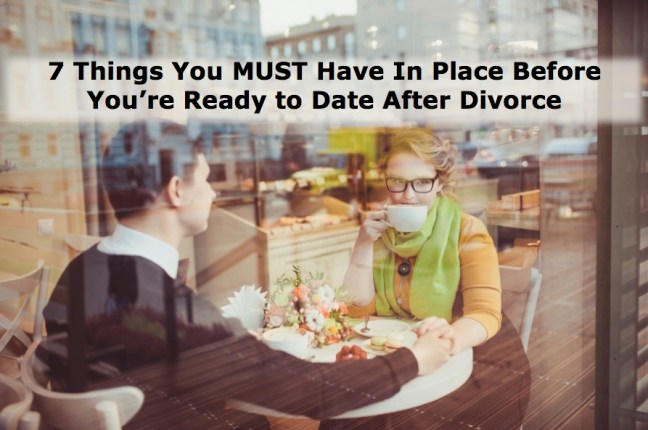
You’re Not Ready to Date Until You Have These 7 Things In Place!

I put the cart before the horse when it came to dating after divorce. I invited dates to take part in the drama that my ex husband directed. I looked to my partner for the day for emotional support and validation that I was desirable even after being rejected. And I even allowed my date’s views of me to shape my own self-image.

Overall, I made the experience much harder than it needed to be because I didn’t have these seven things in place before I started dating:


The Volume Turned Down On the Drama

“Can you believe my ex said that? He is such a narcissist.”

“She didn’t show up at school to pick up the kids. Again.”

“I saw her in his Facebook feed again. Ugh. She’s young enough to be his daughter.”

Divorce brings with it immense change and overwhelming emotion. And when those two collide, drama is sure to ensue. And even though the theatrics are often negative, it is easy to habituate to the intensity and excitement until drama becomes the norm.

If your life currently resembles an episode of reality television, it is not yet time to craft a profile on OKCupid. Rather than acting as a stabilizing influence, bringing somebody into an unstable environment only accentuates the turmoil. Wait until your life is more documentary and less Real Housewives before you enter the dating scene.

A Supportive and Diverse Friend Group


There is no doubt about it – divorce is isolating and can often leave you feeling lonely and rejected. It can be so tempting to turn to dating to meet your social and emotional needs, to feel loved and lovable.

Yet, if you approach dating with this need front and center, you will find that you are unsuccessful in attracting emotional healthy people. Additionally, you are placing an unfair share of your needs at the feet of another.

Before you focus on dating, spend time and energy building and fostering your platonic friend group. Your goal is to have all of your social requirements met so that when you do date, it’s out of want, not driven from need.

Time and Energy to Spare


First you have to write your dating profile or make an effort to get out of your usual circles. Then come the early exchanges, the tentative assessments of potential compatibility and shared interests. This is followed by the actual date, filled with nerves and expectations.

And that’s only the beginning. Dating requires a consistent supply of time and energy. And both of those can be in short supply in the early stages of divorce. Before you begin dating, ensure that you have the space and enthusiasm to accommodate it in your life.

A Passion Project or Engrossing Hobby


When we experience a void in our lives (such as after divorce), it is easy to become obsessive in the drive to fill the emptiness. And if you don’t have something in your life that brings you joy and a sense of accomplishment, it’s easy to turn that all-consuming drive towards dating. Often with disastrous consequences.

So before you attempt to fill that emptiness with another person, take the time to find some activity or cause that you are passionate about. Throw yourself into for a time. Use that opportunity to discover (or rediscover) what makes you tick and what makes you special. And then later, when you begin dating, you’re looking to be complemented, not completed.

A Counselor or Other Emotional Outlet


Your date is not your therapist.

When triggers arise or emotions become overwhelming, it is critical that you already have a safe and supportive place to vent and receive guidance. You can certainly be open with your date about your experiences and your past history, but refrain from unloading the emotion on them. That’s not their role.

Prior to accepting or asking for that first date, make sure you have your support system in place and that you’re practiced with turning to them for help.


Belief That You Can Be In a Healthy Relationship


Seems obvious, doesn’t it? Yet obvious doesn’t always happen. It can be tempting to turn to dating as a distraction from the pain and loneliness of divorce. Sometimes we find ourselves “sliding” into a relationship without much foresight or intention.

And when these happen, the change in status can come before the conviction that you can be in a healthy relationship. Which often means that you find yourself in a partnership that is toxic at worst and unfulfilling at best.

Spend time defining what a “healthy” relationship looks like to you and cultivating the traits needed to make it a reality before you act.

Self Worth and a Realistic Self-Image


It feels great when a stranger complements your appearance or a date makes you feel desirable. Especially after the rejection and uncertainty surrounding divorce, that attention is affirming and confidence-building.

And it’s also a bit of an illusion because when you seek validation outside of yourself, it’s never enough. Work to establish and recognize your own worth independent of the thoughts and actions of others. That internal validation is always enough.

Additionally, make an effort to construct a realistic image of yourself, untarnished by the possibly harsh words of your ex or the sycophantic remarks of a prospective date.

You don’t need a partner to tell you you’re worthy.

You don’t need a date to tell you who you are.

Once you see, know and appreciate yourself, you will project that confidence and invite others to view the same.

Advantages to Dating In Your 40s (and Beyond)

dating 40s

One of the myriad side effects of divorce is that you may find yourself thrust back into the daunting world of dating in your 40s or beyond. It’s easy to dismiss dating as a young person’s game and become intimidated at the prospect of putting yourself back out there after life has had years to make its marks upon you.

Love is not, “One strike and you’re out.” You always have another chance.

Perhaps you worry that your body is too saggy or that your emotional baggage is too heavy. The thought of putting your best face forward and making the effort to get to know somebody sounds exhausting. You’re hesitant at the thought of opening up again and you’re increasingly enjoying doing things your way. And through all of these concerns, is the uneasiness that there is nobody out there for you (or the twin fear that nobody will want you).

Yet the urge to connect is still there, persistent in its approach. You may no longer be looking for somebody to start a family with and your white picket fence dreams have faded with the harsh light of day, but even now, you desire to have someone by your side. A partner through life’s second half.

Dating in your 40s is an opportunity to apply what you learned in your 20s and 30s. 

Dating when you’re younger is all about possibility. Excitement. It’s less about what you’ve experienced and more about what you want to accomplish. The youthful veneer of invincibility has yet to wear off and so you may approach relationships with a sense of certainty that if it feels right, it is right.

Dating in your 40s is different. You’ve experienced both love and loss. You’ve had to accept that wanting something to be true doesn’t make it so. And while it’s true that dating in midlife can be more challenging in many ways, there are also many advantages to dating once you have lived a little.

In many ways, it’s easier to determine if someone is the right person for you when you’re dating in your 40s.

Here’s why…

You see who somebody is, not what they promise to become.

When I was dating my first husband, I stated that I would never be a teacher and he promised that he would never turn into his father. We were wrong on both counts.

When you’re dating in your teens and 20s, you are basing decisions about how well you fit with somebody based on their dreams and youthful intentions. And many of those expectations may never materialize.

Once you’ve reached your 40s, those early aspirations have been woven with reality, a tapestry that speaks to the truth of who you are. You no longer have to rely on who somebody says they want to be, you now have evidence to support (or refute) their claims.

You are able to ascertain how they handle transition, disappointment, mistakes and failure. 

I never knew that my first husband was prone to cowardice and deception until he faced some harsh realities associated with his chosen career. If I had known that about him ahead of time, I may have thought twice before deciding to marry.

Few of us reach 40 without dealing with some major blows from life. When you are getting to someone new that has been through life’s tumbler, you have the opportunity to discover how they handle hard times before you make the decision to make them your partner through the good and the bad.

All of this is valuable data to have that is difficult to come by when you’re younger.

The inevitability of mortality often encourages more vulnerability.

There’s a softening that happens to people in their 40s that is unrelated to the effects of gravity and a slowing metabolism. Parents are aging, friends are beginning to be diagnosed with serious illnesses and you begin to experience the inevitability of aging.

As a sense of invincibility is replaced with a respect for mortality, a desire for real connection often follows. When you no longer feel like you have forever, you begin to understand the importance of every moment and every interaction.

Along with this sense of urgency comes a fear of being alone and of missed opportunities to express your feelings. All of this can lead to more openness and less ego.

Your beliefs and values have become your own and you are less concerned about appearances and the views of others.

I love to compare first weddings to subsequent ones. The initial nuptials are often lavish affairs, dictated both by what’s popular and by the expectations of the families. Second weddings are more personalized and less commercial, reflecting more on the couple than on those around them.

Relationships often follow similar patterns. When we’re younger, we’re more likely to structure our lives in a certain way because it’s what’s expected or because we want others to perceive us in a certain way. Once we reach our 40s, there’s a certain confidence and a “Don’t care what others think” attitude that reflects a comfort with your own beliefs and decisions.

Lasting friendships give insight into commitment and loyalty. 

“I promise to never leave you,” my first husband said. And then, over the years, I saw him leave friendships, his parents and eventually, me. In contrast, when I met my second husband’s friends, I was impressed at the longevity of these friendships and his loyalty even through trying times.

Maintaining friendships becomes more challenging as we grow older and our lives become increasingly busy. When you’re dating someone in midlife, you have this powerful window into how important maintaining relationships is to them.

You learn about their adaptability. 

Change or become obsolete.

It’s harsh. But you only have to look to the natural world to see its truth.

I’m a firm believer that adaptability is one of the core qualities people need to have for successful relationships.

And by our 40s, life has given us many opportunities to adapt – children come and go, jobs are secured and security is threatened, earlier choices lead to unseen consequences that require difficult choices. And aging will bring even more opportunities for adaptation. Isn’t it nice to have a sense of how somebody will cope?

Dating has its challenges at any life stage.

And it also has its advantages.

Don’t let fear or discouragement hold you back.

There is no age limit to love.

6 Questions to Ask Yourself to Decide If You’re Ready to Date After Divorce

You’re Not Ready to Date Until You Have These 7 Things In Place!

I put the cart before the horse when it came to dating after divorce. I invited dates to take part in the drama that my ex-husband directed. I looked to my partner for the day for emotional support and validation that I was desirable even after being rejected. And I even allowed my date’s views of me to shape my own self-image.

Overall, I made the experience much harder than it needed to be because I didn’t have these seven things in place before I started dating. Click here to learn more about my mistakes!