Why I Don’t Want a Perfect Marriage

I became a bit incredulous yesterday when a woman on Twitter proclaimed that her marriage was “perfect” once she found a compatible partner. You see, not only do I not believe in perfection (except in the obvious exception of the first sip of hot coffee on a cold morning), I don’t trust it.

Sometimes perfection is a cover.

In many ways, my first marriage was perfect: we rarely disagreed, we shared many views and ideas and we worked together seamlessly. But underneath that facade was a husband who was playing a role and a wife too afraid to turn on the stage lights.

Sometimes perfection is a phase.

In the early stages of a relationship, it is completely normal to place your partner on a pedestal and to casually whitewash over any red flags (or even areas of discord). It’s easy to be perfect when reality hasn’t had time to intrude upon fantasy.

Sometimes perfection is boring.

There’s a reason that artists add a jarring element to their work and writers give their protagonists a flaw. Perfection isn’t interesting. It doesn’t hold our attention or stimulate our thoughts. It demands nothing of us and offers little contrast to prompt gratitude and attention.

And sometimes perfection is protection.

It’s scary to truly accept your partner as an individual with his or her own views, perceptions and decisions. It’s terrifying to see that no marriage, no matter how seemingly perfect, is infallible. It’s much nicer to see your vessel as sink-proof rather than acknowledge the weakness inherent in its construction.

Perfection is illusion.

None of us are perfect in our own right. And when you join two together in a day-to-day venture with long-reaching goals? That imperfection can easily be amplified. Marriage is not a fairy tale. Happily ever after is not a conclusion; it is a choice.

Relationships are not easy.

But that doesn’t mean that they should be a source of constant struggle or endless fear.

There is a wide span between dysfunctional and perfect.

A world between bad and flawless.

Aim to be there.

Finding a compatible (and healthy) partner is important.

But that’s not the end game.

It’s just the beginning of a relationship that requires intention, attention and adaptation.

I don’t want a perfect marriage.

I want a marriage that encourages two imperfect people to become better.

I don’t want a husband that always agrees with me.

Sure, it’s nice to hear that you’re right. It’s validating to have somebody echo your perspectives and pat you on the back for your insight. But it’s also limiting. If you surround yourself with “yes men,” you will never have your assumptions challenged or be forced to confront your own incorrect beliefs and conclusions.

I want to be called out on my B.S. Not because it feels good, but because it forces me to face it. I want to have to defend my thoughts. Not because I always seek debate, but because it requires that I think about a topic rationally and thoroughly. I want to hear other perspectives. Not because I always agree, but because seeing all sides of a thing adds to understanding.

I want a husband that always believes in me.

Although I don’t want a husband that is a sycophantic parrot who agrees with my every utterance, I do want a spouse that believes in me. That sees my potential even when he disagrees with my approach. That trusts that my intentions are sound even when my tactics may be less than ideal. That sees past the noise of the moment and sees the person beneath.

I want a husband that believes in me even though I am far from perfect and that believes in our marriage even when that marriage requires work.

I don’t want a partner to complete me.

I am whole on my own, thank you very much. One of the ironies of a good relationship is that it starts when neither partner needs the other. I’ve lived the life where I experienced a constant fear of losing my spouse. And I don’t want to ever live that again.

I don’t want a person that molds to my every weakness, filling in the areas where I lack. I don’t want somebody that always takes over when I am lacking, shifting all of the burden onto his shoulders. I don’t want dependence. I want interdependence.

I want a partner that complements me.

I want a partner who shares a life vision and philosophy with me. Who has the same overall goals even when the approach may differ. I want my husband to model ways of improving my weaknesses and act as a cheerleader and coach to help me strengthen those areas. I want to do the same for my spouse, not enabling but encouraging.

I want a partner that does the jobs I don’t enjoy or that don’t match my skills. But I also want my partner to teach me how to do them. Even if I never excel, at least I know that I am capable.

I don’t want a relationship that always makes me feel comfortable.

It’s nice to be comfortable. There’s a reason most of us live in conditioned spaces furnished with upholstered pieces. It’s relaxing. But it’s also limiting. Because when you are too comfortable, you become afraid of change.

And change is inevitable.

Growth is optional.

Our adult relationships are often the place where we play out and hopefully resolve the wounds of our childhoods. Common themes of abandonment, codependency and addiction often follow us into our marriages, forcing us to confront uncomfortable truths.

We don’t learn when we’re comfortable. But we also don’t learn when we’re panicked.

I want a relationship that makes me feel safe.

I want a relationship where I feel safe. Not just physically, but emotionally. Where I feel like I won’t be shunned for stating my feelings and I feel able to express my emotions. Where it is understood that a disagreement does not mark the end and that a different view does not represent a different intention.

I want a relationship that may not always be the upholstered chair but that is always a sanctuary to return to. Where I know I’m okay even though I may be a little uncomfortable.

I don’t want a partnership where I never have to compromise my choices.

It’s unrealistic to believe that two people can coexist without some compromise. Whether it be the color on the walls or the number of children, there will be times when one or both partners have to adjust their desires. When the good of the marriage is more important than the good of the individual.

I want a partnership where sometimes my spouse caves in to my desires. And when sometimes I have to subdue mine for his sake. Part of playing nicely is learning how to share.

I want a partnership where I never compromise my core self and values.

But I also want a partnership where I feel at peace and connected to myself. Where I hold true to my values and basic beliefs. Where I am not lost under the weight of the marriage, but serve as one of the foundations of it.

I don’t want a marriage that is perfect.

I don’t want a perfect marriage. A perfect marriage doesn’t have the ability to grow and change as life changes around it. It doesn’t serve to challenge its participants and teach them how to improve. A perfect marriage is a risky marriage; there is no practice in facing adversity from within. When a perfect marriage fails to be perfect, it fails.

I want a marriage that accepts imperfections and grows and adapts. And that encourages me to do the same.

I want a marriage that accepts me as I am. I want a marriage that challenges me. I want a marriage that is exciting and a little uncertain. I want a marriage that requires attention to grow. I want a marriage that looks different in ten years than it does today. I want a marriage that adapts and keeps me on my toes.

I want a marriage that is real.

And real is rarely perfect.

As for the woman on Twitter with the perfect marriage?

I ended the conversation by saying that I am happy for her.

And I am.

I just hope that she doesn’t get cut too deeply if that perfections shatters.

Love With a Ten-Foot Pole

When catching up with my mom’s neighbor (and member of the virtual Lisa cheering squad over the last 6 years) last month, he jokingly asked me how I managed to fall in love again.

“I assumed you would have those boys held back with a ten-foot pole. After what you’ve been through, I sure wouldn’t blame you!”

“It doesn’t work that way,” I responded. “Love from ten feet away is no love at all. Gotta go for it or decide you it’s not for you.”

Love is all or none.

If you try to hold it at a distance, you end up pushing it away.

If you attempt to control it, you will inevitably strangle it.

If you build walls and hang back out of a fear of being hurt, you are avoiding the very intimacy that is the foundation of a relationship.

If you punish your new partner for the sins of the old, you are wrapping the new in the cloak of the past.

If you assume that this partner will also hurt you, you are more likely to be hurt again. After all, the dog that you expect to bite often does.

Love is always a risk. Whether you’ve been hurt before or not.

It’s just that those of us who have felt the anguish of an end know exactly what it is we are risking.

And you may decide that it’s not for you. That you’re happier alone and don’t want the risk or the compromises again.

That’s okay. Life is not one size fits all. Tailor your life to your specifications.

But if you do decide you want to let love in, you have to be ready to embrace it. Risks and all.

That ten-foot pole may make you feel safer, but all it’s really doing is keeping love at arm’s length.

Love is all or none.

The “Ikea Effect” in Marriage

My aunt and uncle came through Atlanta a couple of weeks ago on their trek to escape the horrid winter the north has experienced this year. It was their first time visiting the house we bought a year and a half ago.

And as I was taking them on the obligatory house tour, I realized something.

I don’t feel a super-strong sense of ownership of my home. At least not like I did with my old house. With my first property, there was not a wall I didn’t paint, a floor I didn’t redo or a room that wasn’t meticulously planned and executed. I was proud of that house, not because it was so great, but because my then-husband and I created it through endless hours of sweat and tears, late-night marathons of Love Line alternating with the soundtrack from Jesus Christ Superstar and countless creative work-arounds to create our vision on the cheap. We made that house.

I love my home now. Unlike the last one, this one didn’t require endless hours (and dollars!) to make it what we wanted. In most ways, it was move in ready. All we have really personalized at this point is the basement theater and, to a much lesser extent, the yard.  Which has been awesome (especially because it gives us time to live, not just renovate). Yet it also changes how I feel about the house. It’s mine, but it’s not born of me. I live here, but I didn’t have to give it life.

Economists have dubbed the impact of sweat equity on emotions the “Ikea effect” after the attachment people can feel to their inexpensive mass-produced furniture after they have contributed their effort in the turns of a few cam nuts and the insertion of countless wooden dowels.

It’s why people often have an inflated sense of value of a home they have renovated or believe that others will hold their creations in high regard. It is even part of what makes every parent believe their child is special.

When we build it, we appreciate it.

All of these thoughts tumbled through my mind as I led them through the rooms. Honestly, it was starting to make me feel like we needed to fast-track some of the non-essential projects we have planned for the future.

And then I realized the impact the Ikea effect has on my marriage.

Unlike my first marriage, this one was born of intention and effort on both of our parts. We have removed the rotten pieces of our pasts, sanded smooth the rough edges and built upon the reinforced foundation.

And when we build it, we cherish it.

I may not have much sweat equity in my house yet (although this gardening season will change that. literally.), but I have plenty of sweat equity in my marriage. A trade-off I am more than okay with.

Where do you see the Ikea effect in your life?

10 Contradictory Qualities of a Good Marriage

It is often said that marriage is a balancing act. It requires weighing the needs of the individual against the needs of the partnership. It necessitates compromise and constant communication. And a good marriage also needs to find the equilibrium with the following contradictory qualities:

1) Adaptability

A good marriage is adaptable; it grows and molds itself to the environment and current needs. It changes as the partners do, shifting over time and over life transitions. It acts like the flexible caulk used to secure two surfaces together while allowing each to move independently of the other. A good marriage possesses a growth mindset, where both partners are motivated to learn and believe that they can improve with effort. Growth ensures that a marriage remains relevant and useful.

Adaptability extends to the individuals. It accepts that people change over time and with experience. In an adaptable marriage, each partner remains curious about the other and limits assumptions and premature conclusions.

And although a marriage needs to be adjustable, it also requires…

2) Consistency

A sense of security and support is critical in marriage. Both partners need to have a sense that their spouse has their back. Each needs to feel safe, both physically and emotionally, so that the critical component of vulnerability can be revealed.

And much of this peace of mind comes from stability. Consistency. You want to know what you’re returning home to each night. You want to have a sense of what your partner likes and how he or she will react. Consistency encourages confidence and trust, both critical for a marriage to thrive.


3) Personal Responsibility

In a good marriage, both people are looking for a partner to complement them, not complete them. Each person accepts responsibility for his or her baggage, actions and emotions. Nobody is held accountable for the other person’s happiness and nobody is expected to be a white knight to the rescue. Blame is withheld and instead of expecting the other person to change, each partner modified his or her response to a situation. A healthy marriage begins with two healthy people and that requires taking responsibility for yourself.

However, there are times when you can’t do it yourself, and in a good marriage, you also need to be able to…

4) Ask For and Receive Assistance

Being able to ask for help is a sign of both humility and strength. Being able and willing to provide help is a sign of empathy and compassion. Part of a good marriage is being willing to quiet the ego and admit when you lack knowledge or ability. In turn, a strong partnership calls for a partner who is responsive to their spouse’s needs and refrains from making him or her feel inferior when assistance is required. Marriage is about partnership. And a good marriage is about helping your partner when he or she cannot help themselves.


5) Withhold Judgment

In a good marriage, the word “should” is banned from the table. Assumptions and projections are limited as each person is accepted for who he or she is. In conversations, the partners listen to understand rather than listen to respond. Instead of leading with judgment, the spouses lead with curiosity. Criticism kills a marriage. Appreciation nourishes it.

Yet even though a good marriage is free from judgment, it also requires that the partners are not afraid to…

6) Call Each Other Out

Presumably, nobody knows you better than your spouse. And that puts them in a unique position to see and perceive the lies and limitations you place upon yourself. In a good marriage, partners will call each other out on their s**t. Not to shame or bully, but to help the other become better. A marriage thrives when rather than quietly accepting the excuse of “I can’t,” a spouse helps to show their partner that indeed, they can.


7) Overlapping Worlds

A good marriage exists in the intersection of two lives. There are shared experiences. Shared friends. Shared passions. And shared dreams. There is a merging of two lives. “Me” is replaced with “we” and “mine” with “ours.” Each person plays an active and visible role in their spouse’s life. Compromises are made and the marriage is prioritized.

Although a good marriage requires sharing many aspects of life, it also needs…

8) Independence

Each person should always know where they end and their partner begins. A marriage is not one and one make one; it’s two individuals choosing to share their lives. And they need to maintain their individuality. A good marriage allows each person to explore his or her own interests. It provides freedom and encouragement to explore individuality while maintaining the bond of the shared life.


9) Enjoyment of Each Other

A good marriage has at its heart two people that enjoy each other. Partners that greet the other with a smile and look forward to time together. Spouses that are both friends and lovers, providing comfort and excitement with their touch and their presence. Marriage is about the shared and realized dreams. The laughter over a joke nobody else understands. The knowing glance that contains a year’s worth of information with no words exchanged.

Even though the partners in a good marriage enjoy each other, they may not always like each other and so they also…

10) Accept the Bad Days

Even in the best of marriage, there will be bad days. And in the best of marriages, these days are not perceived as the beginning of the end nor do they signal a need for panic. Rather, it is accepted that some days will be bad, that marriages have an ebb and a flow. That there will be times that one person withdraws, and that withdrawal is usually temporary.

Bad days can be an opportunity to learn and grow. Or simply a sign that it’s time to rest a bit and wait for the storm to pass. Just as a bad day does not mean a bad life, a bad day does not signal a bad marriage. The spouses trust that the tide always turns and they’re waiting for each other when it does.

How to Change a Man

I met up with a friend the other day. She’s at a crossroads with the man she’s been dating for the past year or so. She wants marriage. Not now, but she wants to move that direction and wants that to be the mutual end goal. At this point, he states he does not want marriage. Now or at any point. They’re in that difficult place where the relationship works, but the objectives of the partnership don’t align.

Having known Brock back in the days when he said he never wanted to be married, she inquired, “How did you get him to change?”

The short answer?

I didn’t.

And I couldn’t. At least not in any meaningful and lasting way.

I didn’t make him change. I didn’t ask him to change. I didn’t expect him to change.

But here’s what I did do:

I Accepted Where We Were

I always knew I wanted to be married (or at least something like it) again. But that didn’t mean I wanted to jump straight into commitment immediately. In fact, Brock was always the forerunner on taking the relationship to the next level.  And we baby-stepped it from one level to the next. And as we slowly integrated our lives and tore down our walls, I simply enjoyed the place where we were.

I Accepted Him

As with any relationship, as the newness wears off and the pedestal lowers, you discover certain traits and characteristics of your partner that drive you a little nuts. Since none of his quirks were red flags or deal breakers, I worked on accepting them. In fact, I’ve even learned to appreciate some of what can easily annoy me.

I Limited Expectations

I knew that our relationship may not progress to marriage. And I was okay with that. I had no expectations of a wedding or a white picket fence. I simply knew that I loved him and loved being with him. And that the time together wasn’t wasted even if it didn’t result in nuptials. Besides, I had learned about the dangers of expectations:)

I Didn’t Push

I never initiated a “where are we going?”talk. In fact, the only relationship-oriented talks we had were about where we were, making sure that we were on the same page along the way. I was patient as he learned how to be in a serious relationship and, later on, learned how to share a home and a life. I gave him time and space to acclimate.

I Worked on Myself

Whenever I found myself frustrated or disappointed by something in the relationship, I made an effort to examine my own responses (which, no surprise, were often overreactions). I learned that by changing my reactions, I could change the dynamics of our interactions.

And over time, the man that never thought he would be married, not only decided that he did, he also became an amazing and dedicated husband.

But the most important part wasn’t what I did.

It’s what we did.

Because everything that I did that compelled him to change, he also did for me. In spades.

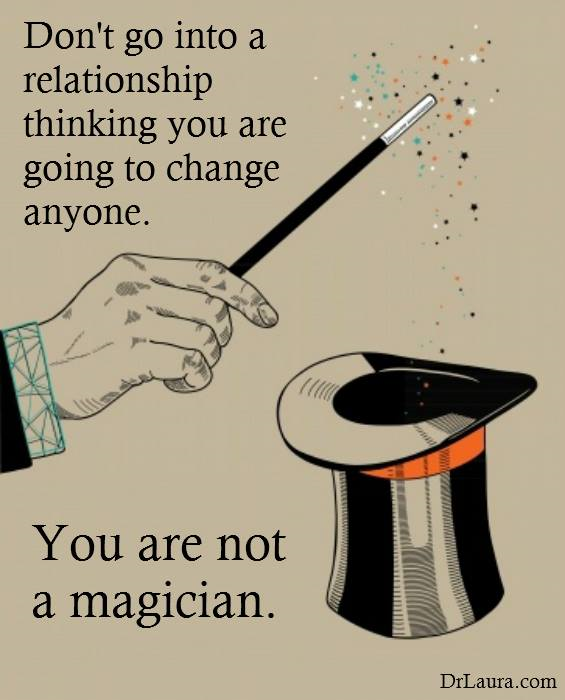
You cannot ever change your partner.

But you can be someone that inspires them to change themselves.

Because ultimately, the only guaranteed way to change a man (or a woman) is to change yourself.

2015/02/img_4385-1.png