When Fears Become Reality

The trill of my phone woke me up.

Fumbling without the benefit of my glasses, I managed to answer the call.

“I’ve been in an accident,” I heard my husband’s voice say. “I was driving 75 on the interstate and someone slammed into the back of me and drove off.”

“Are you okay?” I implore, my heart already seeking shelter in my stomach.

That phone call, or one like it, is my fear every time he travels the roads for work. And last night, that fear became reality.


In my first marriage, I had a persistent fear of losing my husband. It was a low-level hum of anxiety that periodically (spurred by some situation or another) would spike into almost-panic. Sometimes, I would follow my thoughts down a mental rabbit hole, even picturing receiving the news and the aftermath that followed.

And then ten years ago, that fear became real.

What used to be my nightmare became my life.


That happens sometimes – our fears becoming real. And the way I see it is that, after the dust settles, we ultimately have two choices, two conclusions that we can reach.

My fears became real. Therefore, I should always listen to and believe my fears.

Or…

My fears became real. And I survived. Maybe even discovered that the reality wasn’t as bad as what the imagination had conjured. Therefore, I should learn to trust in myself and my ability to handle whatever life throws at me.


Last night was rough. The accident happened in Alabama, almost three hours away from the house. My husband was experiencing neck pain just above where he had cervical fusion last year. And he wasn’t sure if the car was drivable. It was a rough few hours while he made it back and I sat helplessly worrying.

But he made it home just after midnight. And today, the doctor cleared the neck and the car is in the hands of the body shop. It could have been a tragic night. Instead, it’s now in the realm of an expense and a nuisance.

My heart is back where it belongs.


The Many Faces of the Affair Partner

I saw a question posed on Twitter yesterday asking if anyone had written to the affair partner and, if so, what the outcome was.

The responses were interesting and quite diverse. It soon became clear that the type of communication (not to mention its aftereffects) with the affair partner were very much dependent on the relationship that person had to the wayward spouse prior to the affair and their role in the infidelity.


The Relationship of the Affair Partner Prior to the Infidelity


The Stranger

This is definitely the easiest of the horrible options to stomach. When the affair partner is a stranger, they become a blank canvas where you can easily project your own insecurities. However, there is little betrayal felt from them; after all, you’re a stranger to them as well. Additionally, if there is an attempt to salvage the marriage, this is the easiest relationship to cease all contact with and there are not likely many ties that make the disentanglement difficult.

The Acquaintance

We’re venturing into more difficult territory here. You’re likely to replay countless encounters with this person, wondering what was simmering beneath the surface that you failed to notice. There is probably an additional level of betrayal since this person knows who you are and knows who they were hurting in the process. As an acquaintance, it’s more likely that you’ll run into them and there may be mutual connections that lead to difficult or awkward situations.


The Coworker

This relationship is especially difficult if you’re trying to save the marriage. After all, your spouse can go “no contact” with a former friend, but generally bosses don’t look too kindly on that. They have to navigate the transition back to a professional relationship (which may be next-to-impossible if the affair partner has other ideas) and you have to fight the feelings of panic every day when they begin their morning commute.


The Friend

Your spouse and your confidant have been playing you. What a devastating discovery that throws your whole world into question. Who can you trust? The fractures caused by this type of infidelity travel far and wide, splintering friend groups and causing people to take sides. If you decide to try to salvage one or both relationships, building trust again will be especially difficult because everybody seems like a potential threat.


The Family Member

It doesn’t get any worse. We expect that family will always be there for us. And so the betrayal by a family member is equal to or even greater than the betrayal by a partner. You may be facing divorce and family estrangement at the same time, leaving you feeling orphaned and adrift.


The Role of the Affair Partner in the Infidelity


The Victim

They didn’t know that they were having an affair. They were told their partner was single, divorced or in the process of divorcing. Although they may not have been married, they are feeling betrayed as well once they learned that you were still very much in the picture.


The Willing Participant

This affair partner knows about your marriage, although they may have been incorrectly informed that your marriage is awful and that a divorce is inevitable. They may be married themselves or they may be attracted to those that cannot fully commit. In order to justify the affair, they may downplay its importance, minimize the marriage or compartmentalize the areas of their life.


The Instigator

This person set their sights on your spouse and then deliberately set out to win their attentions. They were not afraid to manipulate or lie in order to get what they want. If your spouse tried to set boundaries, this affair partner would attempt to bulldoze them over. They are unlikely to end the affair themselves and may make it difficult for your spouse to end it as well.


The Saboteur

Have you received disturbing messages from the affair partner? If so, this may be what you’re dealing with. These are the people that will not rest until they have left a path of destruction in their wake.


So What Does This Mean?


No matter the role of the affair partner, it’s natural to want to reach out – either to scream or to question. Or perhaps both. You want your pain to be heard and you want your questions answered.

Keep in mind who you’re dealing with. You can have a conversation with a victim, but not with a saboteur. The questions you’re going to pose to a stranger are very different than those you may ask a friend.

In my case, the affair partner was a stranger and a victim. I spoke to her on the phone for several hours while my (actually, our) husband was in jail. I wanted to warn her, protect her. She was never somebody that I had ill will towards. In fact, I desperately hope that she is okay. However, if she had been in a different role, I cannot promise that I would feel the same.

If you do attempt contact, wait until your emotional state is out of the red zone. By all means, scream or write those words you need to release, but release them into a safe space that will not have repercussions. Also, be aware of your expectations going into the contact. You most likely will not receive the response or answers you crave. There is no magic balm that comes from confrontation. No answers that illuminate everything. You’re not going to find healing from them.

So have your say. Ask your questions. Set your boundaries. And then let it go.

Enemy of the Good

Things are returning to normal around here.

The suitcase is unpacked and the warm-weather clothes, still imbued with the briny odor of the sea, have been washed and put away. When I stirred at 5:00 this morning, there were two pit bulls instantly by my side, anxious for their morning walk.

It’s good to be home. Back to my dogs, my bed, my shower and the simple pleasure of having access to a stocked kitchen. Unfortunately, my mind is back as well, losing touch with the straightforward plans of a vacation day and beginning to become overwhelmed with everything I’m telling myself I need to get done.

As I walked the pups this morning, acutely aware of the refreshing crisp air on my face in contrast to the wet slaps of the south Florida breeze, a familiar phrase made its way into my mind –

“The perfect is the enemy of the good.”

I had to smile at myself, thinking of the to-do list perched on my desk back at the house, items filling the page, waiting to be completed and crossed off. And that I wasn’t giving myself permission to relax until the list was complete.

I was – correction, I am – allowing the perfection of a completed task list to become the enemy of the enjoyment of a life filled with blessings.

And perfection isn’t the only adversary that good has to overcome. Can you relate to any of these?


Resistance to Change is the Enemy of the Good

I largely took a break from social media while we were on vacation. Yet every time I checked my Twitter account, I felt my heart smile. I’m a part of an informal group on there formed from those who have experienced infidelity. Apart from that common thread, the group runs the gamut from those that have just discovered the betrayal to those who, like me, are years out. Some are staying in their marriages while others have decided to move on.

For many in the group, this holiday is one of firsts – first since the discovery of the betrayal, first since the end of the marriage, or the first without the kids. In other words, it’s a hard holiday season for many in this group.

So why was I smiling? I was so inspired by the make-the-best-of-it attitudes and vows to start new traditions that I saw on my feed. This year was different. And resisting that change would only keep them from appreciating the good that was to be found in the little moments of this year.

Because that’s how it works, doesn’t it? If we refrain from focusing on what was, we allow ourselves to appreciate what is.


Expectations Are the Enemy of the Good

For our recent trip, we flew into Miami and rented a car (a convertible Mustang just like every other person in south Florida, apparently). We took our time exploring the keys, staying in Key Largo and Marathon before ending up in Key West, where we immediately returned the car.

The plan was to rent bicycles in order to get around the island for the final three days of the trip. I was all-in, picturing quiet beach streets and wide bike paths without any treacherous downhills to contend with. I pictured us exploring the area on our bikes, the breeze in our hair and the sun on our shoulders.

I was right about the hills. And the sun.

But the rest? Not so much. It turned out that the trek from our hotel to the main area was three miles on a crowded sidewalk next to busy street with constant traffic (including lots of trucks which provided the only breeze since I was moving too slowly to generate any myself). I started off shaky, but okay. But after a couple miles, I entered into full-on panic. It was far from the expectation that I had for myself.

Bless my husband; he was so patient. And even while I was tearing myself down, he was expressing how proud he was of me that I kept going even though I was petrified. At the end of that evening, I took an Uber back to the hotel while he took back one of the bikes. Then, the next morning, he pedaled back the remaining bike and we rented a scooter (where I would NOT be driving!).

And it was wonderful. Different than I had imagined, yes. But wonderful.

Because that’s how it works, isn’t it? If we let go of the mental image of how something should be, we can enjoy it for what it is.


Comparisons Are the the Enemy of the Good

One of the reasons that holidays can be so hard is that everybody tries to put on a show and then we end up comparing ourselves to these picture-perfect families and celebrations.

On Monday night, we watched football from the comfort of our hotel room (go Ravens!). The commercials broadcast by everyone from the grocery store to the car dealership seemed intent on cultivating envy in the viewers. The message was clear – just buy this thing and you too will have a perfect family filled with endless cheer and devoid of worry.

And so for those watching either the commercials or the curated posts by friends, the comparisons are inevitable and easily heart-breaking. Their concern about finances seems overwhelming when held up against the free spending on their screen. Their family, impacted by addiction or estrangement or divorce, seems incomplete and lacking compared to the perfectly posed group in matching pajamas. And their loss seems alien when contrasted with the bounty portrayed to us.

We know that these images are not real. That they are scripted and acted. Yet we sometimes still them as ideal and achievable, even when we know what is happening behind the scenes. Yet we can choose to see them for what they are – images created to either prey on our own insecurities or alleviate the insecurities of others.

Because that’s how it works, isn’t it? If we refuse to compare our lives to others, we can be grateful for what we have.


And for me, I’m going to try to focus less on completing my to-do list and more on enjoying what today has to offer.


Here are a few pictures from our trip. I highly recommend the Florida Keys for anyone who wants a Caribbean feel on U.S. soil and is looking for a great excuse to slow down and enjoy each moment.

This slideshow requires JavaScript.


The Power in Knowing You’re Not Alone

Releasing Attachments

Trigger warning: This post contains references to math. No math knowledge is needed to understand the point of the post and no test will be given at the end.

I helped to lead a professional learning opportunity for some teachers the other day. The focus was on the benefit of productive struggle for students. I had the teachers do one of the activities I do with my kids on the first day of school.

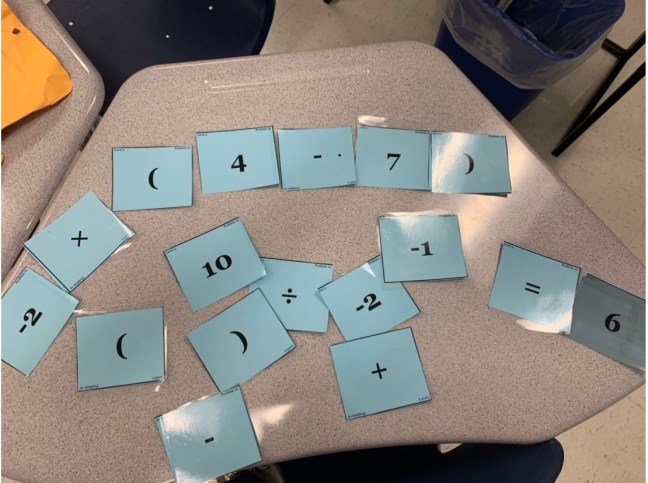
Each group of teachers received a set of cards. Their goal was to create a correct mathematical expression that, when using the order of operations, would equal the number on the gray card.

IMG_2069.jpg

It was fascinating to watch the adults, who were much more deliberate than the kids (no surprises there). Most interestingly, was how some of the groups became attached to certain parts of their expressions and, even when they could not make the problem work, refused to move those cards around.

Other groups never became attached to any particular combinations and freely tried a large variety of options.

In every session, the groups who held fast to their non-working attachments failed to complete the activity. And in every case, those that kept trying new things and were willing to release what didn’t work solved their problem.

Which often applies in other situations too, doesn’t it?

As is so often the case, I went in expecting to teach one lesson and I ended up learning something completely different myself.