What Are You Fighting For?

The streets and public gathering areas were filled yesterday as people came together to speak out about gun violence in our schools. The messages –  both printed and spoken aloud – were powerful, imbued with the energy that only honest emotion can convey. Instead of quietly cowering behind desks in the case of an active shooter, these determined voices are refusing to sit silently while life happens to them.

All of those who participated yesterday, either in-person or in-spirit, know what they’re fighting for. They are passionate, dedicated and motivated by their beliefs. They refuse to be passive in the face of adversity and instead of focusing on what they cannot do, they choose to concentrate on what influence they do have.

_ _ _ _ _

Nine years ago, I felt like I was in hiding from an attacker. Even though the assault was emotional and financial, my body spent much of the time curled into a protective fetal curve, quaking with the fear of anticipation over the next offensive volley.  I felt helpless, a ping-pong ball caught in the crushing turmoil as the brutal waves of reality crashed upon my unprotected shore.

I trembled. I questioned. I cried. I cursed the universe for the unfairness and I cursed the perpetrator for his selfishness.

He controlled me through the divorce, just as he controlled me through the marriage. As he attacked, I ducked. He accused, I defended. He stonewalled, I grew frustrated.

I was fighting, but I still felt powerless. Hopeless.

Because I was fighting for the wrong reasons.

I was battling against him instead of fighting for something that I believed in.

And as long as I allowed him to dictate the terms of the engagement, I would remain stuck and feeling victimized by my circumstances.

So I shoved him out of my mental space and instead I listened to my voice. My own convictions and guiding principles. And I changed the nature of my fight.

I vowed to fight for others who had experienced covert abuse, offering whatever I could through my own brush with gaslighting and manipulation. I had to make it through so that I could help others find their own way. As my focus shifted away from my own pains and my own struggles, I found more energy and fortitude than I realized I had. When I didn’t feel like I had the strength to climb each hurdle, I reminded myself why it was necessary. And that conviction made it possible.

_ _ _ _ _

When we have something to fight for, determination replaces the immobility of fear. Hopelessness is exchanged for motivation as the internal dialog changes from one of defeat to one of purpose. When you know what you’re fighting for, your focus narrows and your strength intensifies.

My challenge for you today is to identify what it is that you’re fighting for. Maybe you want to create a better life for children. Or perhaps you’re motivated to support your community or to create something new that meets a need.

Don’t stop with just the outline of an idea, flesh it out. Make it real. What form does this purpose take? What does it look like as you activate this purpose? See what you’re fighting for as your target, your focus.

And rather than fighting against what has already happened, fight for what you believe.


Jumping to Conclusions

jumping to conclusions

My 8th graders are finishing up a unit on geometric proofs. This material has even my live-and-breathe-math kids questioning, “When will we ever have to use this?”

And I’m honest with them. I confess that they will never be asked to write a two-column proof justifying why two triangles are congruent in order to clinch a job interview. No romantic interest will ever look over their paragraph constructed to show that a quadrilateral is, in fact, a rectangle and criticize the fact that they failed to correctly use the slopes to show right angles. In fact, the only time that this exact skill will come in handy is if they happen to become math teachers. (In fact, I’m kicking myself now for making my way through 9th grade geometry in a zombie-like haze.)

But I don’t stop there.

“Forget the content for a moment,” I advise them. “What does this process, as painful as it may be, actually teach you?”

There are confused looks. A few random and half-hearted attempts to answer my question. And then I hear it from the back corner –


“It teaches us how to think. How to move from one fact to another and not jump to conclusions.”


When I was four, I had not yet had the benefit of geometric proofs to teach me how to think. At my grandmother’s house, I would spend hours sitting by her side as she narrated her way through countless family photos. Photos, that were for the most part, in black and white.

So I reached the obvious (well, to a four-year-old at least), conclusion: the world used to be in black and white.

That made sense. But I still struggled to understand how my grandmother, who sat next to me in full color, could have become pigmented as a young adult. I wrestled with this dilemma for a time until I finally solved the problem (and felt quite proud of myself for my powers of deduction) –  Rainbow Brite was responsible for bringing color to the world.

Well, it sure seemed reasonable then.

I had leaped from one fact – photos had transitioned from black and white to color over time – to a completely arbitrary conclusion that was based solely on the information generated within my own mind.

That particular assumption was harmless (and humorous). But that’s not always the case.


Once we believe something, even if we leapt recklessly to that opinion, we then proceed to ignore that which doesn’t support our conclusion. 


We become willfully blind. Feeding on an information diet filtered through confirmation bias. Conclusions, like habits, are much more difficult to shape once they’ve hardened into place. The time to be careful is when you’re laying down the initial layers. Jumping to conclusions has a tendency to keep you in one place.

And that’s what my students are learning. Just like you can’t claim that an angle is right because it “looks” like 90º, you can’t assume things in life just because it “feels” a certain way. 

It’s harder in life than in the classroom. After all, the stakes are higher when you’re you’re talking about real life instead of a poorly drawn polygon. Yet the lesson is still the same as we learn how to not carelessly jump to conclusions:


Base everything on the facts.

Move from one fact to another. No jumping.

Accept that there may be more than one correct way to link these facts and don’t be afraid to explore these options.

Ask for another person’s opinion. Sometimes a fresh set of eyes will see something you do not.

When you have enough facts, make a conclusion.

If you find other facts that refute your conclusion, be ready with the eraser.

In fact, actively look for ways that your reasoning may be wrong. That’s how you test its strength.

It’s okay to make temporary assumptions to test a theory, but refrain from putting it in writing until you can prove it using facts.


Here’s an example of how I put this into practice in my own life as it pertains to learning to trust again after betrayal.


11 Tips to Make Friends As an Introverted Adult

make friends

I watch friendships form every day. I see the new kids slink through the halls and into the classrooms on their first day, both wanting to be invisible and also yearning for recognition and acceptance. Their first interactions with the other kids are often uncomfortable, but within the span of a week, most of the new students no longer stand out as different.

It’s easy to make friends in childhood. School provides both the structure and freedom needed for relationships to develop. Classes and lunch schedules allow for repeated exposure to the same people so that familiarity easily builds. The down time in the halls and the lunch room provides an easy opening for exploration and banter, often centered on the shared experience of school.

It’s not as easy to make friends as an adult.

Especially as an introverted one.

Introverts can easily underestimate the importance of friendships. After all, we don’t feel the same intense pull towards others that our more extroverted brethren experience. Our social groups are smaller, our interactions fewer. The need for time alone is often more pressing than the need for connection.

And yet, we need friends just as much as the gregarious. Loneliness and a lack of human connection has been associated with both lower mental and physical well-being. We introverted ones may treat friendships as a nicety, but they are really a necessity.

Introverts tend to be adept at maintaining already established friendships, especially with people that are understanding of their periodic need for hibernation. But when life circumstances remove those familiar relationships, introverts can stall in the quest to create – and build – new friendships.

So how can introverts make friends in adulthood?

Adult life doesn’t easily provide the nutrient-rich agar that friendships feed off of. We may encounter others sporadically or only with a task-oriented goal in mind. There are no teachers or counselors to intervene on our behalf, requesting that others extend a hand.

By the time we’re old enough to rent a car, we have become quite comfortable with the room within our own minds and, as independent beings, have the opportunity to curl up and stay there. This natural introversion can come across as cold or uncaring, leading to further isolation.

But with just a few tweaks and adjustments, even the most introverted can find and nurture new friendships.


Accept that you will be uncomfortable sometimes.

Like most introverts, I am comfortable in my own home. My own room. My own head.

But that’s not where potential friends reside. In order to meet people, you will have to leave your comfort zone. You will be in environments that may feel overwhelming. You will be asked to stretch beyond your unusual routine. Learn to distinguish between ordinary discomfort and your intuition telling you that something is amiss. Refuse to pander to the former and what was once unsettling will become easier to navigate.


1 – Seek out one-to-one or (very) small group interactions.

Play to your strengths. You likely find large groups of people draining and even isolating. While an extrovert may throw a party to meet new people, you’ll be better served by inviting an acquaintance to coffee.

Recognize the numerical tipping point where you go from. “I like this” to “This is too much” and strive to keep your social interactions within that limit. When you do find yourself in a big group, try to find or create a smaller, more intimate gathering within (or just beyond) the masses.


2 – Say yes.

I know your book is calling. I know that you crave the solitude of your bed after a crazy day. It’s easy to make excuses to those invites that find there way to you. To beg off those intrusions on your peace.

Make a promise to yourself to say “Yes” to a certain number of invitations every month. The gathering may not exactly be your cup of tea (again, you will be uncomfortable sometimes), but you’re opening the door to allowing someone in. And you never know, they just might become a friend.


3 – Plan for buffer zones.

If Maslow had written a hierarchy of needs for the introvert, alone time would certainly be on the lower rungs. In order to both maintain your sanity and to ensure that you’re at your best in social situations, plan for some down time both before and after any taxing interactions.

You may be surprised how minimal these need to be in order to be effective. Try wearing headphones to block out others on your daily commute or diving into a book for five minutes in the parking lot before you exit your car.


4 – Strive for repeated and frequent exposure.

Familiarity breeds friendships. You cannot make a friend in just one encounter. If you meet someone and they pique your interest, look for a way to see them again soon. If you’re trying to meet others, seek out environments where you encounter the same (manageable-sized) group on a frequent basis.

Repetition is especially important in the beginning of a friendship. You may need to have more contact than you usually prefer in the early stages in order to get the relationship off the ground.


5 – Practice extending invites.

I’m good about saying “Yes” to invites, but not as good at initiating them. And since I have a lot of introverted friends, we can easily go quite a long time without contact.

Look for opportunities to extend an invitation. Instead of falling to your default position of doing things alone, see if somebody wants to join. It may feel awkward at first to ask, but often that effort is needed to create the frequency of contact needed for friendship.


6 – Use technology wisely.

On the one hand, the internet and texting technology has been a boon for introverts. After all, we can now “talk” to others without ever leaving our home. On the other hand, it can easily provide an excuse to not have meaningful connections with others as we hide behind our screens.

Use technology as an assist, not an excuse. Send an invite through text. Find potential friends through an online interest group. And then put the phone down and talk to the person. In person.


7 – Find your niche.

If you find small talk awkward and annoying, you may find it easier to meet potential friends that already share an interest of yours.

Introverts often have passions and hobbies that are largely solo activities – writing, model-building, gaming, etc. Since you may not meet others simply by engaging in your interests, it will take some extra effort to find others that share your enthusiasm.


8 – Look outside your familiars.

When we’re in school, our friends largely mirror us. They tend to be of a similar age, background and social class. As adults, we are not limited by the factors that guide childhood friendships.

We find it easier to identify with and bond with those that are superficially like us, but sometimes the best friendships can be formed with apparent opposites.


9 – Identify and manage any social anxiety.

Introversion and social anxiety are no the same thing (the former deals with how you recharge your energy and the latter comes from a fear of “what ifs”), but they can go hand-in-hand.

Recognize if you have any signs of social anxiety that are making it more difficult for you to make friends. Anxiety can be managed and inaction often serves to only allow it to grow.


10 – Communicate your needs.

Your budding friends may not recognize you as an introvert or may be unfamiliar with the needs of the more introspective set. Be upfront with your need for alone time and be clear that it has nothing to do with your like – or dislike – of another.

People are going to respond much more favorably to an explanation of a need for solitude than to constant brush-offs or unanswered texts. Additionally, if you sometimes need a nudge to get you out of the house, let that be known as well.


11 – Maintain your intention.

As an introvert, you need your time alone. Yet you also need meaningful human connection. Once you determine how much you require of each in order to be happy and healthy, make maintaining that balance a priority.


Related –  An Open Letter to Extroverts: What the Introverts in Your Life Want You to Know


Looking For the Sun

It’s been a rough few weeks.

It turns out having a puppy on forced bed rest with a broken leg is a lot like having a newborn. He’s up throughout the night (necessitating my sleeping on the sofa). Feedings and medications seem to endlessly cycle throughout the day. He can’t be left alone, leaving both my husband and I feeling frustrated and trapped and irritable (especially when he eats his cast and requires a new one).

In my zombified state, I’ve walked out of the house for work with only one earring in and with my hair only halfway in a ponytail. Instead of baby spit-up on my clothes, I have leaves and dog hair and mud from the crazy routine needed to hold up a 60-lb dog’s back end while they use the bathroom during a wet (but thankfully, warm) winter.

Adding to it, I’ve been sick. Not the flu (thank goodness!), but a sinus infection/bronchitis with a dash of pneumonia that I let go for far too long without medical intervention. (Again, like with a newborn, I’ve had no time or energy to take care of my own needs). It’s taken almost a week of heavy-duty medications to get my breathing back under some semblance of control.

And yet…

My dog wags his tail every time I enter the room. And needing to keep him calm leaves room for lots of puppy snuggles.

His injury may have interrupted normal puppy socialization and training, but it has made us bond with him faster and has accelerated trust.

My husband and I may be frustrated with the situation (and at times, each other), but we’re working together as a team to get through this.

My husband has a break from the house for a few days (he’s actually recording a television show!!!) and I’m hopeful that he’ll be able to recharge.

The current rainy weekend and being tied to the house will give me plenty of time to catch up on much-needed rest (especially because the pupster is now sleeping through the night again!).

Amazon Prime is amazing when you need supplies for work and home and you’re not able to get to the store.

And, most importantly, this too shall pass.

Kazh gets re-xrayed on the 20th and will hopefully receive clearance to be a puppy again (although probably one with a peanut butter addiction after the amount we’ve used to get his medications down!). My cough will eventually fade and I’ll be able to lace up my running shoes or roll out my yoga mat. My husband and I will be able to re-engage in normal life and actually leave the house together.

And this dreary and rainy February will be followed with sunny days.


On a Dime

It never ceases to amaze me how quickly life can change.

How fast it can go from routine to survival.

How rapidly the big priorities are forgotten once other needs force their way to the top of the heap.

And how suddenly the attitude can shift from high expectations to one of immense gratitude for even the smallest blessings.

One week ago today, things were good. Normal. I snapped this picture of Kazh on our morning walk and captioned it, “Bat Boy.”

A few hours later, a normal walk became an impossibility.

Filled with more enthusiasm than grace, our boy broke his leg later that afternoon in a heroic attempt to catch a tennis ball.

It was bad. Brock and I both heard the snap of the bone and we both cried out that his leg was broken. We rushed to our vet, thankfully just down the street.

In the exam room, our emotions were high. Not only was it hard to see him consumed with pain and fear, it was all-too-familiar waiting on news from the vet. Tiger’s loss is still very fresh.

We were sent home with pain medication, a temporary splint and a CD with X-rays that confirmed the break, due to be delivered the following day to the surgeon.

It was a long night. Brock built me a pallet on the floor next to Kazh’s bed. The initial shock had worn off and the medication wasn’t able to eliminate the pain. All I could do was hold him as he cried and shook.

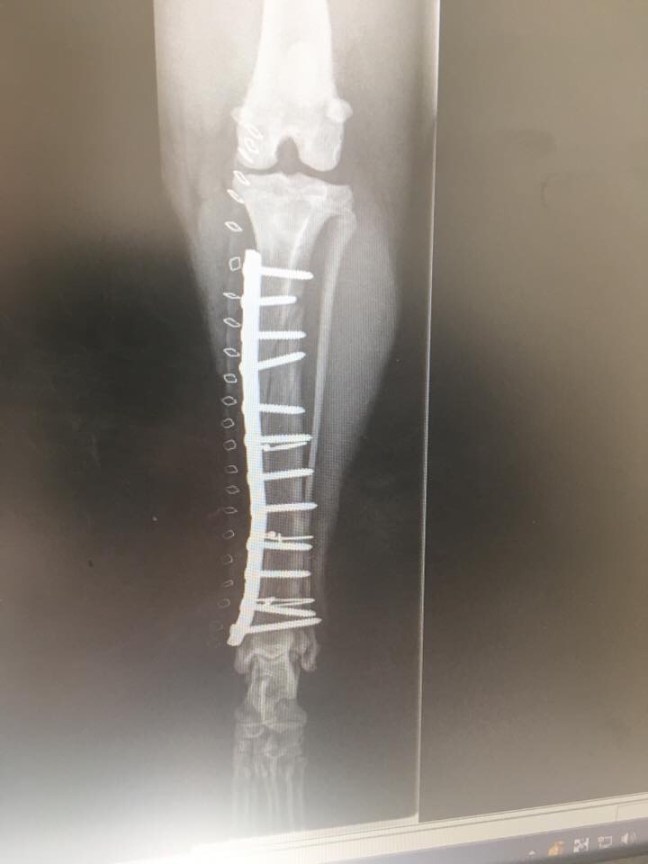
The break was a doozy- a spiral fracture the entire length of the tibia, missing the ankle by a mere millimeter. The surgeon implanted a plate, held with twelve screws.

And now the long, slow and frustrating process of healing has begun.

As soon as the bone was anchored, his pain became manageable. However, he’s not allowed to bear weight on the injured limb for several weeks.

It’s like having a newborn. He can’t be left alone. He’s on a regular schedule of food and medication. And a simple trip to the bathroom requires a waterproof sock over his cast, a sling under his belly and a leash to hold him back from his instinct to run and play.

It’s hard right now. We’re all sleep deprived. Stressed. And having a hard time accepting the slow pace of healing and the restrictions it requires.

And yet, we’re incredibly grateful that our boy will be okay, that we’re able to take care of him and that we have each other to help us through.

Life. It definitely keeps us on our toes.