How to Rein In Your Need For Control

control

I was embarrassed to wear shorts.

The insides of my thighs were covered with tiny half-moon cuts and welts, formed by my own finger nails digging into my tender flesh. It hurt. But strangely enough, I did it in an attempt to not feel pain.

It was my first conscious bid for control. Every month, my hormones would send my insides roiling and the uncontrollable pain made me feel like I was a pawn to my body’s commands.

And so I found a way to create a pain that was under my control. A pain that would distract from the other and that I could alter the intensity at will.

The next act of control was also prompted by the actions of my body. After hand surgery and complications, I faced months of physical therapy and time in homebound school. Again, I felt helpless against the pain and limitations of my body.

And this time my dominant hand was unavailable to cut half-moon slivers from my thighs.

So instead, I cut fat from my diet. Today, I probably would be diagnosed as orthorexic, a pattern of eating extremely “healthy,” where major food groups are eliminated. I ate plenty. But still my hair grew thin and my skin dry because of the lack of fat.

I saw it at the time as an example of great willpower.

In reality, it was great fear.

I continued to play this game. Every time life told me I wasn’t in the driver’s seat, I responded with a, “Yeah, watch this! I’m going to MAKE this happen.”

And then I would.

And I would feel a little better for a time.

A little more in control.

And a little less scared.

But it was always temporary. Because life always had something else in store. Something I couldn’t control.

And it took the big one – facing my biggest fears of losing my then-husband along with all of my financial security – to make me finally realize that the joke was on me.

That by trying to control, I was only adding to the tension. The fear.

Because there I was, everything gone. Nothing certain.

And for the first time in my entire life, I felt no need to try to control anything.

Control What You Can (And Only What You Can)

Even in the most overwhelming and devastating of life’s tsunamis, there will always be something that you have some level of power over.

And it’s amazing how far just a touch of control can go in easing your mind. Identify what you can control within your situation and control the heck out it. Be careful here not to make the mistake I did in my youth. You’re looking for areas you can control that don’t cause you additional harm.

For example, I have a friend in the early (and rife with scary unknowns) stages of cancer treatment. There is so much she has no jurisdiction over. However, when she was sent home with a software-protected disc of images and instructions to wait several days until her doctor could read the results, she had other ideas. She controlled what little she could.

Look At the Big Picture

The more narrow your focus, the more likely you are to get upset or scared by what you see. Because in the details, it’s all overwhelming. So take a step back and try to see the bigger picture. Not only does the current situation represent only a small section of your life, but you may also find that the areas where you can take more control will increase in time.

If you’re having trouble seeing the forest for the trees at your current juncture, talk to, read or watch somebody who has been through similar. This will help to provide perspective and give you ideas of how you can work within your particular parameters.

Build Belief in Yourself

Part of what makes a lack of control so scary is that we can easily become afraid that we won’t be able to make it through. So put effort into building your confidence in yourself (guess what – that’s something you do have some control over!).

Remind yourself of areas where you succeeded despite the odds. Engage in activities where you shine. Surround yourself with people that believe in you and build you up. Set (and achieve) small challenges for yourself.

Understand the Difference Between Control and Choice

You cannot always control what happens to you, but you can always choose your response. Rather than get hung up on what you cannot control, recognize the power inherent in being able to select your reaction.

When my first husband ended the marriage with a text, I was so angry at first that I couldn’t make him talk to me. I felt powerless. Like my voice and and my options were taken from me. Eventually, after months of being angry and frustrated, I realized that I was focusing on what I couldn’t do rather than on what I could. And I soon as I made the decision to shift my attentions to my own choices (as opposed to his), the anger and frustration started to dissipate.

It’s a little crazy, the only control he had over me was the control I gave him. Once I decided that I would be okay regardless of him, I took back that control. That’s really what forgiveness is all about – a shift in the idea of who gets to decide when you’re okay.

Learn Your Fear Languages

It’s not just love that has its own languages; fear has its preferred tongues as well. Do you have a tendency to catastrophize, assuming that everything will end in the worst? Are you prone to all-or-none thinking when it comes to life’s struggles? Do you get overwhelmed by the details and fear that you’ll never find your way out? Do you stop sleeping as your nights fill with thoughts? Or do you worry about the future, endlessly ruminating over possible scenarios?

Learn to recognize when your fear is speaking. That alone is powerful. We often interpret its words as facts, when really they’re just opinions. And biased ones at that.

Know Your Go-To No-Goods

We all have distractions we turn to in an effort to take the edge off of the discomfort of being out of control of our lives. I used to tattoo half-moons into my legs and demonize butter. Maybe you turn to alcohol or Netflix or the space under your covers.

Recognize what you are pulled towards that is not good for you or not good for you in quantity. Just naming them can sometimes help lessen their pull. If you find their siren song is too strong, don’t hesitate to get help. Because at that point, you have relinquished control to your particular habit. And isn’t a desire for control what sent you there in the first place?

Learn to Steer Intro the Skid

One of the first safety lessons new drivers learn is what to do in case of a skid. Because untrained instinct, which tells us to pull the wheel sharply against the skid, will only lead us off the road. Instead, we have to be coached (and often convinced) that the best way out of a skid is to move the wheel along with it until control of the car is regained.

And that same principle holds true when life throws us into a skid. Be patient. Work with it. And take control again once you are able.

Remind Yourself Why It’s Worth It

When you’re feeling out of control, it’s easy to center your attention on what you don’t like about the situation. So try shifting it to what you eventually will like about the results. When I was going through my divorce, I wrote a list of all of the things I was experiencing or would (hopefully) get to experience that wouldn’t have happened if the marriage didn’t end. I also constantly reminded myself that the (totally unwanted and totally sucky) situation was also making me stronger, more aware and more compassionate.

Trust That You’ll Be Okay (Even If You Don’t Know How)

So much of a need to control is a desire to know the future. Which, of course, is impossible. For all of us. It really comes down to faith. Trust that even if you don’t know how or when, you’ll be okay.

Time spent worrying and trying to control takes away your happiness now in a barter with life for happiness later. But life doesn’t always honor those rules. You’re much better off taking life as it comes and accepting that the only thing you can ever control is your own response.

So make it a good one.


The Magic That Happens When You Realize You’re On the Same Side

There’s a funny thing that happens in education. Each level – from 1st to grad school – has a tendency to grumble about the earlier grades, assuming that the reasons that the kids are [fill in the blank] is because of something the previous instructors are or are not doing.

And then, on those rare opportunities when we are able to meet with other grade levels, we quickly realize that the struggles and the efforts and the goals are the same at every level.

And as soon as we realize that we are on the same side – the side of doing everything we can to help these kids succeed in school and in life – the conversation shifts. From one of blame and frustration to one of problem solving and sharing ideas.

The struggles haven’t changed. The kids are still [fill in the blank]. But by changing the way we look at it, what we’re looking at changes.

—–

This mental shift is relatively easy to do in education. After all, we’re a group of coworkers brainstorming ideas to help kids that are ultimately only ours for a year. We care. We’re invested. But it’s not personal.

It’s a lot harder to do in a marriage. Because there, everything feels personal.

Even when it’s not.

And it’s easy to forget that all so often you really have the same goals.

Even when you have different ideas about how to reach them.

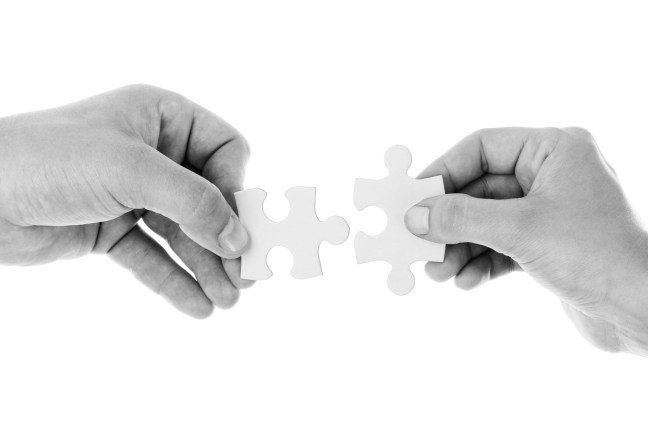
There’s a magic that happens when you realize that you’re on the same side.

A laying down of the defenses because you’re no longer feeling like you’re being attacked.

A willingness to listen because their words aren’t against you, they’re towards the goal.

An openness to new ideas because you’re more willing to bend when you’re not bracing.

And energy can be put towards solving problems rather than placing blame.

The magic that happens when we realize we’re on the same side.

From Divorce to Happiness: March Reading List

Spring is finally here in the south. The flowers are blooming (yea!) and the pollen is coating (yuck!). Highs in the 80s are followed by frost warnings as a reminder that no transition is ever smooth.

The following articles have graced my feed recently and they all worthy of reading and sharing. Enjoy!

How Divorce Exacerbates the Retirement Process

This is a sobering account of the impact that divorce (especially later in life) has on retirement (especially for women). It makes me very grateful that I had my own pension and makes me very sad for people who weren’t as fortunate. Check it out here.

Divorce Is a Good Thing

Okay, so I can’t say that I see divorce as a good thing. But sometimes it is a necessary thing, the best answer to a tough situation. This piece addresses the increasing stigma and judgment about divorce and how that shaming only serves to hurt those who are already hurt. Read it here.

Are You Falling For the Same Type of Mate You Gladly Left Behind?

It’s easier than you think. This article, written by an attorney, presents five warning signs that your selection process may be setting you up for another divorce. Read it with an open mind. You may be surprised at what you’re unintentionally drawn towards. See the five danger signs here.

How to Be Happy: 5 Secrets Backed By Research

Because, after all, isn’t happiness what we all want? 🙂 See how to get it here.

Challenged

And this is how it’s done.

Baby steps. Take them. Acknowledge them. Celebrate them.

That’s how moving on happens. One. Step. At. A. Time.

8 Ways This Election is Like a Dirty Divorce

Can I just hibernate until November? Pretty please?

I reached election fatigue several months ago and it’s only getting worse with the ever-present coverage and the ever-increasing contemptible behavior from the politicians, the media and even the general public.

I miss my educational and informative talk radio during my drives; it has morphed into a never-ending episode of Jerry Springer, only the guests are fighting over power instead of girlfriends. Thank goodness for audiobooks and Pandora. So far they’re untouched.

My Facebook feed looks like the politicians are trying to battle it out via memes, as though the one with the most superimposed quotes will capture the flag of the presidency. I wish I could install some sort of political filter on my social media so that I can still have friends come next year.

I’m tired of trying to explain to my students that mentions of penis size and potential federal indictments are not usually part of a presidential campaign. And that politics is supposed to be about governance, not entertainment. Yes, this is reality TV. But it’s reality TV that’s way more important than your favorite contestant being voted off the island.

And here’s the crazy thing – even though I have absolutely no experience in politics (and nor do I ever intend to), this election is bringing back some unpleasant deja vu for me. Not of an election. But of a dirty divorce.

The 8 ways this election season reminds me of a no-good, very-bad, down-and-dirty divorce:

Emotion Trumps Reason (No Pun Intended)

Looking back, I can see that I made many irrational decisions during my divorce. And that’s because I wasn’t thinking rationally. I was hurt and wanted to shovel some of that hurt on him. I was in shock and busy reacting instead of pressing pause and planning. But mostly, I was scared. Scared of what the unknown future would hold. And so I was grasping onto anything I could that gave me a sense of control over my life. With the gift of hindsight, there are some things I would have done differently. But I wouldn’t have been able to hear that advice then because I was too flooded with emotion to be able to reason.

This election is much the same. People are appearing to lose their minds. And that’s because rational thought has been displaced with emotion. People are frightened about what is around the corner for our country and they want to hold on to any sense of control that they can find. Much like facing a malignant ex in court, watching your anti-candidate debate fills you with disgust and aversion. If you have a beloved candidate, that person fills you with hope and promise, much like the first flame after a brutal break-up.

And the politicians and the media know this. They play on the emotions, knowing that emotions drive views, clicks and follow throughs. Just like the lawyers are the ones to benefit from an ugly divorce, the media is cashing in on this election. We’re being played.

Everything is Presented in Black and White

In family court, the story of the marriage and its demise is presented in absolutes – “I was the perfect spouse. He/she did everything wrong.” Nuance is wiped away in favor of decisive judgments. A lifetime of interactions and emotions and needs are distilled down into sparse sentences and quantified into legally-binding calculations.

This over-simplification is occurring as well in the political arena. Complex health plans are relayed in a single paragraph. A soundbite captures the intentions for illegal immigrants. These absolutes are easy to understand and easy to repeat. Yet they ignore the muddied gray area that really exists.

There is a place for stripping something down to its bare bones in order to see the inherent components and structure. But never get complacent that the skeleton is all there is. People and life are more complex than that.

Winning Becomes Everything

I was a boxer defending my title in the ring of my divorce. I was determined to win, even though I wasn’t exactly sure what winning even looked like. I just knew that I needed to be the victor. At any cost.

When I sat in court across the aisle from my soon-to-be-ex, I remember looking at this stranger and wondering how we could have gone from planning for retirement together to him trying to wrestle my retirement from me. We had completely lost sight of our once-shared goals.

When watching the current presidential contenders on the battlefield, it’s almost impossible to believe that they all (supposedly) share the common goal of guiding this country and its inhabitants towards a better future. They have become so consumed with obtaining the title (and wounding their opponents), that they seem to have forgotten what the purpose of the role even is.

Dirty Fighting in the Norm

As a pathological rule-follower, I was mortified when I first saw the lies from my husband recorded on his discovery documents. “How could he sink so low? How can he lie on legal documents?” I asked my attorney. She was unfazed. In a dirty divorce, dirty fighting is the norm. People will lie, use others as pawns and even escalate situations in an attempt to dominate the process.

The jokes about dirty politicians are endless. And not just the ones currently in the running. When you value winning at all costs, the costs are often high. And when you get so caught up in your campaign, it’s easy to lose sight of the truth.

Blame Becomes the Hot Potato

Many dirty divorces become an alternating he-said, she-said where one allegation is countered with another and the blame is passed back and forth. I know. I played that game too. And the harsh truth I eventually had to accept was that by focusing on blaming him, I was also giving him the power to decide when and if I was going to move on.

Blame is a distraction. A misdirection.

And it’s no different in this election. The GOP blames Obama for its troubles. The democrats blame the republicans for poverty. They all blame each other for the increase in political tensions. Fault is assigned. Fingers are pointed.

And it keeps the attention away from the candidate-in-question.

Victimhood is Nurtured

I certainly felt victimized by my ex husband and by my divorce. And I could have easily stayed there. As a society, we have gone from empathizing for victims to enabling victims. We issue trigger warnings and excuse poor choices all in the name of trying to keep victims comfortable. We seek to penalize bullies while ignoring what we can do to empower their targets. And when we nurture victims, we cultivate victims. The victim of a dirty divorce can end up being trapped by their position, giving up responsibility along with any power of their own well-being.

Politicians like victims. Because victims need somebody to rescue them. And they are wanting to be selected as your knight (or knightess?) in shining armor. Victims are perceived as weak, needing guidance and protection. And just like some people are drawn to dating victims because it makes them feel needed, some politicians are pulled towards being the savior of the injured parties.

Promises Are Made (But Not Kept)

I felt relieved when I saw the ink on the decree. I was going to be reimbursed for some of my expenses. He would take on the house and I wouldn’t have to absorb a foreclosure. Apparently, he was only making those promises because he knew what the judge wanted to hear. Because as soon as court was adjourned, so were his promises.  Trust becomes as extinct as the dodo.

The politicians are well-versed in saying what we want to hear. They make promises that they have no intention of keeping, knowing that we have no real way to enforce their follow through once they have taken oath.

Throughout my divorce and its aftermath, I finally learned to take every promise with a saltshaker. I have the same position with this election. I’ll believe when I see it, and not a moment sooner.

There is Collateral Damage

And this is the unfortunate part. Every dirty divorce has collateral damage. Others, frequently children, caught in the crossfire. When the focus is on winning at any cost, that debt often falls to others to pay.

I’m feeling the same way watching this election, like a kid between bickering parents, pleading with to stop yelling and just talk. The politicians and the parties are pitting us against each other like children against a parent in court. And when that happens, everyone loses.

Okay, political rant over. I’m going to put my earplugs back in now, keep my head down until this is all over and cross my fingers that this country does a better job electing the next president than I did with selecting my first husband.

Oh, and if you know a way to scrub all political news from all my feeds, please let me know:)