Divorce and Twitter: What’s the Connection?

Links to a recent study associating active Twitter users with an increased risk of cheating and divorce filled my newsfeed yesterday. The study shows a direct correlation between heavy Twitter use and the likelihood of divorce across age ranges. Many of the pieces that featured the study implied that romantic or sexual interactions on the social media platform were the precipitating factor in the end of the union.

But I’m not so sure it’s that straightforward.

You see, our brains are not that different than mice in a lab. We like rewards. And technology has capitalized on that part of human drive and motivation. You gets levels and badges for succeeding in a game on your phone, you get a buzz or chime every time someone contacts you and, on most social media, you vie for likes and shares. Each of those interactions is like giving the proverbial mouse a treat, eliciting a release of dopamine in the brain. And, just like a mouse that receives too much cheese, those electronic rewards fatten us as well. We become accustomed to that higher level of stimulation.

And real life, including real marriage, doesn’t offer neurochemical rewards on such a frequent basis.

But cheating does.

The risks and newness of an affair bring with it an increased production in dopamine, rewarding the cheater for his or her indiscretions.

So maybe the problem isn’t really found in flirty Tweets. Maybe the problem is that we’re training our brains to require an unnatural level of rewards. And then it becomes all too easy to seek the desired attention elsewhere.

Unless your spouse has a gold star chart for on the fridge. Who knows? Maybe that will become the new affair prevention technique:)

Value Added

When I interviewed for my current teaching position, one of the questions I was asked was to describe my value added. The interviewing committee wanted to know what worth I would bring to the school outside of the usual classroom duties. I described my passion for wellness and how I could help the staff and students with education and motivation with food and fitness. I guess my answer was acceptable, since I got the job:)

That question stayed with me over the past three years. All too often, people’s assets and strengths remain hidden. In a school environment, great leaders and planners and problem solvers often hide behind their classroom doors in an environment that may not reveal all of their strengths. And, unfortunately, sometimes liabilities are visible while assets are buried (I think about one former coworker who always missed meeting but was amazing at parent phone calls, which we rarely witnessed).

It’s all too easy to make assumptions about what someone brings (or fails to bring) to the table. But we only see a piece of the story. A part of the environment.

In a relationship, your partner may not be hiding some of his or her assets behind a classroom door (unless you’re married to a teacher, that is!), but it is still easy for strengths to hide and for you to fail to see some of the value added that your partner brings to the relationship.

I was aware of this in my own marriage this past week. I was on spring break, so I had time at home during the work week. I could overhear Brock conducting his business from down the hall and it reminded me all over again how expert he is at assertive negotiations. That’s a side of him I do not normally witness. I revealed some of my own value added by planning, shopping for and installing over 150 plants in a single day. He knew I could garden, but had never actually seen me in action. He was puzzled (about a third of them are roots and rhizomes still buried beneath the soil) but impressed.

We often fixate on what our partners don’t have; we ruminate on their weaknesses and liabilities. Next time you find yourself complaining about what isn’t there, try focusing on the value added that they bring to the relationship. If you feel like some of your strengths are unappreciated, ask yourself if they are hidden. We often assume that others are aware of all that we do, but there focus is on their thoughts and tasks. It’s okay to share your value added.

We all have strengths. Reveal them. Share them. Embrace them.

You are valuable.

And if you’re ever in Atlanta and have a talent for weeding, please give me call. I’ll be happy to see your value added:)

Marital Limbo

marital limbo

We had one of our good friends over the other evening. He was recently divorced when I met him a few years ago, although Brock knew him through much of his marriage. In the past several years, he’s been dating, at times sporadically and at other times with more intent. He even contemplated moving in with one woman not all that long ago.

So I was shocked when I heard these words out of his mouth the other night –

“I never want to get married again.”

I was shocked, not because I think marriage is the best answer for everyone. And I certainly understand shying away from matrimony after enduring the pain of divorce. I was shocked because marriage seems to fit him. He’s stable, healthy and loyal. He has goals and doesn’t shy from hard work to achieve them. He has grown as a person and has developed many healthy relationships around him. When dating, he is a serial monogamist, developing deep relationships with one woman at a time. And I’ve never sensed any bitterness about his past.

So why the anti-marriage stance?

And then yesterday, I read this post from Matt over at Must Be This Tall To Ride. He talks about the time spent in marriage limbo when he slept in the guest bedroom for over a year. I winced while reading it; it certainly sounded like a special kind of hell. Neither married nor single. Like living in a home destroyed by a flood, yet unwilling or unable to let it go.

And I thought about my friend. He lived in marriage limbo for a long time. He was married, yet in the most important ways, had no wife. They orbited around each other with little chance of connection. And when they did connect, it was ugly. The divorce, in many ways, was a relief. An untethering to a lame duck marriage.

His memory of marriage is not a good one; what was good has been sullied by the time spent in limbo. No wonder he is shying away.

My experience could not have been more different. I never spent time in a decaying marriage. I never visited that marital land of neither here nor there. I was in marriage heaven and then instantly plummeted into the fires when it ended. My bad memories are not of marriage, but of marriage ending.

So perhaps that’s part of why I wanted to be married again.


My curiosity is piqued – is there a correlation between time spent in marital limbo and desire to be married again? What’s your story?

Make It Better

I had no idea.

I had no idea when I started blogging that it would change the way I look at, well, everything.

I am a numbers gal. I like data and graphs, empirical evidence of cause and effect. But I’m also a relationship person. I like to build and nurture connections with people.

And blogging is interesting that way. The input in is words and the output is in relationships and data. And the data holds clues to building relationships.


Behind the scenes on any website, you get information about traffic and views. You can track visits over time and analyze the impact of certain posts or links. And for a numbers gal like me, that data is intoxicating. It’s like a full-time science experiment with little restraint, “Let’s see what happens if I try this.”

After a few months blogging, I noticed an interesting pattern. From day to day, week to week and month to month, all of my data takes a cyclical pattern, growing and shrinking in a predictable wave.

wavelength

Simply the recognition of that pattern was comforting. In those early days, those troughs caused me to question, well, everything. It was easy to conclude that the downward slide would continue until my site was obsolete. Remember that I didn’t see myself as a writer. Just a math teacher who happened to have a story. But every time, with no clear reason, the pendulum would shift and the readers would come again. I learned to find comfort in the pattern, secure in the belief that the pattern would continue.

But that wasn’t enough. After all, a science experience where you simply observe is no fun at all. So I started to increase my efforts every time the numbers would fall. I would post more frequently, seek out new readers and new platforms and generally market like crazy. My goal was to raise the troughs to the level of the crests.

The interesting part? It didn’t work.

I mean, the numbers would increase again, but only in the same pattern as before. Yet I would be exhausted for the efforts. Perhaps because efforts during ebbs are often driven by fear and frustration. And they’re lousy drivers.

So I changed tactics. When the numbers indicated a trough, I stayed steady. But when a crest approached, I got busy. I realized it was easier to build at the top. I was excited and my energy was contagious. Leads seemed to come from everywhere and links would pour in. The good mojo would feed my creativity and the words would flow from my fingers.

And you know what?

It worked.

The amplitude increased, each crest a little higher than the one before. And those dips? Well, they also stepped up and weren’t quite as dippy.

And I wasn’t exhausted after the cycle of increased effort. In fact, I felt energized.

When something is good, it is easy to make it better.

As a numbers gal, I see patterns everywhere. And, as I learned to recognize and work with this cyclical pattern in blogging, I began to see it in other areas of my life.

My students’ progress ebbs and flows throughout the year.

My fitness seems to build only to fall again due to injury or illness.

My writing inspiration comes in waves (usually with ill-timing!).

Money comes and goes.

Social events arrive in waves.

And, most interestingly, my relationships seem to be on a similar wavelength, with periods of greater intimacy and connection followed by times of more detachment.

And that was eye-opening.

As someone who has been betrayed and abandoned, it is all too easy to interpret that downward trend as an inevitable slide towards the death of a relationship.

When in reality, it’s just part of a normal pattern.

Periods of growth are often followed by periods of rest.

Just look around you.

After my experiments on the blog proved successful, I decided to try them on my marriage.

I put my efforts into making the good times even better. To build even greater intimacy and connection at those times when everything seemed to just flow. And when I feel more distance, I don’t without effort, but I also don’t expend extra. I just recognize it as a period of rest before the next wave.

And you know what?

It works.

The crests get higher, pulling the troughs up as well. Every effort is magnified. The good feelings are multiplied.

Just like the best way to build yourself up is to help build up those around you.

And the best part?

Energy spent making the good even better isn’t draining. It’s rewarding.

Look around your life.

Do you see cycles?

Periods of ebb and flow.

You can fight the ebb.

You can go with the flow.

Or you can can work to amplify each pinnacle, reaching new heights with every period of growth.

Making the good even better.

There’s no limit to what you can reach.


Significance

It’s amazing the significance that can be found in the smallest of things. I found it this past weekend in a can of stain.

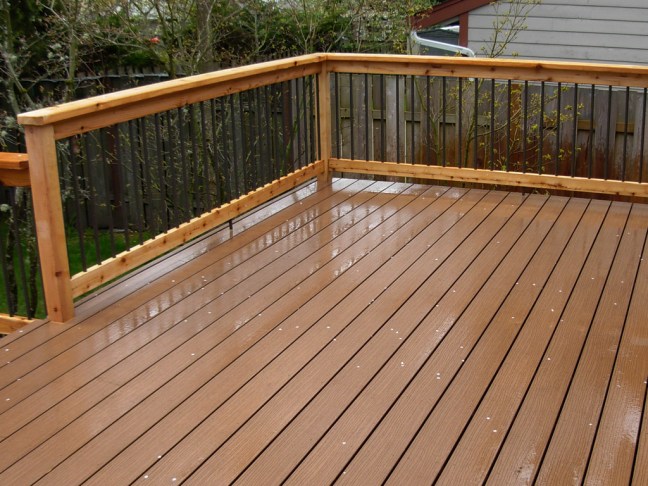
In my former life, my husband and I had an amazing deck built about 15 months before he left. This deck had been a dream of ours since we purchased the house nine years prior. I loved that space and spent every available moment on it. When the deck’s one year anniversary came around, we made plans to stain it, as advised. We researched products and purchased a five gallon bucket of stain.

A bucket of stain that still stood unopened in the basement on the day he left.

During those months between the deck’s birthdate and his life’s death date, he made excuses not to undertake the project. He was too busy to pressure wash (his domain) or was worried about the pollen. Or the weather. Or his blood pressure. Or even the cost of tea in China. He always had a reason.

But the real reason was that there was no need to stain a deck to ensure its longevity when your life is on its last breaths.

A few years later, and my new husband and I purchased a house with a new deck. The planks one-year anniversary was this spring and we celebrated by coating it with stain over the weekend. He pressure washed and covered the large expanses of deck while I tackled the nooks and crannies of the railings and steps. It was a simple process yet suffused with meaning.

This deck, this marriage and life are coated to last.