
Benefits of Traveling Outside Your Comfort Zone

comfort zone

images-33

I had two choices for my morning run today – the relative comfort of a treadmill in my dry and air-conditioned gym or the muddy trails of a nearby park in the rain and oppressive mugginess that blankets the east coast in the warm months.

I debated for a few moments, considered how miserable I would likely be on an outdoor run as I struggled to breathe in air that was more water than oxygen and how tempting it was to remain in the manufactured comfort of air-conditioned space.

After swallowing the last of my coffee, I went downstairs and selected my trail-running shoes, opting for the less comfortable option. At the beginning of the trail, I questioned my choice. The sweat was already soaking through my shirt, my lungs were threatening to wheeze and a strange guy on the relatively empty trail caused me to grip the mace I carry just a little tighter.

But then after the first mile, I began to find my stride. The moisture in the air became less noticeable, my breathing began to acclimate and the weird guy stayed weird, but also stayed back. And by the time I made it back to my car, looking like I had just completed a mud run complete with a culminating dunk in a body of water, I was happy that I chose the less comfortable route.
images-36


Which are you more likely to regret – the step that takes you out of your comfort zone or the inaction that keeps you there?


We all like to be comfortable. All of us fear the unknown and to some extent, shudder at the thought of potential failure. We shy away from experiencing any sensation that could be labeled as unpleasant. All of us have become experts at crafting and disseminating excuses that give us permission to maintain the status quo, telling ourselves stories to justify our inaction and our conclusions.

images-34

Life – real life – happens outside your comfort zone.


When we take steps outside our comfort zone, we are granted permission to fail.

Once you’ve been labeled “good” at something, you are expected to perform at a certain level every single time. In contrast, when something is brand new to you, any failure is somehow less personal and more situational. That makes it much easier to face.


When we take steps outside our comfort zone, we are allowed to be unsure.

I don’t know about you, but I always feel pressure to appear confident about my decisions and my actions. I feel like this is one of the great lies of adulting. When we were little, we assumed that adults knew what they were doing. Only now, we’re the grown ones and we’re just faking it. When you’re doing something new, you’re allowed to reveal that insecurity.


images-32

When we take steps outside our comfort zone, small achievements are recognized and celebrated.

When you were a baby, your every “first” was marked and even memorialized. That recognition of small successes often fades as we age. When you’re outside your comfort zone, you are far more aware of those “firsts” and mark them of signs of growth.


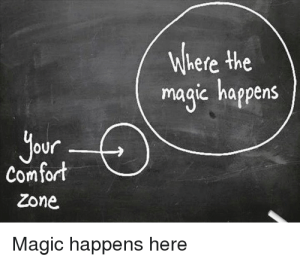
When we take steps outside our comfort zone, we have fewer expectations from ourselves or from others.

Expectations can be powerful limiters. Just look at those studies where teachers of completely average classes were either told that their children were brilliant or behind. The children performed not based on their ability, but according to their teacher’s expectations. And in our day-to-day lives, we are just as likely to limit ourselves with claims of, “I can’t.” When we take that step outside of our comfort zone, we are instead asking, “But what if I can…?”
our-comfort-zone-where-the-magic-happens-magic-happens-here-18784279


When we take steps outside our comfort zone, assumptions – and beliefs – are challenged and often adjusted.

WE often reach conclusions based on what we experience. So the more limited your experiences, the less-informed and potentially more biased your assumptions will be. When we meet new people and experience new ways of seeing the world, we are forced to re-examine and maybe even readjust our beliefs.


When we take steps outside our comfort zone, learning combats frustration born of stagnation.

Humans get bored. Just watch a modern queue and take notice of how many people are engaged in their phones to avoid a few minutes of idle and purposeless time. The same thing happens on a larger scale. We thrive on novelty, on challenge. When there is nothing left to learn, we become stagnant and then frustrated. The space outside a comfort zone offers unlimited opportunities for learning.

images-35


When we take steps outside our comfort zone, curiosity dominates and inspires wonder.

Have you ever watched a kid in a new environment? A place that is known to you suddenly becomes alive with possibility when seen through their eyes. Our brains have literally evolved to disregard that which is too ordinary. And when your life is spent entirely within a comfort zone, you risk having your brain ignore it all. Newness encourages our brains to wake up and pay attention, bringing with it a childish sense of exploration and wonder.


When we take steps outside our comfort zone, we allow space for authenticity and purpose.

We all-too-often become our labels – mother, father, caretaker, employee, etc. We forget who we really are and what really inspires us and drives us. When we leave our comfort zone, we often discard those labels for a period of time, allowing us the the opportunity to discover what is really important to us.
 

images-37


Bust a Rut – How to Get Out of Your Comfort Zone and Reinvigorate Your Life

I always start out the year by telling me students that part of my job is to make them uncomfortable.

Not by turning the AC down too low.

Not by unscrewing one of the feet off of their desks.

And not even by calling them up to the board to publicly solve a difficult math problem.

But simply by pulling them just beyond their comfort zone.

I begin by putting a diagram up on the board.

comfort zoneI ask them to describe the math that is within their comfort zone and I’m inevitably rewarded with elementary-level concepts: addition, subtraction, etc.

“So if we added and subtracted all day, you’d be comfortable?”

The heads all nod in agreement.

“And if we added and subtracted all day, do think you would ever grow?”

Brows furrow and heads cease their nodding.

“And if all we ever did was what you felt comfortable doing, do you think you would start to get bored?”

“Yes!” comes the choral reply.

“Now what about if I presented you with some 12th grade calculus problems? What would happen then?”

“It would be too hard.”

“We’d get frustrated and give up.”

“I’d panic.”

“It’s too far out of your comfort zone. You don’t know how to get there yet.” I summarize.

Heads nod again in agreement.

“So, where should we be in this class?”

A hand tentatively rises, “Just outside the comfort zone.”

I smile. “Exactly. Now, when we’re just outside our comfort zone, is it always going to feel good?”

Heads turn side to side.

“Are we sometimes going to struggle?”

The nodding returns.

“And what happens when we stay with it and keep practicing?”

“We get better.”

Holding out the marker, “Can you show me what that looks like on the diagram?”

reach

The bubble enclosing the comfort zone is enlarged, absorbing the area just outside and moving closer to what once seemed impossible.

———-

One of the common complaints I hear from adults is that they feel as though they are stuck in a rut. Those daily routines have become all-encompassing and all-too-familiar.

It’s sometimes funny working as a wellness/transition coach. I help some people establish routines (usually centered around healthy behaviors) and I help others break out of routines.

Because let’s face it – making flossing a mindless habit is beneficial, but turning sex into a robotic and automatic task is not.

We fall into ruts for the same reasons my students resist learning new material. It’s comfortable to stay where you are. It requires little to no mental energy and effort. It needs no learning curve. And the results come as no surprise.

But although it is comfortable, it is also boring. Predictable.

And boredom and predictability extinguish passion and excitement within a life like a wet comforter on a campfire.

Sometimes people respond to the rut by making extreme changes – they quit their job and embark on a 6 month trail hike, they cultivate the spark felt in a new relationship while they are committed to another or they cut all ties and relocate to a new city, starting over again from scratch.

And yes, those decisions are certainly going to pull someone out of their rut. But you don’t have to be so extreme (or inevitably harm others) to break out of your routine. Small changes can have big consequences, as my students illustrated on the board.

These changes should be large enough to create excitement and curiosity yet small enough to feel feasible without prompting panic. Some may become part of your normal experience, while others may be tried on and discarded. The duration here is not important. Doing something different is.

Take a New Route

Is your commute to and from work largely completed on autopilot? Yeah, me too. It means that day is book-ended with familiarity and routine. Try taking a new route one morning. Yes, you may have to leave extra time for the new path, but you will start your day more aware and alert.

Get Lost

On your next walk or run or bike ride, intentionally get lost. Take a turn you never have and explore the area. It’s amazing what you can find in your own environment when you allow yourself off your beaten path. Once you’re ready to be found again, either trace your back or let your phone guide you back to familiarity.

Teach a Class

You’re good at something. And you are probably well within your comfort zone when you do that thing. In fact, maybe it has even become a little boring. A great way to see it with fresh eyes is to teach that knowledge or skill to someone else. You can informally pass along your knowledge or you can find a way to teach a class through a church, a school, a community organization or even online.

Turn Off Technology

Technology has become our comfort zone. It’s a little scary when I see the panic every spring when all students and teachers are required to turn off and lock up their devices during standardized testing. We’ve become acclimated to always be reachable and always being connected. So, turn it off. It’s uncomfortable. Remember, that’s the point.

Change Seats

Which side of the bed do you sleep on? Which spot on the sofa is yours? Which sink do you use? Mix it up. It’s funny, due to Brock’s continual injuries, we end up switching sides of the bed every few months. I grumble, but I actually kind of like it (once I learn which side is “off” in the morning!) because it keeps us from settling into a set routine. Apply that idea in other venues. A small shift can create a big change in perspective.

Play

One of the reasons we get into ruts is that we forget how to play. Watch children – play leads them to try new things and explore new ideas. Don’t take it all too seriously.

Spend Time With a Person Much Older or Younger

Most of us spend the majority of our adult time with people that fall into the same income and age bracket as ourselves. Expand your network and, in turn, expand your horizons. When you interact with others who have a different experience, it enriches your own.

Do Something You’re Not Good At

When I sit down to solve a math problem or write a blog post, I have an expectation of my performance because those are things that I see myself as pretty good at. I pretty much know ahead of time what the experience will entail. But when I first pierced the skin of a bait fish and threw it over the side of the boat last summer? I had no idea what was going to come my way.

Switch Stores

You know that grocery store you always go to? The one where could almost close your eyes and still locate the particular brand of cereal you always buy? Take it off the rotation for a few weeks. Visit different stores. Like with a new route, it will take more time, but it will also make a routine errand become something more interesting.

Shake Up the To-Do List

If you’re anything like me, you have a weekly to-do list that doesn’t vary all too much – shopping, cooking, laundry, etc. Obviously, those things need to happen, but try to find a way that they can happen differently. For example, when I was feeling bogged down by my weekly Sunday routine of cooking my lunches for the week, I decided to pretend I was getting ready for a dinner party instead, complete with nibbles, music and sips of a preferred beverage. Much better.

IMG_4191

Specific To Those In a Relationship:

Spend Some Time Apart

And DO something while you’re apart other than the usual. It’s easy to have the same conversations about what needs to get done. It’s easy to zone out while your partner again complains about the same boss or shares about the same hobbies. By spending time apart and doing something different with that time, it creates some mystery and excitement.

Paint Your Dreams

In the beginning of a relationship, couples often share their dreams and life goals. Often, these broad and sweeping dreams get replaced by the mundane have-tos of daily life and the short-term goals of adulthood. Take away the restraints for an evening and spend some time sharing your dreams. It helps you to see what’s possible and maybe even gives the motivation to work towards something.

Change Rooms

This is an extension of the switching seats challenge. Always watch TV in the living room? Bring the tablet onto the deck and watch it there. Sex restricted to the bedroom? Ban it from the bed and try out the other rooms (just be careful of the neighbors if you decide to take that out to the deck too!). Always eat in the kitchen? Set the dining room table, even if it’s just for two.

Switch Roles

Everybody in a relationship gravitates towards certain roles because of skill or experience. It’s easy to take your partner’s tasks for granted and get into a rut with your own. So, trade roles for period. If you normally cook the meals, leave that to your partner and tackle the lawn. It can lead to greater appreciation and even some laughs.

Do Something Scary

Maybe it’s a simple as switching out the drama for a horror movie or as involved as jumping out of a plane. The excitement that comes from novelty and uncertainty is catching.

SEE Your Partner

At some point in a relationship, it’s easier to see who we think are partner is and hear what we think they say rather than to actually look and listen. And that’s because sometimes what we may see or hear may not be comfortable.

And While You’re At It, SEE Yourself Too

And that’s what ruts and routine are all about. We do what we do because we do it. It becomes as comfortable as an old robe and as predictable as a favorite movie.

And about as exciting.

So be a little uncomfortable.

And be curious.

Invigorated.

Alive.