Enemy of the Good

Things are returning to normal around here.

The suitcase is unpacked and the warm-weather clothes, still imbued with the briny odor of the sea, have been washed and put away. When I stirred at 5:00 this morning, there were two pit bulls instantly by my side, anxious for their morning walk.

It’s good to be home. Back to my dogs, my bed, my shower and the simple pleasure of having access to a stocked kitchen. Unfortunately, my mind is back as well, losing touch with the straightforward plans of a vacation day and beginning to become overwhelmed with everything I’m telling myself I need to get done.

As I walked the pups this morning, acutely aware of the refreshing crisp air on my face in contrast to the wet slaps of the south Florida breeze, a familiar phrase made its way into my mind –

“The perfect is the enemy of the good.”

I had to smile at myself, thinking of the to-do list perched on my desk back at the house, items filling the page, waiting to be completed and crossed off. And that I wasn’t giving myself permission to relax until the list was complete.

I was – correction, I am – allowing the perfection of a completed task list to become the enemy of the enjoyment of a life filled with blessings.

And perfection isn’t the only adversary that good has to overcome. Can you relate to any of these?


Resistance to Change is the Enemy of the Good

I largely took a break from social media while we were on vacation. Yet every time I checked my Twitter account, I felt my heart smile. I’m a part of an informal group on there formed from those who have experienced infidelity. Apart from that common thread, the group runs the gamut from those that have just discovered the betrayal to those who, like me, are years out. Some are staying in their marriages while others have decided to move on.

For many in the group, this holiday is one of firsts – first since the discovery of the betrayal, first since the end of the marriage, or the first without the kids. In other words, it’s a hard holiday season for many in this group.

So why was I smiling? I was so inspired by the make-the-best-of-it attitudes and vows to start new traditions that I saw on my feed. This year was different. And resisting that change would only keep them from appreciating the good that was to be found in the little moments of this year.

Because that’s how it works, doesn’t it? If we refrain from focusing on what was, we allow ourselves to appreciate what is.


Expectations Are the Enemy of the Good

For our recent trip, we flew into Miami and rented a car (a convertible Mustang just like every other person in south Florida, apparently). We took our time exploring the keys, staying in Key Largo and Marathon before ending up in Key West, where we immediately returned the car.

The plan was to rent bicycles in order to get around the island for the final three days of the trip. I was all-in, picturing quiet beach streets and wide bike paths without any treacherous downhills to contend with. I pictured us exploring the area on our bikes, the breeze in our hair and the sun on our shoulders.

I was right about the hills. And the sun.

But the rest? Not so much. It turned out that the trek from our hotel to the main area was three miles on a crowded sidewalk next to busy street with constant traffic (including lots of trucks which provided the only breeze since I was moving too slowly to generate any myself). I started off shaky, but okay. But after a couple miles, I entered into full-on panic. It was far from the expectation that I had for myself.

Bless my husband; he was so patient. And even while I was tearing myself down, he was expressing how proud he was of me that I kept going even though I was petrified. At the end of that evening, I took an Uber back to the hotel while he took back one of the bikes. Then, the next morning, he pedaled back the remaining bike and we rented a scooter (where I would NOT be driving!).

And it was wonderful. Different than I had imagined, yes. But wonderful.

Because that’s how it works, isn’t it? If we let go of the mental image of how something should be, we can enjoy it for what it is.


Comparisons Are the the Enemy of the Good

One of the reasons that holidays can be so hard is that everybody tries to put on a show and then we end up comparing ourselves to these picture-perfect families and celebrations.

On Monday night, we watched football from the comfort of our hotel room (go Ravens!). The commercials broadcast by everyone from the grocery store to the car dealership seemed intent on cultivating envy in the viewers. The message was clear – just buy this thing and you too will have a perfect family filled with endless cheer and devoid of worry.

And so for those watching either the commercials or the curated posts by friends, the comparisons are inevitable and easily heart-breaking. Their concern about finances seems overwhelming when held up against the free spending on their screen. Their family, impacted by addiction or estrangement or divorce, seems incomplete and lacking compared to the perfectly posed group in matching pajamas. And their loss seems alien when contrasted with the bounty portrayed to us.

We know that these images are not real. That they are scripted and acted. Yet we sometimes still them as ideal and achievable, even when we know what is happening behind the scenes. Yet we can choose to see them for what they are – images created to either prey on our own insecurities or alleviate the insecurities of others.

Because that’s how it works, isn’t it? If we refuse to compare our lives to others, we can be grateful for what we have.


And for me, I’m going to try to focus less on completing my to-do list and more on enjoying what today has to offer.


Here are a few pictures from our trip. I highly recommend the Florida Keys for anyone who wants a Caribbean feel on U.S. soil and is looking for a great excuse to slow down and enjoy each moment.
This slideshow requires JavaScript.


Releasing Attachments

Trigger warning: This post contains references to math. No math knowledge is needed to understand the point of the post and no test will be given at the end.

I helped to lead a professional learning opportunity for some teachers the other day. The focus was on the benefit of productive struggle for students. I had the teachers do one of the activities I do with my kids on the first day of school.

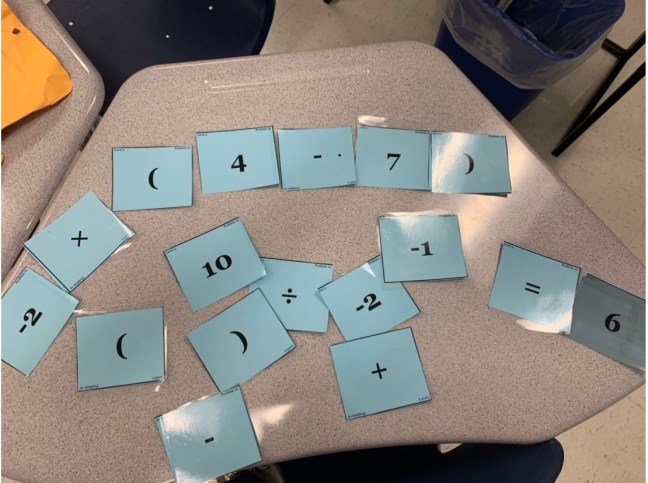
Each group of teachers received a set of cards. Their goal was to create a correct mathematical expression that, when using the order of operations, would equal the number on the gray card.

IMG_2069.jpg

It was fascinating to watch the adults, who were much more deliberate than the kids (no surprises there). Most interestingly, was how some of the groups became attached to certain parts of their expressions and, even when they could not make the problem work, refused to move those cards around.

Other groups never became attached to any particular combinations and freely tried a large variety of options.

In every session, the groups who held fast to their non-working attachments failed to complete the activity. And in every case, those that kept trying new things and were willing to release what didn’t work solved their problem.

Which often applies in other situations too, doesn’t it?

As is so often the case, I went in expecting to teach one lesson and I ended up learning something completely different myself.

The View From Midlife

Midlife is a strange place.

Many of my students still seem to think I’m in my 20s, yet I haven’t been carded in over a year.

I had to stop to buy face wash for acne-prone skin on the way home from my mammogram.

Even as I am seen as a source of advice from my coworkers, I still question myself every day.

I can still run and lift and make it through a power yoga class without pause, yet I can also manage to hurt myself simply while sleeping.

It’s a strange place. Not yet old yet no longer young.  Occupying a body that reminds me it’s aging while my brain still feels like it’s learning to walk.

And I still find myself wondering what I’m going to be when I grow up.

Yeah, it’s a weird place.

As the middle of things often are.

I see many of my friends struggle with the pressures of simultaneously caring for children and aging parents. They are navigating the separation stage of parenting while coming to terms with the increased dependence of the elder generation.

Many of the decisions that make a life have already been made and regrets about some of them may seep in as it begins to feel too late to make a course adjustment.

The mental space that used to be dedicated to caring about what others think and wanting to fit it with the crowd is opening up as a, “This is me, take it or leave it” attitude settles in. Yet, underneath it all, some of the core insecurities still remain.

Friendships have come and gone and returned again. The ones that last have to learn how to fit in around the demands of work and home and general life pressures.

Mortality becomes a constant hum as loss visits more frequently. The illusion of control that helped us power through the life-building years starts to be replaced with a budding acceptance.

And through it all, we contrast how we feel about our accomplishments with where we imagined we would be at this point in life. And reality can never compete with dreams, especially the dreams of the young.

It’s a juncture that calls for pause. For reflection.

I can see how these years can lead to a midlife crisis. A desire to wipe the slate clean and start over, only this time with wisdom gained from decades of living. The urge to undo mistakes from the past now that we have enough information to know that they were mistakes. It’s a time when it’s easy to wonder about the roads not taken, envisioning an alternate life and different outcomes. Outcomes that in our imagination, never seem to have any pain or loss.

Midlife is also a period classified by being needed. We are both the mentors and the caretakers. We pay the mortgage and also feel the pressure to spend on others. In we’re in a relationship, we are acutely aware of our part in the equation now that the naiveté of youth has been washed away. And being needed can become exhausting. It’s no wonder that some decide to run away from all of those responsibilities (even though once the dust has settled, you’re generally back in the same place you started in).

Yet midlife is also an opportunity. It’s a union of wisdom and time. Neither are absolute, yet both are still in abundance. It’s not too late to make changes. There are still opportunities to explore new pathways. And instead of looking at your past decisions with regret, you can instead see them as curriculum that has provided you with the knowledge you have today.


Fear of the Future

My many years of teaching 8th grade has offered a unique perspective. The entire year is a crossroads, a place where childhood and independence meet and often vie for dominance. The kids are excited for their increased freedoms and new opportunities.

But they’re also scared.

They seem to recognize that the life, the relationships and the security that they have known has a deadline.

And that soon, they will have to face a future that they worry they’re not prepared for.

As adults, we watch them grapple with these realizations and we offer words of advice and comfort that come from our additional years of living and navigating change. We smile at their naiveté and their assurances that they will manage to control all elements of their life path.

And yet even while we offer them guidance, we often struggle with similar fears.

Because, let’s face it.

The future, with its infinite possibilities and endless opportunities for challenges, can be downright terrifying. And just like with my students, these fears are at their most vocal during times of transition.

There are five primary fears that can contribute to an apprehension about the future:


1 – “I don’t know what’s coming.”

There’s a reason we often talk through what’s going to happen at a doctor’s visit or on Halloween with young children – once we know what’s coming, it loses some of its power to scare us.

We tend to be most afraid of the future when it seems to stretch out into darkness, when we have to summon the faith to take blind steps not knowing what lurks in the shadows. And the problem with an unknown future is that we view it as a threat and so we go in armed, more apt to attack than explore.

We don’t need to have a crystal ball or an approved life script to prepare ourselves for what’s coming. Energy spent planning and preparing can go a long way towards easing your fears, even if those fears never come to fruition.


2 – “I won’t be able to handle it.”

Much like with any new challenge, we are uncertain with our abilities as we learn to adapt to the new demands. And since the future is a challenge we haven’t faced before, we worry that we won’t pass muster and that we will ultimately fail to rise to the test.

And at first, it may feel like it’s too much. Life often has a way of presenting us with a 200-lb barbell when we’re still struggling to lift a 20-lb dumbbell. But then, a little at a time, you get stronger. And what was once impossible is now completely doable.

When we peer off the cliff edge down into the unknown future, we’re picturing the person we are today trying to handle the challenges of tomorrow. What we often fail to appreciate is the wisdom, strength and training that we gain along the way.


3 – “The future won’t be as good as what I have known.”

The only thing certain is the past. So if you want certainty, that’s where you’ll have set up camp.

We have this way of rose-tinting the past and coal-smudging a future that we fear. And we know what we have treasured in our lives. Those memories gain prominence and importance over the years, developing a shine as we take them out and run over them again. Any grit that accompanied those memories has been worn away in time.

And the future, with its jagged edges, threatens to never be able to compete with those treasured times.

Yet one day, that future that you now fear will provide more memories that you treasure.


4 – “Change means losing what I have.”

We’re hardwired to fear change. We have more aversion to loss than we do anticipation for what might be gained.

And so we often, we freeze. Thinking that if we just stay still, stay quiet, that the status quo will continue. Anticipatory grief and regret keeping us locked in inaction.

Yet the scary – and also freeing – truth is this.

Even if you change nothing, everything will will change.

That’s just how life works.

Some people and things come in and others move out.

Which if you think about it, is as natural as breathing.


5 – “I can’t control the future.”

No, you can’t.

But you do have some say in the control that future has over you.

If you can’t stop what’s coming and you can’t prevent change, why allow a fear of the future to dictate your life now?


A Tough Pill For a People-Pleaser to Swallow

I don’t like to disappoint people.

I work to not be a bother to others and I like to be liked.

On the surface, these might seem to be good qualities in a wife. I am conscientious and attentive and often put the needs of others above my own.

But there’s a dark side to this tendency in a relationship.

One that I only became aware of after my first marriage ended.

And one that I’ve had to actively work on improving both in my marriage and in my relationships in general.

I focused on my efforts on the following three areas –


1  Be Aware of – and Make Space For – Your Own Feelings and Needs

As a natural people pleaser, I used to respond to other’s requests with a quick, “Sure,” before ever even checking with myself. This wasn’t fair to either one of us. I would easily neglect or un-prioritize my own needs in order to take care of the other person. And eventually, I would become resentful which would then bring an unspoken negative undercurrent to the interactions.

If you’re a people-pleaser, you’re not going to suddenly stop caring about those around you. But you can make the effort to give yourself just as much attention. Your feelings and your needs matter as well. Before agreeing – or volunteering – to do something for someone else, check in with yourself first. Is this an appropriate way to help? Are you in a good place to extend a hand? Is there something between a full “yes” and a total “no” that feels better?

It’s not selfish to take care of yourself. In fact, it’s necessary. If you give everything you have, you have a limited amount to give. If instead, you take the time to care for and replenish yourself, you end up with more to share.


2  Don’t Take Ownership of Other People’s Feelings

I have a tendency to struggle when those I care about are irritable or grumpy. I will take on their mood as my responsibility to somehow diagnose and fix.

Yeah, I know.

Not. My. Job.

People-pleasers want those around them to be happy. And they easily take on the job of trying to make others happy. Yet it’s a job we’re guaranteed to fail. 


3  Actively Practice Disappointing People

This was the hard pill for me to swallow. It’s important to be able to say the hard things even if it disappoints – or even hurts – another person. And like with anything, it takes practice to get better.

Now, I’m not recommending that you start a side hustle as an internet troll, spewing vitriol wherever your fingers take you. What I am suggesting is that you practice speaking your truth. Say “no” to the invitation that you would normally agree to only out of obligation. If you’re not happy about a dynamic within the relationship, speak up. Learn to distinguish between your part – delivering these missives with kindness and clarity – and what is not your responsibility – the other person’s reaction to your words.

In order to be a good wife, I need to be willing and able to disappoint – and even hurt – my husband.

I hate even thinking about that. It’s the last thing I would ever want to do. But I’ve also learned that things left unsaid in an attempt to not cause someone pain only build in intensity until they eventually erupt.


In some ways, I am still a people-pleaser. I have to work to not take social media comments personally (I keep reminding myself that I’m not Burger King- they can’t always have it their way) and I have to be very intentional about the responsibilities I take on at work. But I’ve come a long way, in both awareness and action.

And that makes me happy.