Lost and Found

The best lessons can be found when we are facing unanticipated change and loss.

It is a moment between moments where we are lost and searching, broken and vulnerable, wanting and open. In those moments between moments we learn who we really are and what we are capable of.


Read the rest of my post on elephant journal.

English: Sunset on the Path to St Oswald's Cha...

Rediscovering My Warrior

Warrior

When I was a teenager, I identified with the term ‘warrior.’ I liked the sense of quiet power the word conveys and I sought the wisdom that often accompanies it. As I moved into adulthood, I lost my warrior. It was replaced with scholar, wife, teacher and other personas. When I met Brock, who very much embodies the idea of warrior, I started to find my own power again.

As is often the case with Brock and I, we have found ourselves exploring the same idea from multiple perspectives. I picked up the audiobook, Way of the Peaceful Warrior: A Book That Changes Lives from the library a few weeks ago. I had read this back in high school, but had completely forgotten about it until I saw it on the library shelf. I’m only a couple chapters in, but I’m finding that this book has a very different impact on me than it did twenty years ago. Then, it was just a book, teaching me about abstractions. Now? I’ve lived it. Life has been my teacher and the book is simply the Cliff Notes.

Brock has been reading The Warrior Ethos. It hasn’t been passed to me yet, so I cannot comment too much. I know that I love the excerpts that he has shared and the conversations it has spurred.
This is what Brock has to say about warriors, inspired by The Warrior Ethos:
“The term warrior is often thought of as applying to an individual who fights, such as a soldier or martial artist.  However, I believe we are all warriors of life and to that extent most of us live by some sort of moral code that guides us.  We change as we grow and we are always trying to figure out our place in life, whether it be professionally, personally or internally.  Your ethos is just that – yours and yours alone.  It should speak to your soul and if no one else gets it then that is perfectly okay.”

Here is part of Brock’s warrior ethos:

1) Set the standards by leading by example.

2). Never ask a teammate to do something you have not already done or are not willing to do.

2) The team is more important than any one person within the team.

3) Think of the needs of your teammates prior to your own.

4 ) Let your decisions be guided with just cause, compassion and respect.

5). If you share all you have with your teammate you will be rewarded with a with  a wealth of knowledge, skill and most importantly, you will understand what loyalty truly means.

6). Listen more than you talk.

7). Selflessness produces courage because it binds people together and proves to each individual that they are part of a team.

8). Embrace adversity not from the flank but head on with confidence, courage and conviction.

9). Let your life be guided by the light of the sun and the moon and not the empty darkness of nothingness.

10).  Courage to me is defined not by the absence of fear but rather having fears and facing them regardless of the danger to oneself.

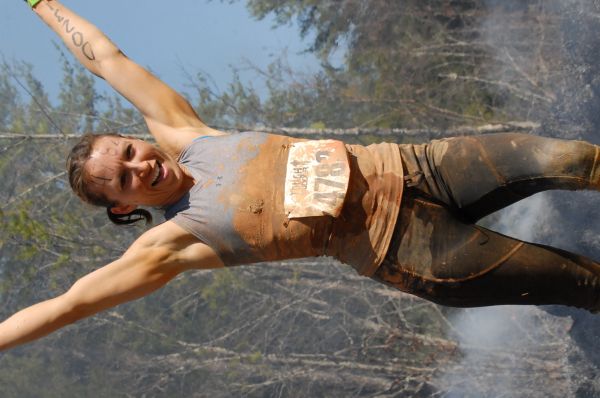
I look forward to developing my own warrior ethos as I yet again embrace my inner warrior.
79483-474-035f

“Whatever you are physically…male or female, strong or weak, ill or healthy–all those things matter less than what your heart contains. If you have the soul of a warrior, you are a warrior. All those other things, they are the glass that contains the lamp, but you are the light inside.”
Cassandra Clare, Clockwork Angel

“A warrior does not give up what he loves, he finds the love in what he does”
Dan Millman, Way of the Peaceful Warrior: A Book That Changes Lives

“When one has nothing to lose, one becomes courageous. We are timid only when there is something we can still cling to.”
Don Juan

“A warrior acknowledges his pain but he doesn’t indulge in it. The mood of the warrior who enters into the unknown is not one of
sadness; on the contrary, he’s joyful because he feels humbled by his great fortune, confident that his spirit is impeccable, and
above all, fully aware of his efficiency. A warrior’s joyfulness comes from having accepted his fate, and from having truthfully
assessed what lies ahead of him.”
― Don Juan Matus

“Even in times of trauma, we try to maintain a sense of normality until we no longer can. That, my friends, is called surviving. Not healing. We never become whole again … we are survivors. Even in times of trauma, we try to maintain a sense of normality until we no longer can. That, my friends, is called surviving. Not healing. We never become whole again … we are survivors. If you are here today… you are a survivor. But those of us who have made it thru hell and are still standing? We bare a different name: warriors.re today… you are a survivor. But those of us who have made it thru hell and are still standing? We bare a different name: warriors.”
Lori Goodwin

Fear in the Driver’s Seat

When tragedies happen, we seek understanding. We want to diagnose and cure. We often try to control our surroundings and the actions of others.

We want to feel safe. It’s a basic need. That desire for security is so primal, so strong, that it can cause us to behave irrationally. I experienced this myself in my teenage years. From my softmore year in high school to my freshman year in college, I had 13 friends or mentors die. I will never forget receiving the news of the final  two. I was in Austin for college when I called a friend back home in San Antonio to see about getting together on an upcoming break. She told me the news about the latest two deaths.

I broke. I simply couldn’t handle any more loss. My reaction? I shrunk my world. I no longer stayed in contact with high school friends. I built walls to keep out new friends. My then-boyfriend (now ex-husband) was the only one that I allowed to stay close. It worked. By shrinking my world, I eliminated the potential for hearing about or being affected by tragedy. The odds were stacked in my favor. After all, I only had one person in my inner circle.

And then there were none. My greatest fear came true; I lost him as well. Surprisingly, I was okay. I realized that my old ways of living in my walled-off world simply guaranteed less happiness at the time and yet provided no guarantee against loss in the future. I grew less afraid. More willing to take risks. I let people get close. Some have stayed, others have moved on. That’s okay. I am figuring out how to live with the natural cycles of growth and decay rather than try to fight against them.

It’s natural to examine your surroundings after a tragedy. To evaluate the weaknesses around you and to shore up any breaches in the hull. That increased security always has a tradeoff, however. It’s up to you to decide if that particular exchange is worth it.

More than a million people die in traffic accidents worldwide each year. We take precautions to keep this from happening. We gladly pay extra for cars with added safety measures, we sacrifice some comfort when we pull the seatbelt around our chests, and we write and enforce laws that limit who can drive and under what conditions they can operate a vehicle. I think we can all agree that these are reasonable measures; they balance security and freedom. Yet, how many of us look at the statistics for traffic fatalities and decide to never enter a car again? Very few. The tradeoff simply isn’t worth it.

It can be scary out there. Recent events have shown us that we cannot assume safety in our theaters, malls, or schools. There can be a temptation to scale back, pull into a shell and seal it shut. Like with me after the deaths, it does tilt the odds in your favor, but it doesn’t eliminate the risk. And, speaking from experience, life behind walls is no way to live.

Fear is an important feeling. It tells us to run when we are being chased. It tells us to seek shelter when we are under attack. It tells us to avoid high and unstable cliffs or dangerous stunts. However, fear also tells us not to love. It whispers avoidance of risk even when those chances can lead to something great. Fear tells you to hunker down and wait rather than live. Listen to your fears. But you don’t have to believe everything they say.

So continue to wear your seatbelt, but don’t neglect to drive your life.

drive

Transforming Fear

Fear

Opening the Journal

photo-180

Deep breath.

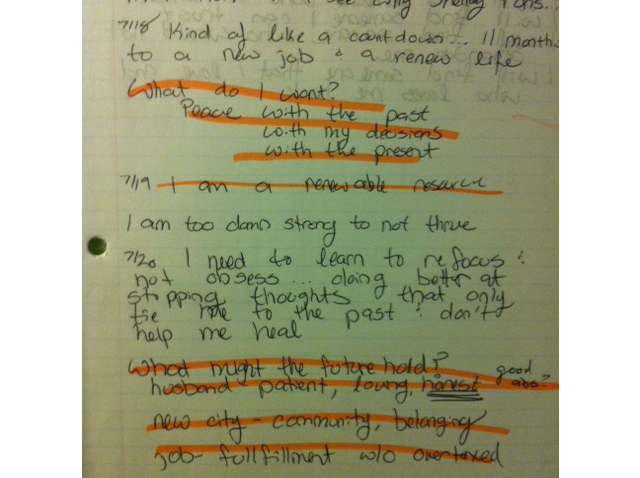
In many ways, this will be my most personal post yet. These are the thoughts, the words, that came in the first few weeks uncensored by the keyboard and unedited by time. I’m choosing to share this to reveal the underbelly of the healing process. I want to show that it is possible to move on from such pain and I want to highlight the importance of positive thinking and goal setting early on in the healing journey.

I started journaling on July 15, 2009, four days after I received the text.I learned about Uganda on July 20 and the bigamy on July 22.  Much of the writing in the journal was done in the early months, as I transitioned to the computer during the late fall and winter.

I chose to divide my journal into three sections and made a rule that each writing session had to begin in section one and proceed through section three.

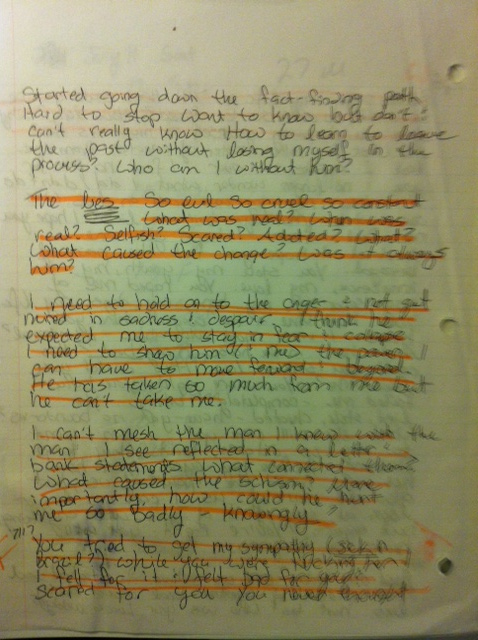
Section one: This was the space for the unedited vitriol. This was the anger, the poison. I knew I had to release it and there was oh so much to release. The writing is rapid, the angles harsh. I pressed so hard that I tore through the pages in spots. This was the domain of the broken heart.

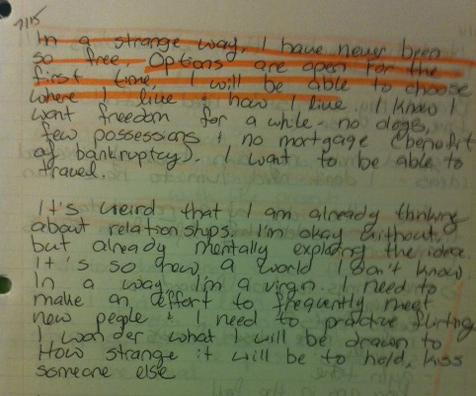
Section Two: This was for the day to day thoughts and practicalities. It was designed for observation and problem solving. This was the domain of the rational mind.

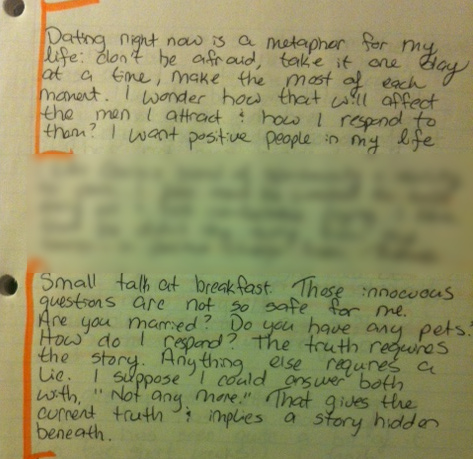
Section Three: The final section was for dreaming. I let my mind focus on the infinite and wonderous possibilities that the future might hold. This was the domain of the spirit.

I have no idea how or why I decided to structure my journal this way. In retrospect, that was surprisingly lucid for my state at the time. Recent research supports this model, as they found that high ruminators (I’m not sure if I am this but I am definitely a high analyzer) benefited from a fact-based, mundane journal but suffered when rehashing the negative feelings over and over. My three part design and my insistence on not ending with the negativity allowed me to vent but kept me from getting stuck in the sadness and anger.

For those of you early on in your journey, I hope you can find recognition and some possibility in these entries. For those partway through, I hope you can find acceptance of the process and be patient with yourself. For those who have come out the other end, I hope that you will find encouragement for how far you have come. On of my biggest lessons in all of this is the enormity of the damage that can occur when you deny your feelings. My ex destroyed his life and impacted others because he refused to face his emotions and instead kept them locked away and hidden beneath a facade.

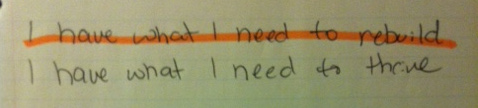
So, here goes. These are excerpts from the journal, in no particular order. Names have been blurred to protect identities. The highlights are from my work when I was writing the book. For those new to my site, please remember that this was 8 years ago. This is not the space I am currently in.

journal18

journal17

journal16

journal15

journal14

journal13

journal12

journal11

journal10

journal9

journal8 journal7 journal6 journal5 journal4 journal3 journal2 journal1

I can read these now with some distance. I remember the pain, yet time has dulled its sharpness to a mere whisper. I identify with the woman who wrote this; I can see traces of who she is going to become. I am no longer her; however, I don’t have the anger anymore that fills these pages. I have learned to soften and to accept. I have forgiven my ex and let go of the need for understanding.  The messages of hope and the small celebrations make me smile. I almost wish I could reach back and give the me of those days a hug and tell her that it will be okay and that her hopes and dreams will come in time.


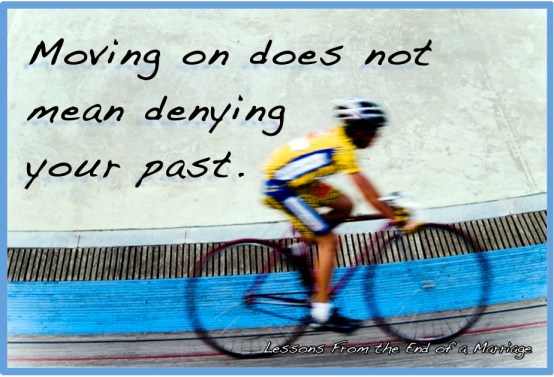
Moving on